Nathan C. Walker on Trading Despair for Solutions
Part of our Responsible Tech Voices series, featuring leaders from All Tech Is Human’s 2026 Responsible Tech Guide.
Within a year of ChatGPT's launch, Dr. Nathan C. Walker had earned eight AI certificates, launched an AI ethics and law seminar at Rutgers University, trained AI models on constitutional and human rights, and conducted research at Oxford. Today, as founder of the AI Ethics Lab at Rutgers, he draws on educational technology, First Amendment law, and moral inquiry to ask what it would take for technology to reflect not just intelligence but wisdom.

How did you get here?
I was so enamored by the launch of ChatGPT in November 2022 that I completed eight certificates in artificial intelligence over the next year. I then proposed teaching an Honors Seminar at Rutgers on AI ethics and law, drawing on my background in educational technology and First Amendment law. I was soon recruited by OpenAI to train its models on constitutional and human rights and later conducted research at Oxford’s Institute for Ethics in AI. These experiences allowed me to immerse myself in the subject through self-study, teaching, training models, and research. My advice is simply to dive deep and let curiosity be your guide.
What fields intersect in your work?
Artificial intelligence is a sociotechnical technology and demands that we understand it through various disciplinary lenses. More than a tool, AI has become an ecosystem that humans inhabit and shape and that, in turn, shapes humans and their decisions. For these reasons, I feel incredibly excited to draw upon my lifelong engagement with interdisciplinary studies. The fields of ed tech, law, and Unitarian Universalist ministry have inspired me to wrestle with the moral issues of our time.
What has surprised you most along the way?
In 1950, U.S. Supreme Court Justice William Douglas wrote, “I learned early that the richness of life is found in adventure.” This has long been our Walker family motto. When I look at my career trajectory, I see a lifetime of adventures rooted in curiosity, mental flexibility, resilience, and a willingness to adapt. From the dial-up age of the internet, when I was starting my career, to social media and smartphones, the pandemic, and now artificial intelligence, it would have been a tragedy if I had remained sedentary. I had to draw upon that adventurous spirit to adapt to these technological revolutions.
Why do those intersections matter?
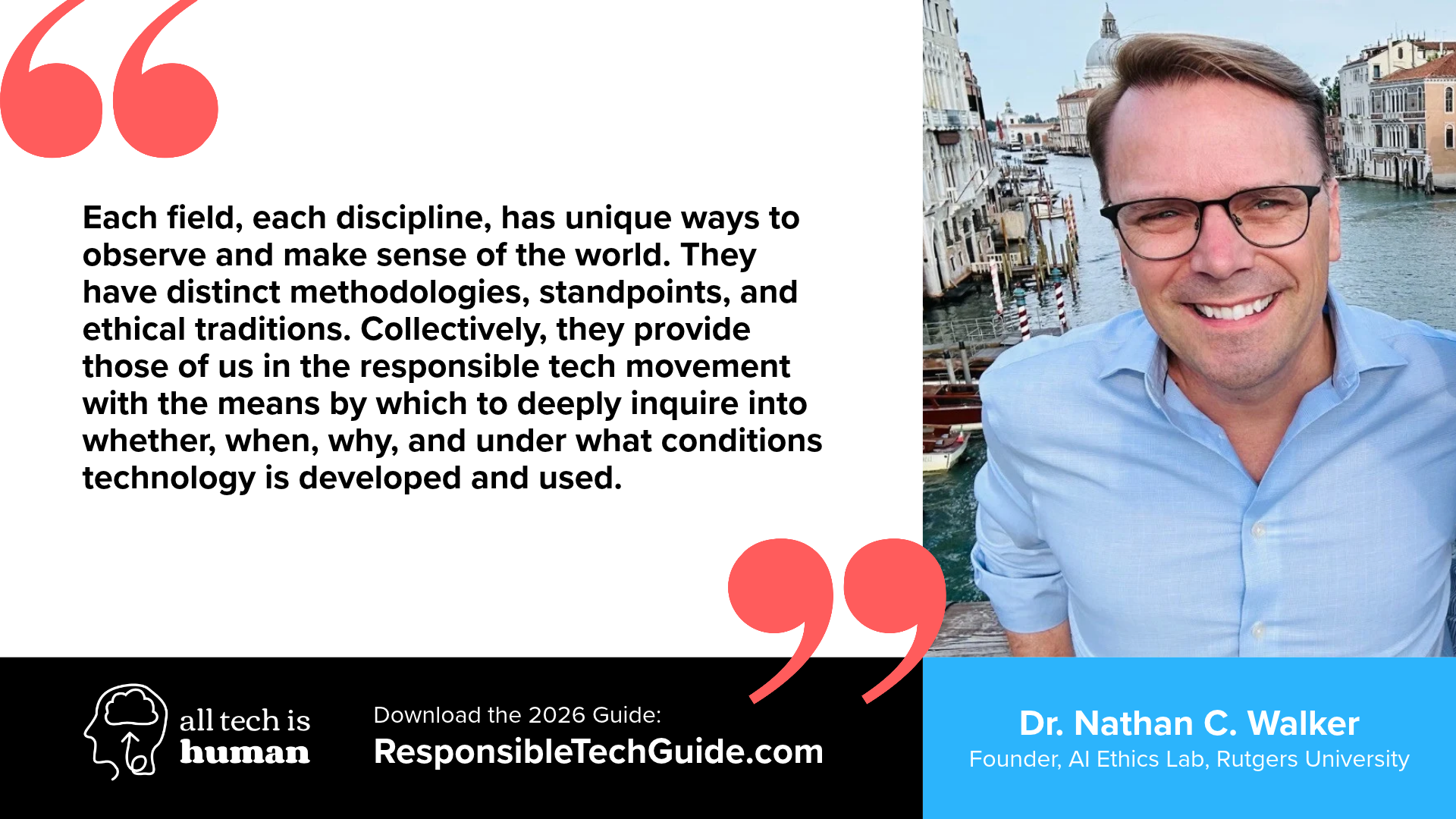
Each field, each discipline, has unique ways to observe and make sense of the world. They have distinct methodologies, standpoints, and ethical traditions. Collectively, they provide those of us in the responsible tech movement with the means by which to deeply inquire into whether, when, why, and under what conditions technology is developed and used.
What's one action you'd like to see?
Those of us who have spent our lives in justice movements know that it's easy to feel depleted and enter a state of despair, raising our fists and screaming into the wind. I've found a remedy in a Solutions Scholarship approach to AI governance, inspired by Solutions Journalism. Rather than constantly exposing audiences to a parade of horribles, these journalists identify problems and focus their investigative energies on the people working to solve them. That's the approach I've learned to take with AI ethics. I would like to see more of us identify the harms, then spend even more of our time in a creative, playful, forward-thinking state where we cultivate real solutions.
What does a better tech future look like to you?
A better tech future begins by asking, Is ‘smart’ really the best we can imagine for this century’s technology? Or are we striving for something more? And can tech truly be smart if people are not making wise choices? What would it look like if we began from the premise that our ultimate vision is to make wise choices and that technology is an extension of that wisdom? To help answer those questions, the AI Ethics Lab at Rutgers University has been developing Dignity by Design 1.0, a living AI governance framework (dignitybydesign.ai) that imagines the century’s technological advances upholding the inherent worth and dignity of every person—without exception.
Learn more about the AI Ethics Lab at Rutgers University here. Want more perspectives like this? Read the full Responsible Tech Guide, where this interview was featured.