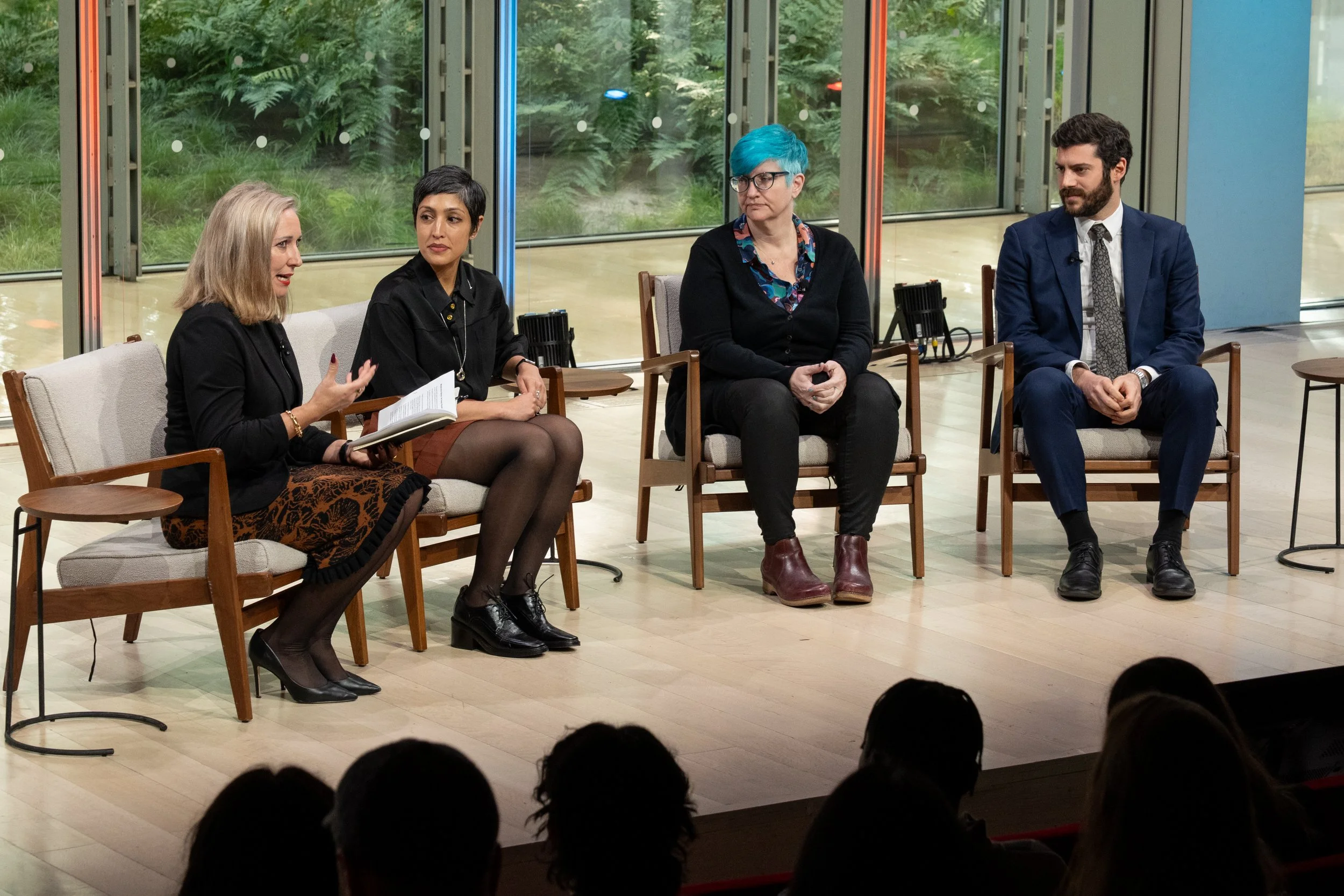
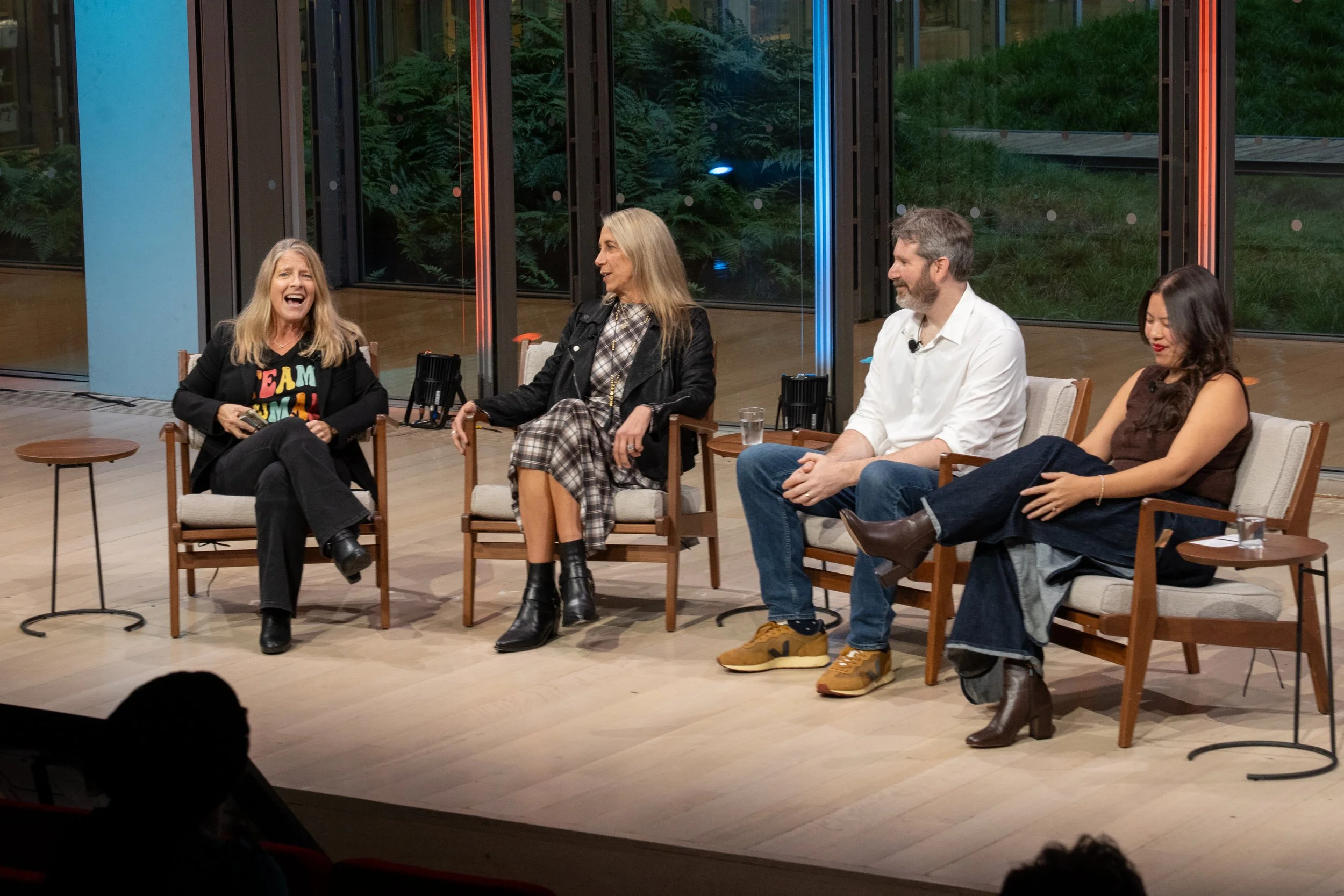
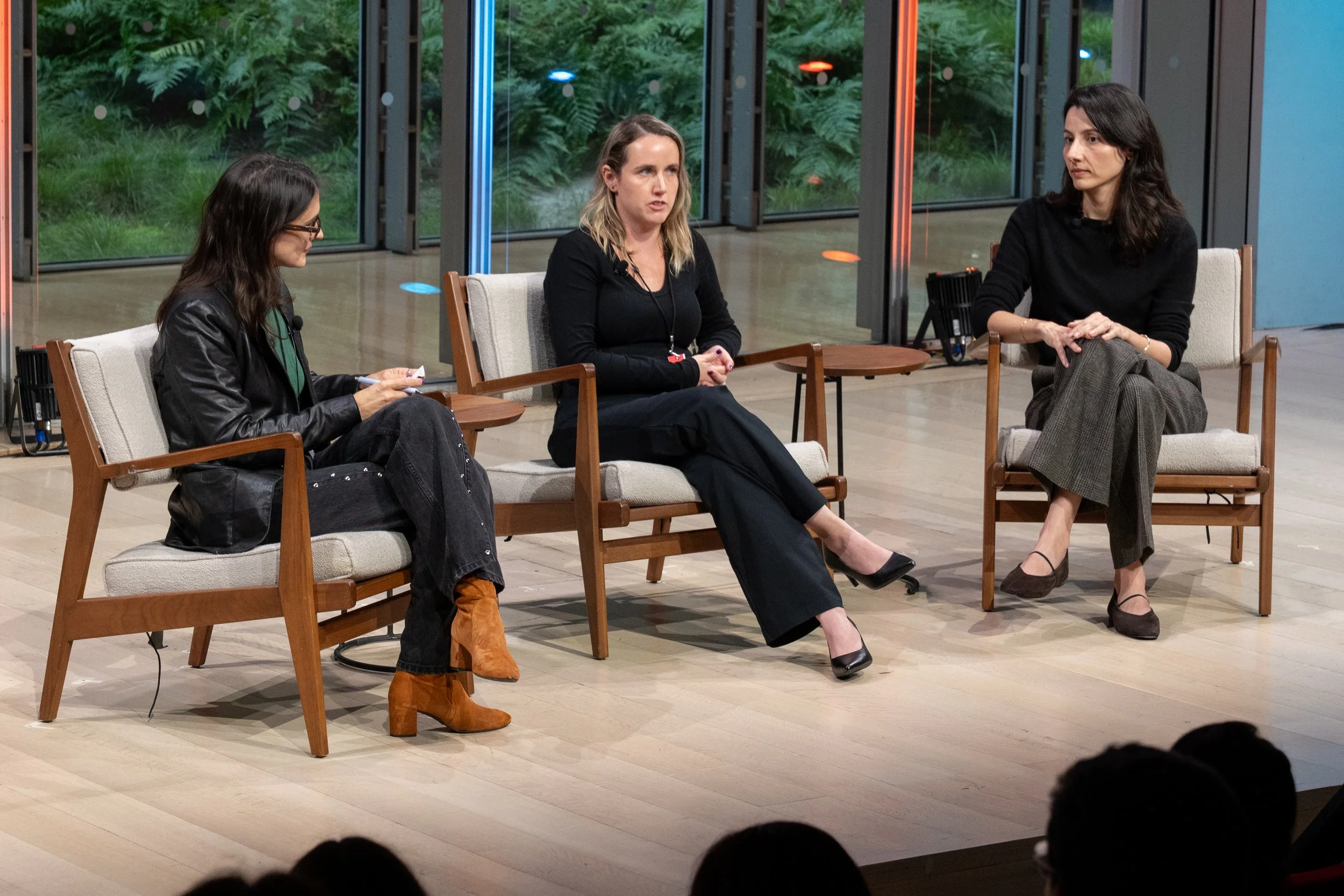
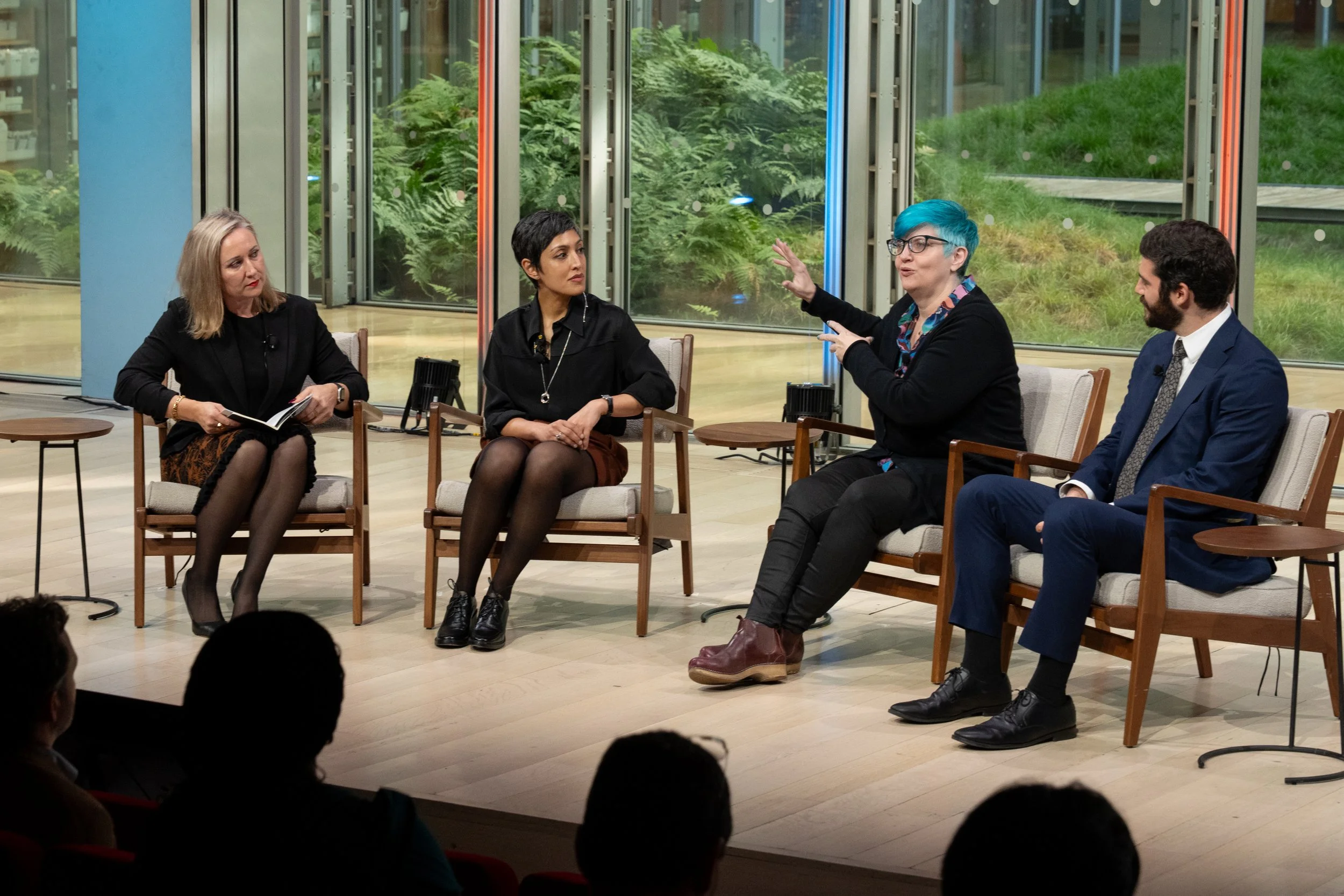
Photo of the panel conversation for Beyond Benchmarks: Turning Evaluations into Enforceable Standards. From Left to Right: Courtney Radsch, Rumman Chowdhury, Cathy O’Neil, and Alex Bores.
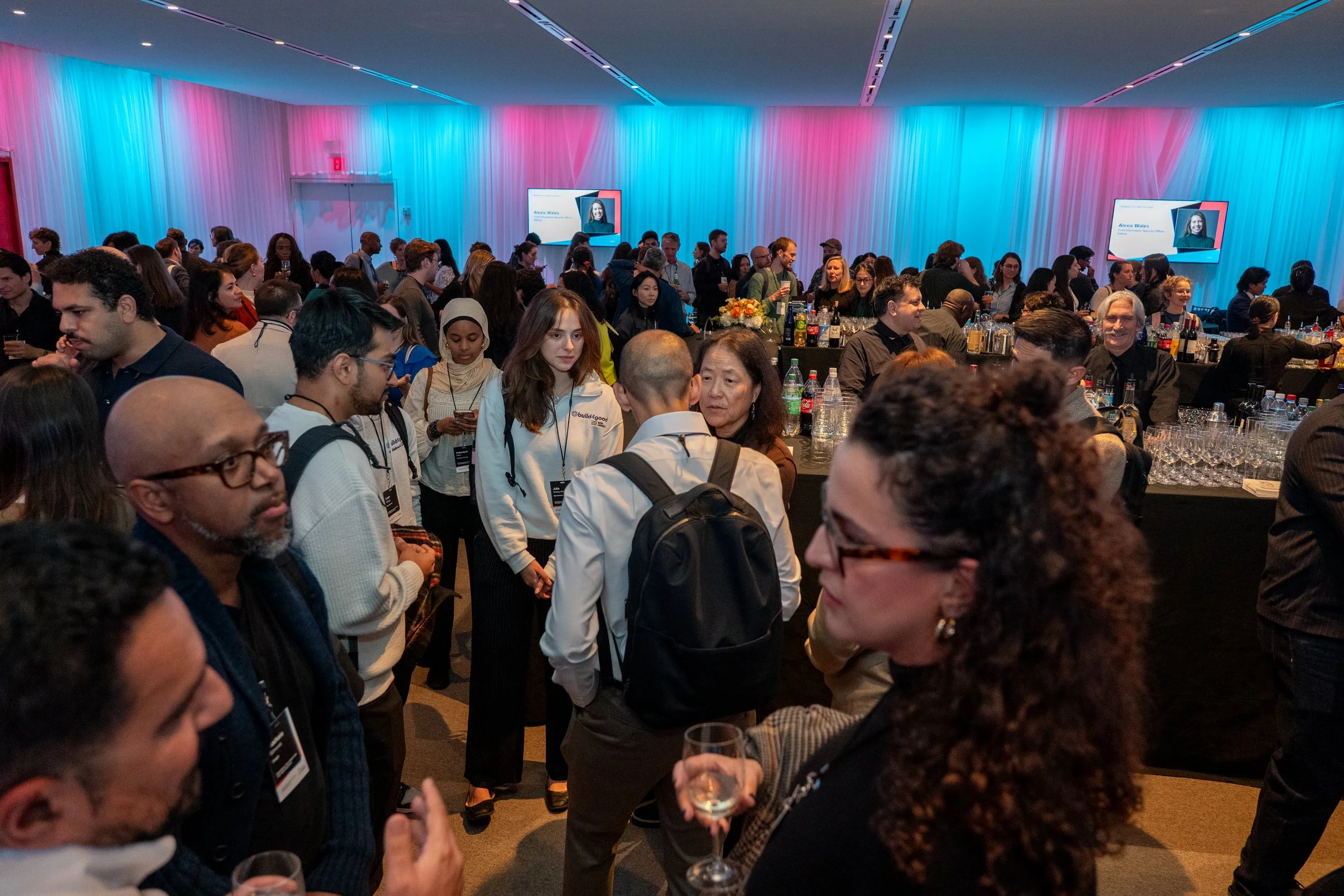
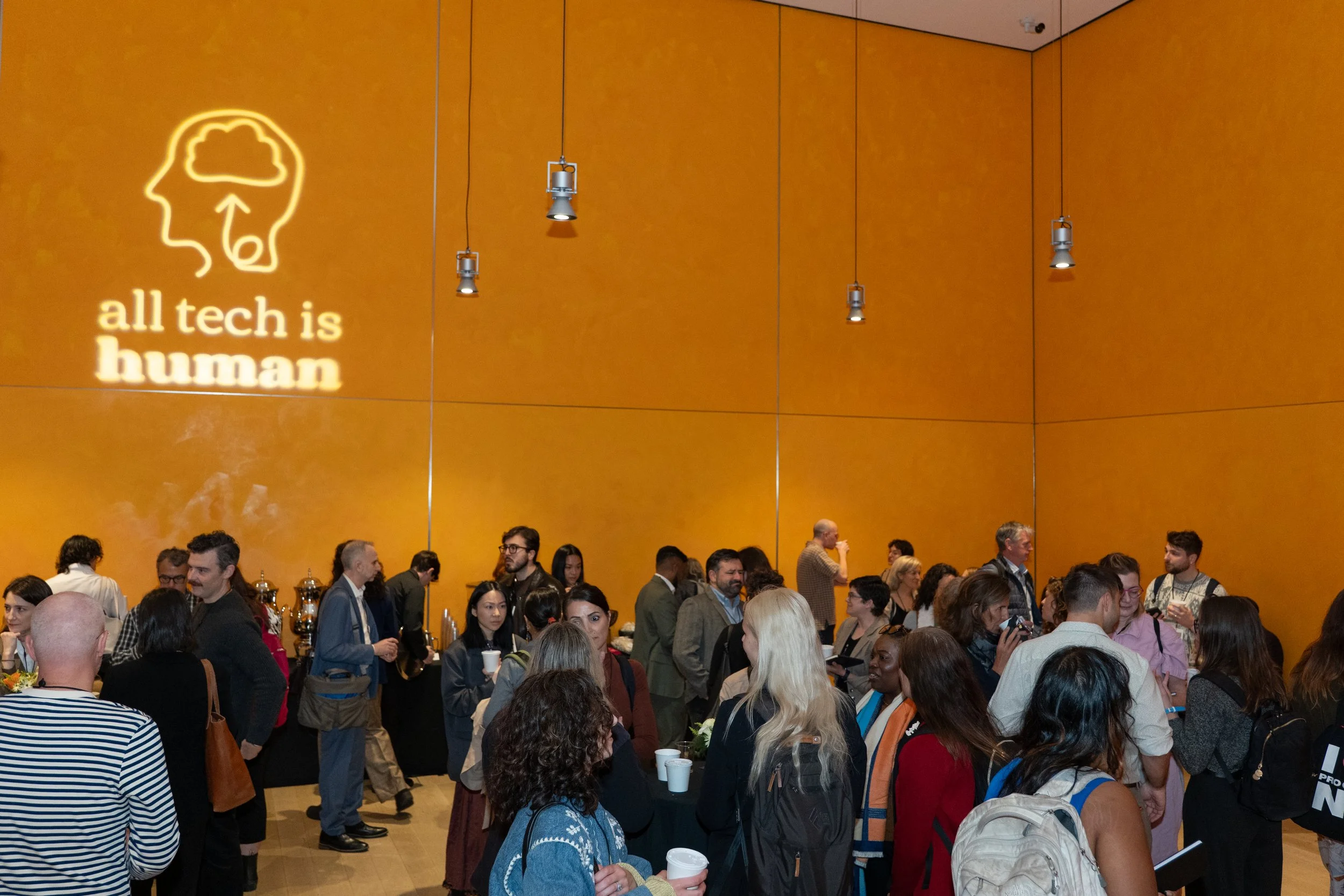
The Responsible Tech Summit, hosted by All Tech Is Human on October 29, 2026, at the Times Center in New York City, brought together leaders across technology, policy, advocacy, and academia to address the most urgent challenges in AI governance, Safety by Design, and ensuring that our tech future is aligned with a thriving democracy.
Our theme, Embedding Accountability in the AI Era, featured panel discussions, keynote presentations, and fireside chats focused on building safer, more equitable digital ecosystems and promoting technology that serves the public interest. By bridging the gap between tech builders, policy experts, and civil society, our gathering served as a major platform for actionable framework design, responsible AI deployment strategies, and cross-sector alignment.
See all of the videos below.
The Responsible Tech Summit was made possible with the support of Mastercard, Workday, Siegel Family Endowment, Microsoft, Google, Pinterest, AE Studio, GitHub, Kapor Foundation, IAPP, Cinder, and Civic Health Project. If you would like to be involved in future summits, reach out to us (hello@alltechishuman.org).
All Tech Is Human is a non-profit organization providing the social infrastructure and connective tissue for the cross-sector Responsible Tech ecosystem. By strengthening the important human layer, we improve society’s ability to tackle thorny tech & society issues and align our tech future with the public interest.


Videos from the Responsible Tech Summit
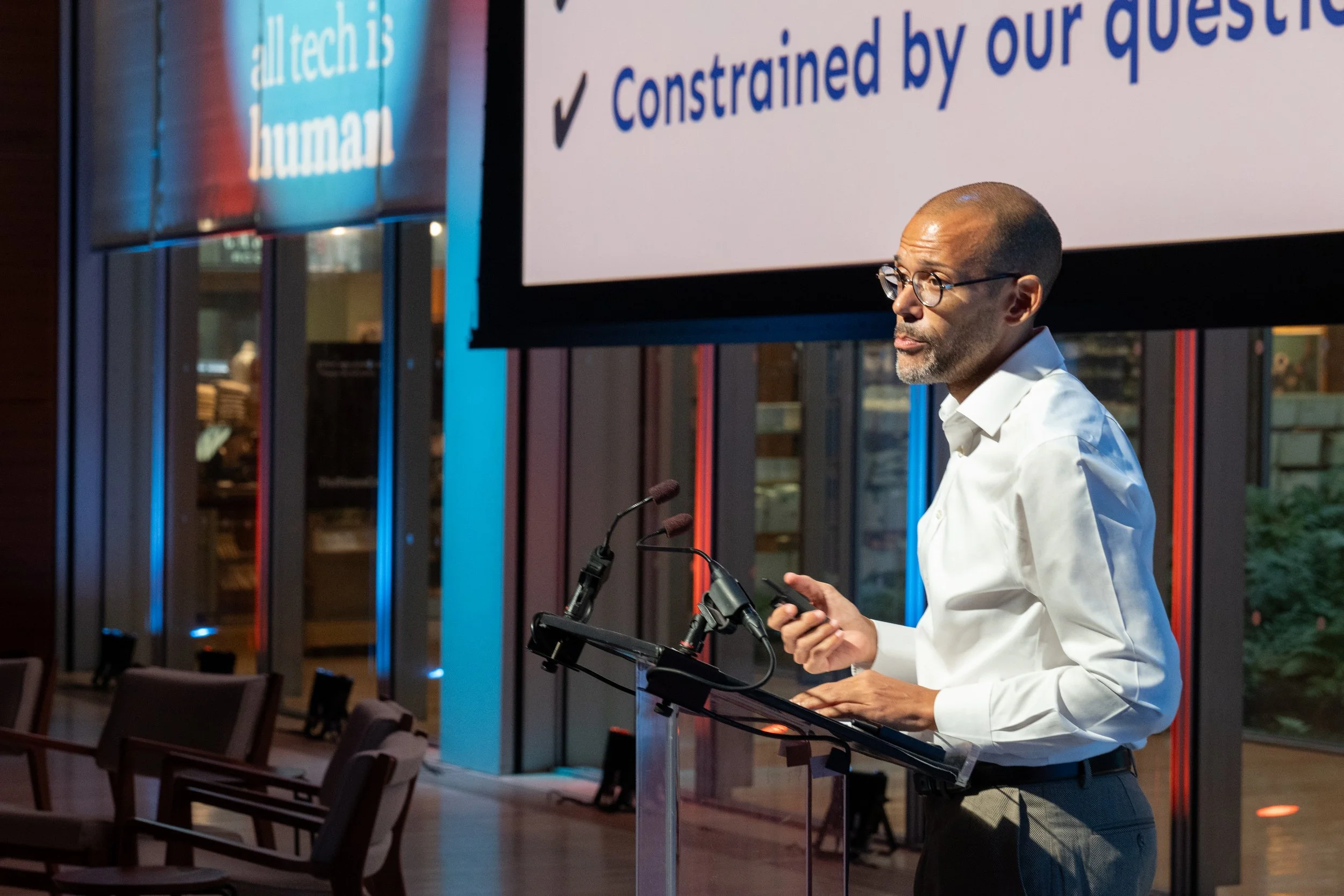
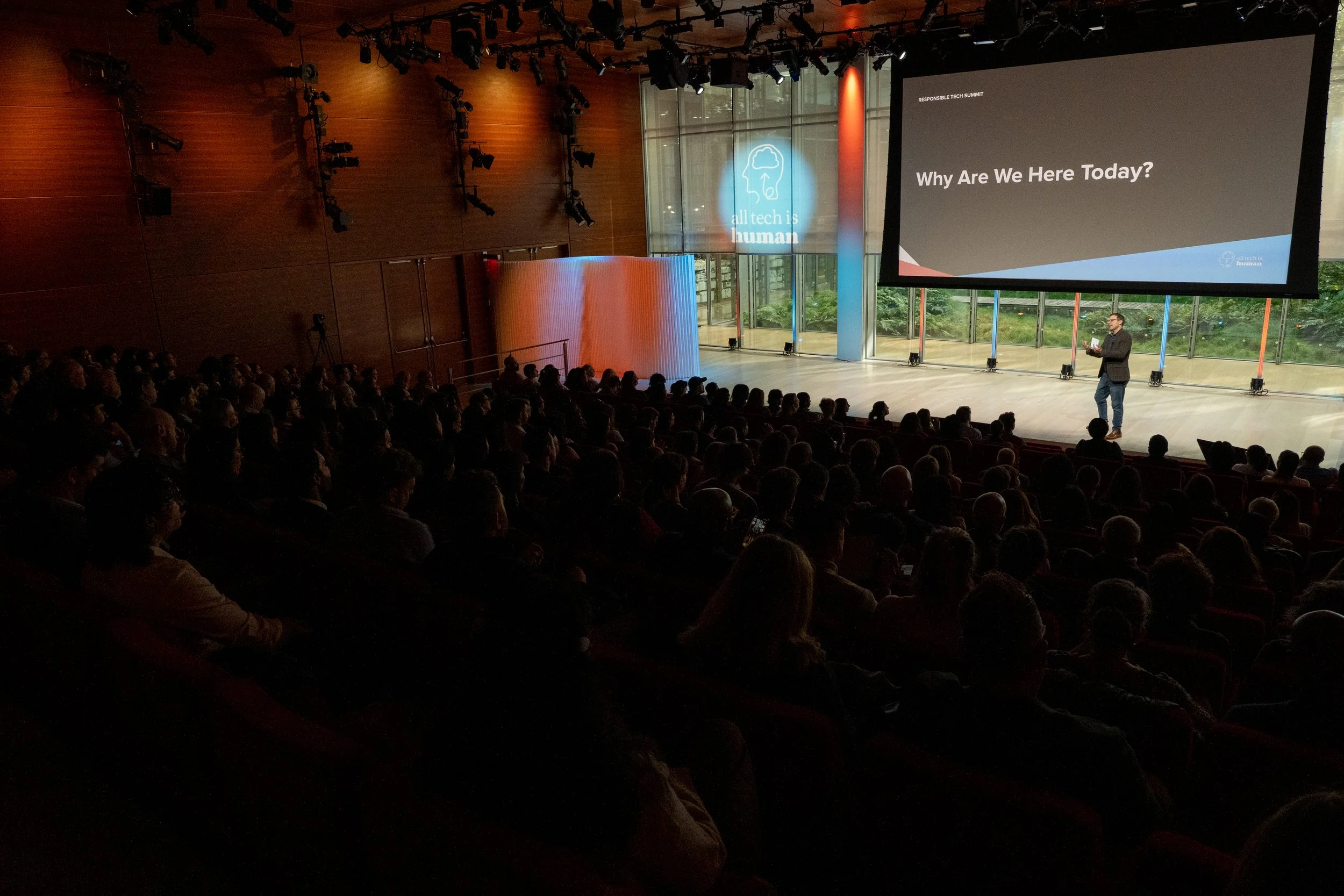
Welcome remarks by David Ryan Polgar, Founder & President of All Tech Is Human. David opens with a hopeful message that carries a challenge: AI isn’t going to “wipe us out in the next ten years,” so the real job is to build a world worth living in, and that means tackling the harms that are already here. That includes nonconsensual intimate imagery, algorithmic bias, and harms to kids. The bigger crisis is that we struggle to work together across sectors. That’s the gap All Tech Is Human fills: instead of chasing one issue that could be irrelevant in the near future, it builds a lasting community of valued stakeholders who care about our collective tech future. He also pushes back on the idea that technology is inevitable or out of our control. People build it, so people decide its guardrails and rules. He closes by pitching New York City as the right home for responsible tech, a middle ground between Silicon Valley’s speed and the EU’s caution.
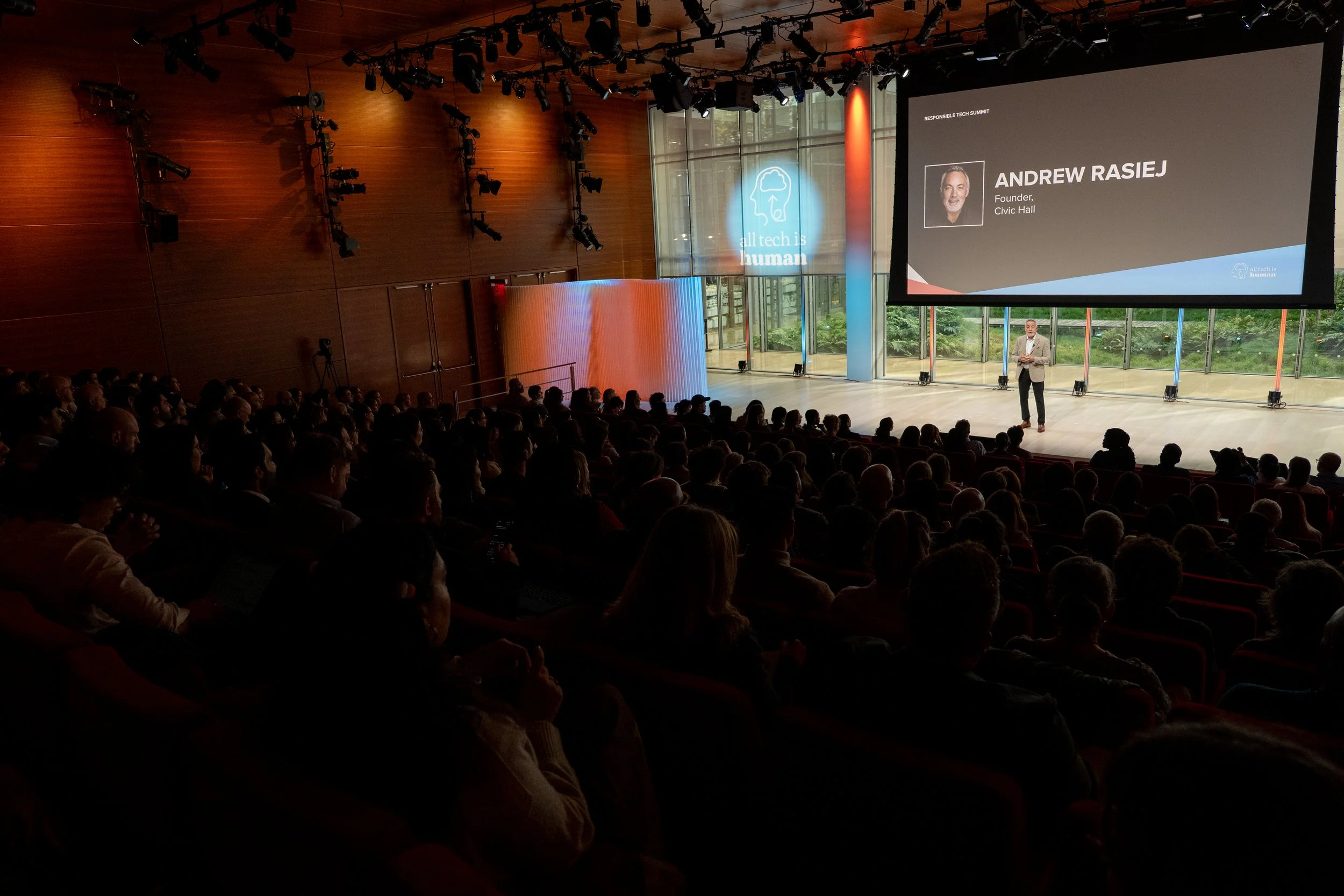
Andrew Rasiej opens with a look back on thirty years in the field. In 1997, he was running Irving Plaza, a New York City nightclub, and found the high school across the street had no computers. He emailed ten friends to help build a lab, and two hundred showed up. Without knowing it, they were starting to close the digital divide. That experience convinced him New York has a uniquely empathetic tech scene, one focused on shifting the power from the few to the many. But the divide has grown worse, he says, and governments and other institutions can’t keep up with the pace of change. His answer is to rethink civic engagement. He tells a story about picking up an apple in the middle of Fifth Avenue before someone could slip on it. For him, civic life is more than voting and jury duty: it means looking out for one another, without waiting for someone else to step in. He urges the audience to build new institutions rather than patching old ones, and to work together towards a fairer, more human world.
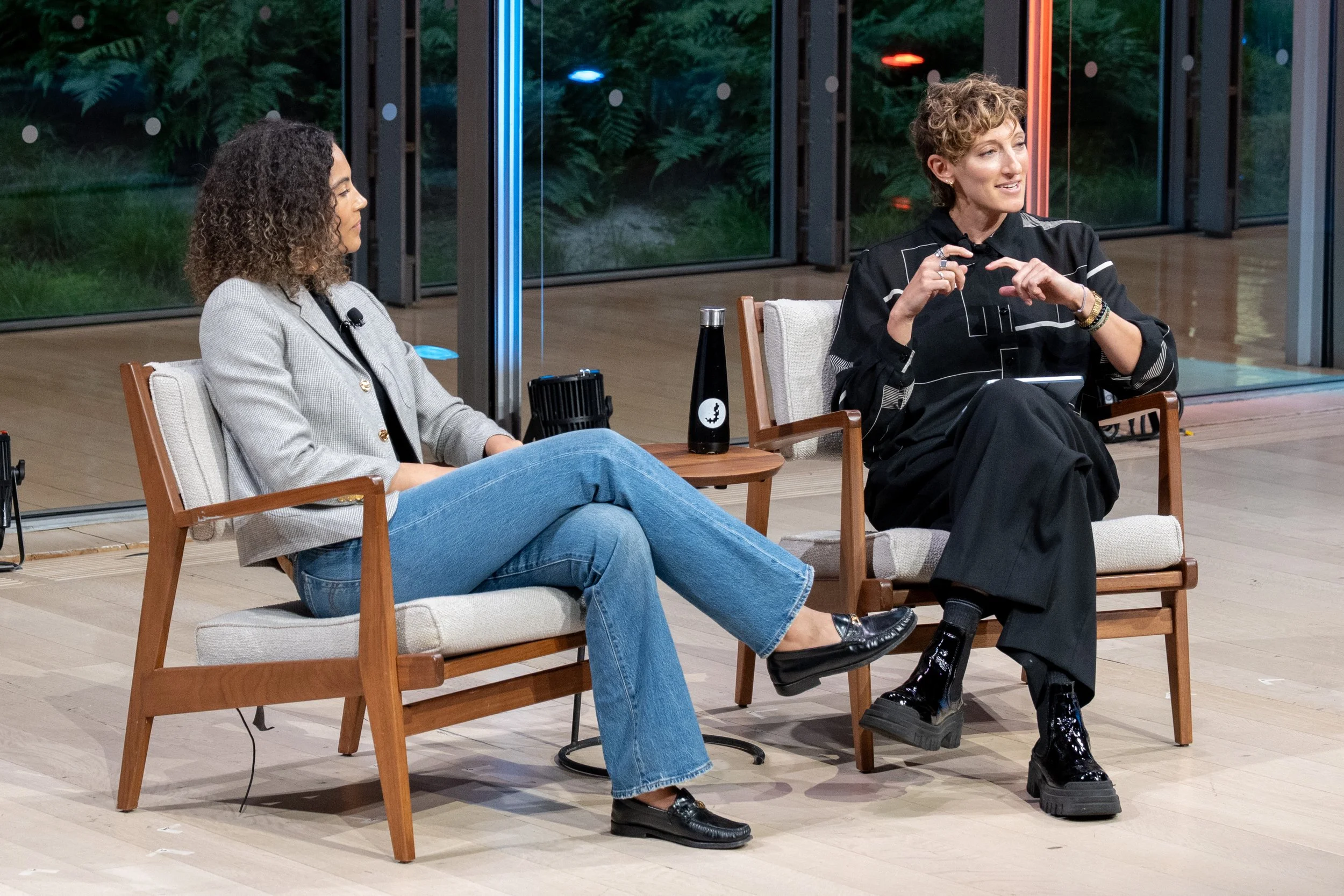
Beyond Benchmarks: Turning Evaluations into Enforceable Standards was moderated by Courtney Radsch (Director of the Center for Media & Digital Governance, Open Markets Institute) and featured Rumman Chowdhury (CEO, Humane Intelligence PBC), Cathy O’Neil (Founder, Author, Mathematician & Data Scientist, O'Neil Risk Consulting & Algorithmic Auditing), and Alex Bores (Assemblymember, New York City’s 73rd District).
Courtney Radsch opens by pointing out that AI testing is never neutral: someone decides what gets tested, how, and who pays for it. Rumman Chowdhury argues that most evaluations stop at a model’s technical capabilities and miss its effects on schools, the economy, and daily life, so experts in those fields should be doing the testing. Cathy O’Neil goes further, saying frontier models can’t truly be audited at all. A narrow hiring algorithm produces a predictable score, but chatbots are so unpredictable that every benchmark plugs one hole while new ones keep opening. The best we can do, she says, is measure specific harms to specific people, one dial at a time. Assemblymember Alex Bores describes how industry lobbying forced him to drop an auditing requirement from New York’s RAISE Act. Rather than accept a watered-down version that would become a ceiling, he cut it to pass the law’s safety and disclosure rules.
The second half turns to power and money. Rumman says the focus on existential risk has crowded out discussions of harms like bias that are happening now, and that foundation rules barring lobbying keep civil society out of the room. To build a real market for independent evaluators, she proposes paying tech vendors based on whether their products actually deliver what they promise. Cathy credits lawsuits brought by grieving families with shifting public opinion where regulation stalled, and argues that real fines are what will bring the companies to auditors. Alex closes by rejecting the idea that we must choose between near-term and catastrophic risks. Keeping AI aligned with its users, he says, will take every tool available, from liability and audits to steep fines.
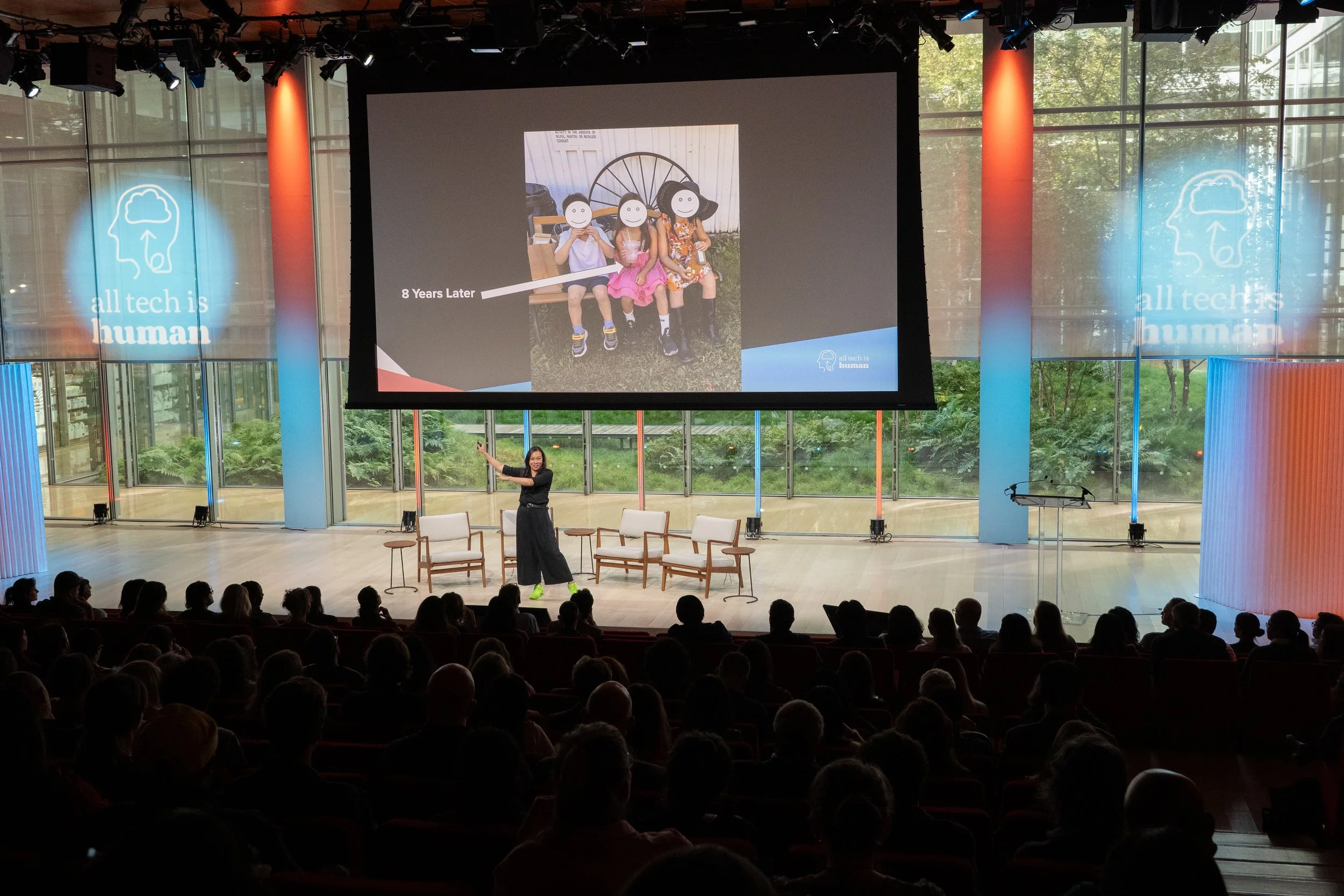
Kathy Pham (Faculty and Senior Fellow, Responsible AI, at Harvard University) structures her talk around two ideas: honoring expertise across disciplines matters more than ever, and better technology depends on paying attention to what usually goes unseen. She opens by having strangers in the audience tell each other what they’d be the go-to “phone a friend” for. Having the right expert to call, she says, makes big decisions faster and products better, whether you’re drafting state AI policy or designing a product. That matters even more now that companies brag about shipping faster and skipping product planning. Moving that fast makes it easy to skip the slow work of sitting with a nurse, a truck driver, or a student to understand what they actually face.
Her second theme comes from the idea of “making seen the unseen,” which means surfacing the people, communities, and lived experiences that technology tends to leave out. Otherwise, AI models trained on what’s already known just carry those gaps forward. The same goes for the less glamorous parts of tech, like infrastructure, energy, security, privacy, and the communities near new data centers. These get overlooked while consumer chatbots dominate the conversation. Drawing on a recent talk asking whether AI should reach bedtime stories to kids, she argues that each use of AI is a judgment call about what technology should take over and where human connection still matters. She closes by calling expertise in the room “an awesome kind of friction” that makes products better.
Safety by Design: Accountability at the Intersection of AI, Industry, and Advocacy was moderated by Shreya Singh Hernandez (Senior Manager, Aspen Digital, The Aspen Institute) and featured Julie Cordua (CEO, Thorn), Alexis Wales (Chief Information Security Officer, GitHub), and Phil Brennan (Co-Founder and COO, Cinder).
Shreya Singh Hernandez asks how to move from agreeing on what responsible AI looks like to actually building it. She starts by asking what each panelist would change about the last decade of tech safety. Julie Cordua says product managers should have been held to safety metrics, instead of handling safety as a separate team that only saw products right before launch. Phil Brennan wishes his early Facebook teams had put a dollar value on safety instead of treating it as a cost, something lawsuits are now doing for them. Alexis Wales draws on her years of experience in federal cybersecurity, arguing that safety teams deserve the same board attention, metrics, and budgets that security teams spent years earning. Phil adds that cybersecurity has another lesson to teach: companies can warn each other about threats without exposing user data, which remains much harder in trust & safety.
The panel then turns to measuring harm that never happened and to the risks of open-source AI. Julie notes that most AI-generated child sexual abuse material (CSAM) comes from open-source models. She describes Thorn’s research on spotting models that can produce such materials without generating it, and its work getting safety-by-design principles into NIST and IEEE standards. Phil argues that the best way to anticipate new harms is to bring in people who know how bad actors think, and points to app stores as powerful gatekeepers. On what’s working, Alexis credits GitHub’s decision to bring its safety and security teams closer, while Phil is encouraged to see trust & safety veterans at AI startups like Cinder. They end on a hopeful note: after a decade of cleaning up after social media, they see the larger AI companies taking note and choosing to build safety in from the start.
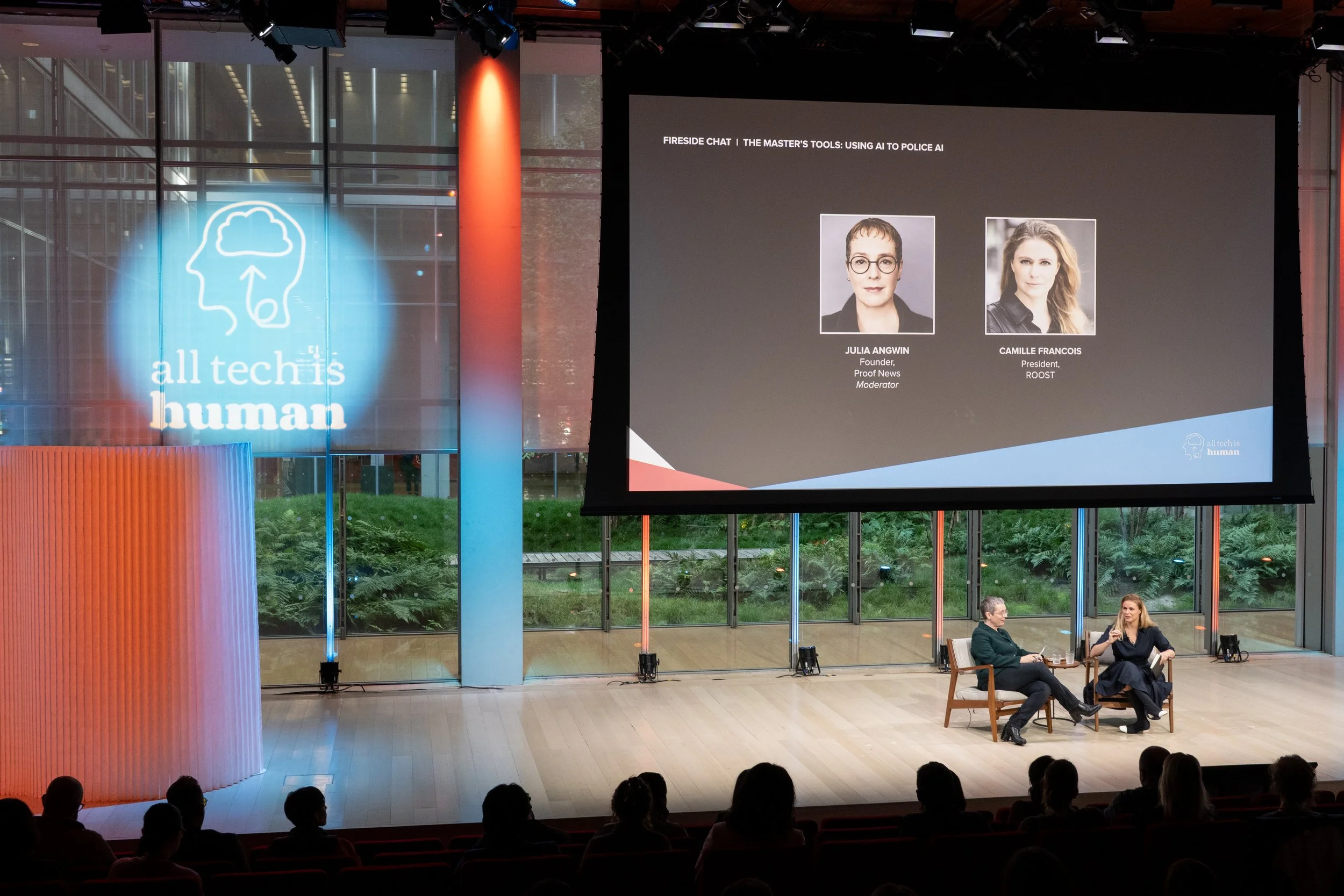
The Master's Tools: Using AI to Police AI: A conversation between Camille Francois (President, ROOST) and Julia Angwin (Founder, Proof News)
Julia Angwin opens by introducing Camille François as a role model. Eighteen months ago, Camille launched Robust Open Online Safety Tools (ROOST) to build and maintain open-source safety tools. Camille explains that the Internet was built on open, shared technology, but safety tools never were. Most of them date to the social media era, and they lag far behind the technology they’re meant to police. They’re also opaque, so users don’t know how their speech gets moderated, and expensive enough that only the biggest platforms can afford them. ROOST borrows from cybersecurity principles in that sense, where shared open-source building blocks mean no one has to reinvent encryption to launch a website. Julia adds that with big tech pulling back from content moderation, safety tools are what make it possible for smaller platforms to compete.
On AI, Camille says the technology both creates new harms and offers a chance to build better safeguards, but only if someone does the work. Safeguards are often weaker and more expensive to run in languages other than English, for example. Building safety tools in the open, she argues, lets real experts weigh in publicly. That beats the old model of consulting experts behind closed doors under nondisclosure agreements. Camille closes with her hope for a more diverse, decentralized Internet. Different communities would be free to define safety in their own ways, rather than relying on a handful of Silicon Valley companies.
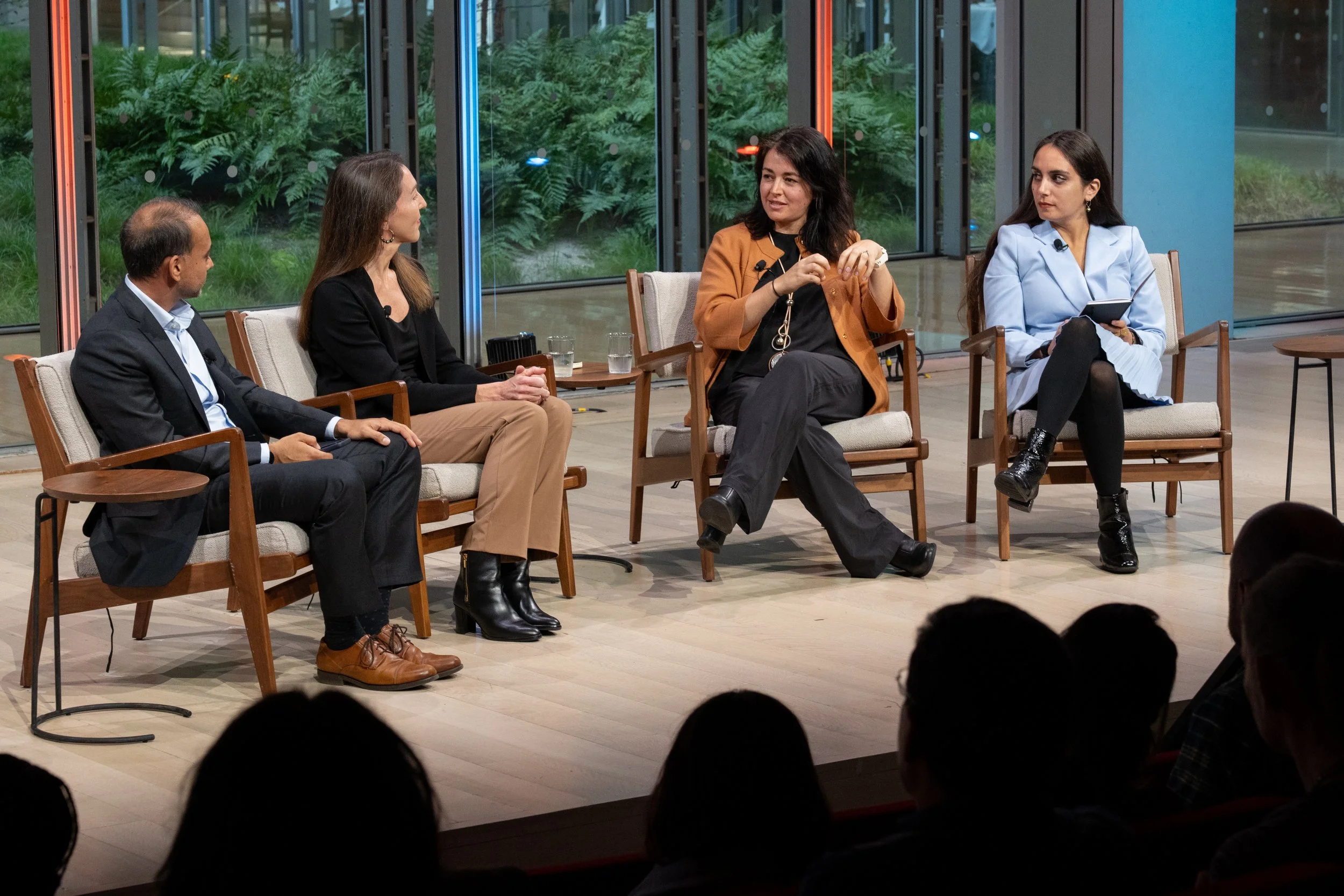
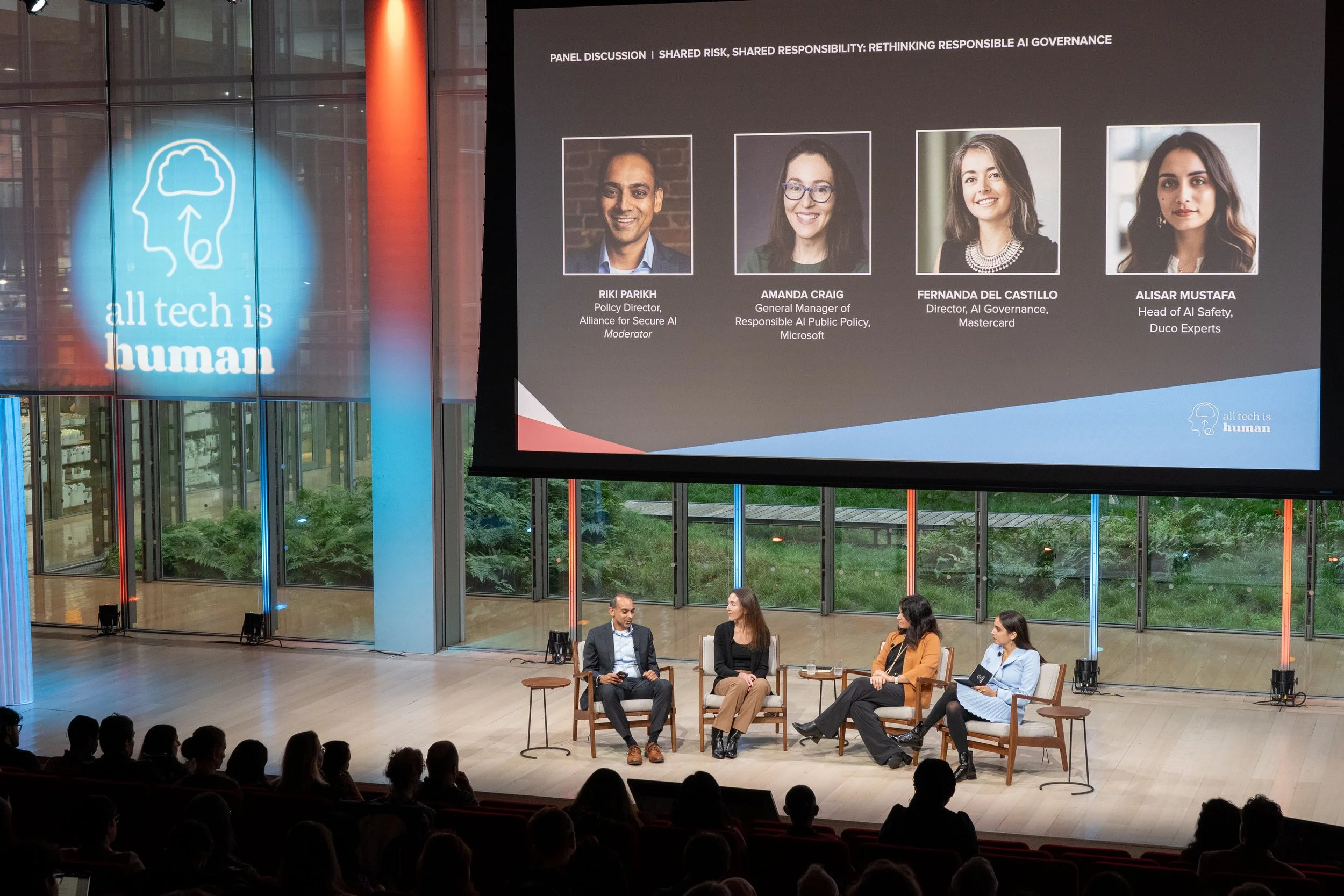
Shared Risk, Shared Responsibility: Rethinking Responsible AI Governance. The conversation was moderated by Riki Parikh (Policy Director, Alliance for Secure AI) and featured Amanda Craig (Manager, Responsible AI Public Policy, Microsoft), Fernanda Del Castillo (Director of AI Governance, Mastercard), and Alisar Mustafa (Head of AI Safety, Duco).
Moderator Riki Parikh opens with a recent example: major US banks are finding third-party AI agents inside customer accounts and can’t tell whether they’re authorized. With little federal regulation, he asks, who’s responsible when an agent causes harm? Amanda Craig says agents act in the real world, so governance has to keep working while they run. That means limiting what an agent can access and do, testing it before and after launch, and watching what it does so someone can step in. Fernanda Del Castillo says information flows only one way along the AI supply chain. Her team can’t take vendors’ test results at face value and has to recheck them before deploying a model. Alisar Mustafa of Duco, which tests AI systems for companies and labs, warns that the biggest failures appear when risks combine and when models are tested over longer conversations or in languages other than English.
On liability, Fernanda argues that responsibility should follow whoever brings the risk and controls the decision. She describes Mastercard’s Agent Pay trust framework, which verifies an agent’s identity, its intent, and the limits on what it can do so that consumers, merchants, and banks can all trust a payment. Amanda adds that responsibility depends on who can see and control what, which is why monitoring matters for working out what went wrong. Alisar says shared responsibility only works if it’s spelled out in advance. On government’s role, the panelists favor shared standards like NIST’s and caution against rushing into agent-specific laws while existing ones still apply. For their one rule, Alisar asks for testing across languages and by human experts, Fernanda for ways to share testing information across the supply chain, and Amanda for strong governance programs that can keep up as the technology changes.
Alignment in Practice: Building AI That Wants to be Good. The conversation was moderated by Tori Elliott (Senior Reporter, WIRED), featuring Melanie Plaza (Chief Technology Officer, AE Studio) and Hale Sirin (Program Scientist, Schmidt Sciences AI and Advanced Computing Institute).
Tori Elliott asks whether AI can be good at scale, or whether its best uses come from narrow, specific contexts. Hale Sirin describes research she funds and leads on legal reasoning and humanities projects, including New Orleans jazz archives and dance and cinema history. She shows why “good” depends on context. A New Orleans team set out to digitize decaying records and found that people read the same Louisiana Creole and Cajun recordings in different dialects depending on their community, so the work now depends on residents’ feedback. Melanie Plaza says alignment isn’t a sci-fi doomsday concern but a practical question: does AI reliably do what we want, and what’s good, across the messy situations it meets in real life? That question, she says, is still unsolved.
Both argue that the riskiest problems sit at the tail: rare failures, and small communities and languages that offer little profit. Companies and labs have little reason to invest in those, so academia and philanthropy have to do the slow, failure-prone foundational research, even as government funding shrinks. They see any pause in AI development as a chance to speed up this work, not a solution in itself. Melanie warns that passing a set of evaluations can create false confidence. Hale adds that some qualities, like historical or cultural accuracy, have no clear right answer to measure against. Both are optimistic that when outside researchers do the risky early work, labs are far more willing to adopt what they find.
Trust as Strategy and the Fight Against AI-Enabled Fraud. The conversation was moderated by Sandra Khalil (Associate Director, All Tech Is Human) and featured Anya Schiffrin (Co-Director, Technology Policy and Innovation, Columbia University (SIPA)), Mackenzie Thomas (Group PMM, Google DeepMind), and Jeff Collins (Director of Trust & Safety, Amazon Web Services (AWS)).
Moderator Sandra Khalil leads a conversation on how AI is fueling fraud and what it takes to rebuild trust. Mackenzie Thomas explains SynthID, an invisible watermark that stays with AI-generated images, video, audio, and text even after they’re cropped or screenshotted. Anyone can now check for it by asking Google tools whether something is real. Jeff Collins says AI lets small teams run faster, more personalized scams around the clock. Bad actors exploit the seams between AI models, cloud providers, platforms, and banks, so no single company can stop them alone. Anya Schiffrin points out that scams now reach nearly everyone, including fake AI immigration lawyers on TikTok and romance scams that drain older people’s savings, and that they erode trust in institutions more broadly.
The panel then turns to solutions. Anya describes how countries like Singapore and Taiwan treat fraud as a pipeline running from phone companies to platforms to banks, and coordinate across all of them. She argues that the companies best placed to stop scams cheaply, especially big social media platforms, should bear the most liability. Jeff calls for shared, machine-readable formats for reporting abuse so companies can warn each other at machine speed, pointing to the Global Signal Exchange as a promising start. In closing, Anya calls for steep fines on platforms that ignore warnings, Mackenzie urges designing for ordinary users rather than the people in the room, and Jeff asks banks, cloud companies, and AI developers to share more signals. That unglamorous work, he says, is how you keep your grandmother from getting scammed.
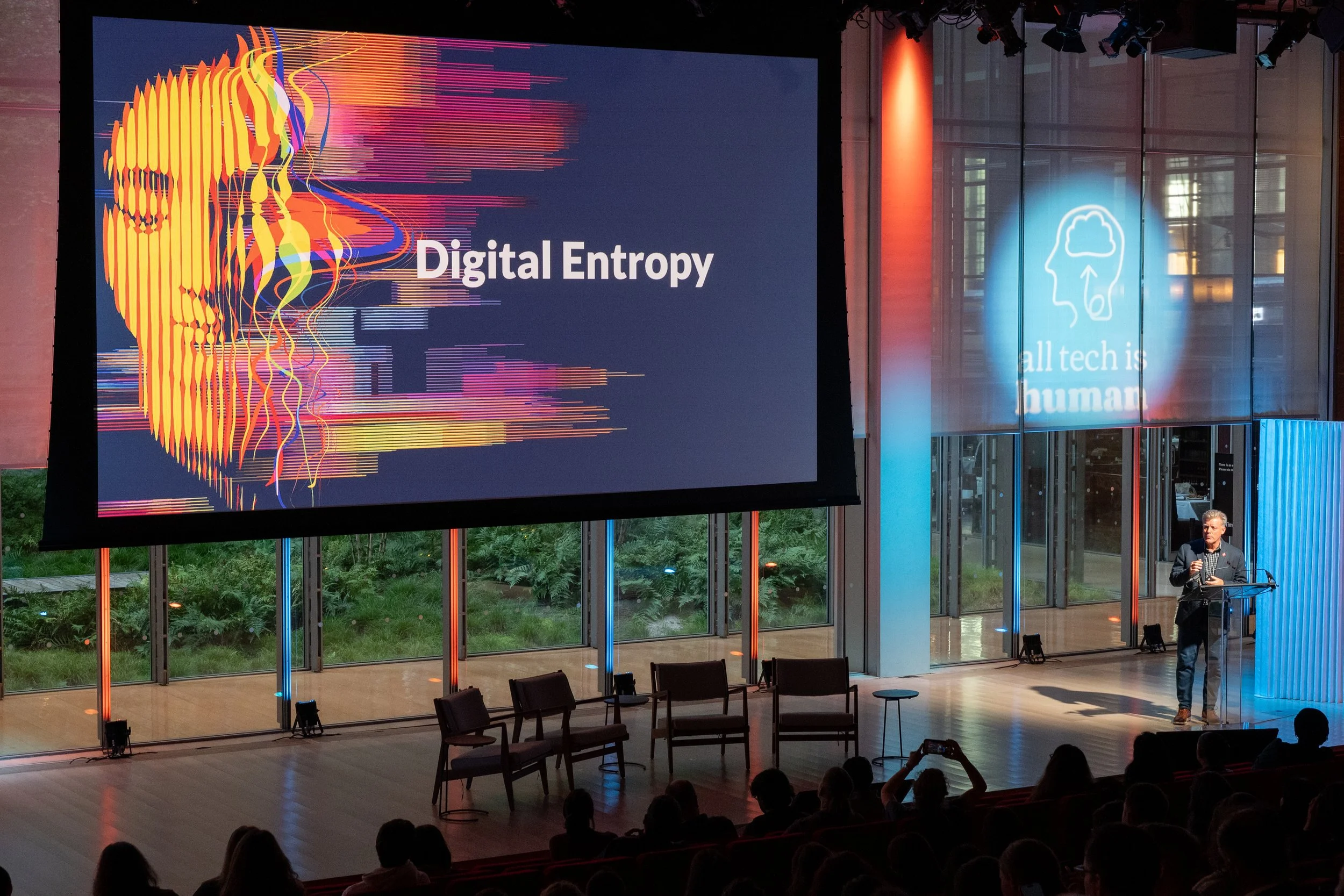
Digital Entropy, a keynote by J. Trevor Hughes (President and CEO, IAPP) at the Responsible Tech Summit.
Trevor Hughes describes a state he calls “digital entropy”: disorder that keeps growing as fast-moving technology, geopolitics, and a pile of new rules collide. The EU alone has more than one hundred tech-focused laws, and Ireland has named fifteen different regulators for the EU AI Act. Meanwhile, US states have introduced close to a thousand AI bills this year. AI has also broken down the walls between privacy, cybersecurity, intellectual property, trust and safety, and other fields that used to work in silos, and organizations are still figuring out how to manage the overlap. Many have simply tacked “AI governance” onto the chief privacy officer’s title. IAPP’s research finds that only 17 percent of organizations have mature AI governance in place.
To show what’s missing, he asks the audience whether anyone feared for their life when they flipped a light switch that morning. A century and a half ago, people did. Today we trust that switch because of generations of building codes, safety certifications, inspectors, and licensed electricians. AI needs the same kind of trust built by people, he argues, but we haven’t trained the tens of thousands of AI governance professionals and auditors we already needed years ago. Policies that call for a human in the loop, he says, have to answer a basic question: who are those humans, and what tools will they need to do the work?
Better Tech Begins with Better Questions. Lightning Talk by Joshua Elder (Senior VP and Head of Grantmaking, Siegel Family Endowment).
Joshua Elder argues that in the rush to adopt AI, we’re skipping a basic step: asking whether we’re asking the right questions. He draws on his background as an educator. When he was pitched an AI tool to catch students cheating, the real question that occurred to him was what learning should look like now that AI is changing how we find knowledge and solve problems. Narrow questions like, “How can we get more schools to adopt AI?” quietly assume that AI is the answer. Broader ones, like “What do students and teachers need, and when could AI help?” leave room for other solutions. Because questions shape what we study, fund, and build, he says they work like infrastructure.
He also notes that questions carry power. Asking “How can we ensure AI is used ethically?” assumes we already agree on what’s ethical. Asking “Who gets to define ethical AI?” opens the door to community-driven standards and public ownership. Too often, he says, the people with money and authority set the questions, and communities are asked for feedback only after the big decisions are made. He closes with three calls to action: check your assumptions, bring communities in for co-designing before the question is settled, and be ambitious and rigorous about what’s worth asking in the first place.
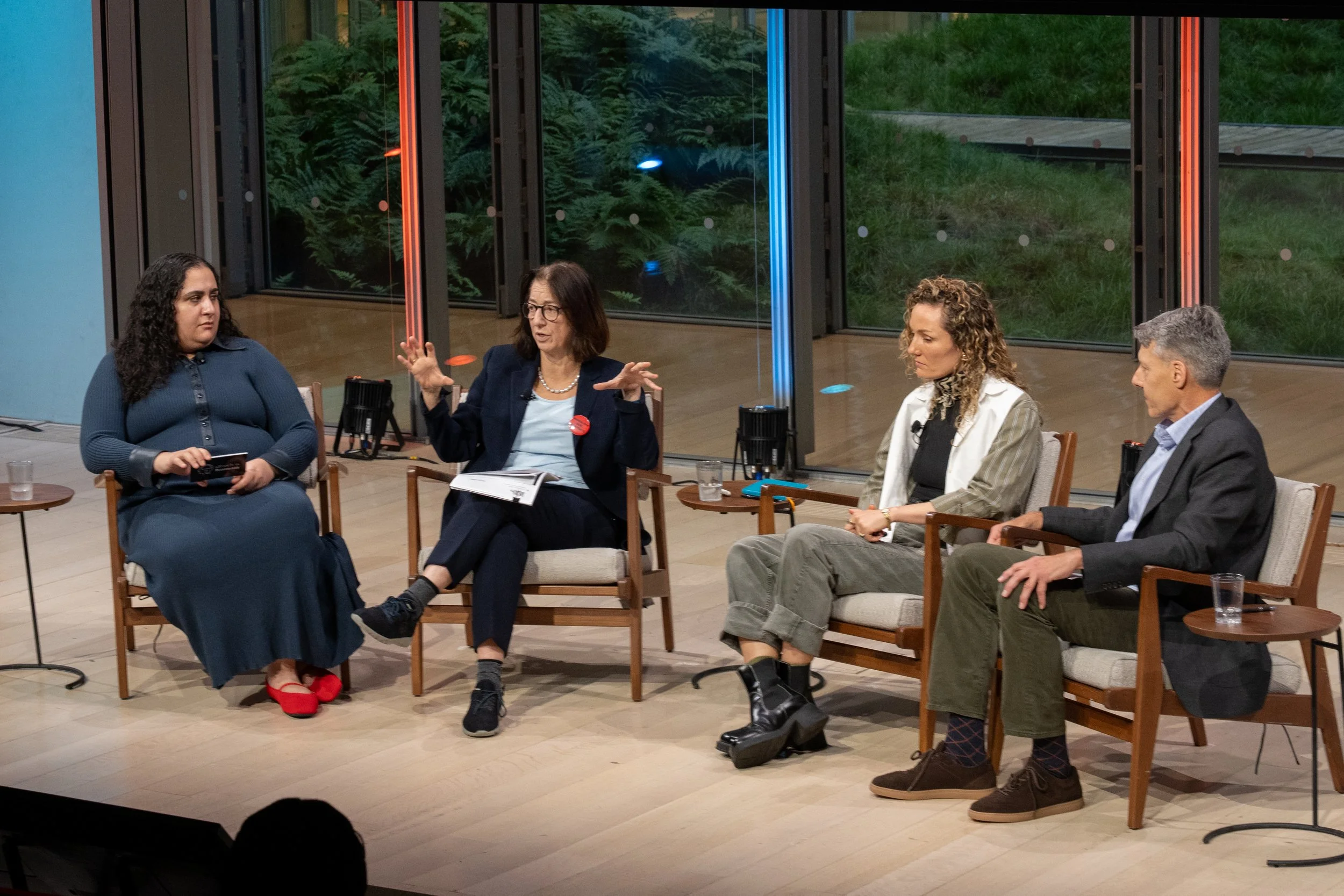
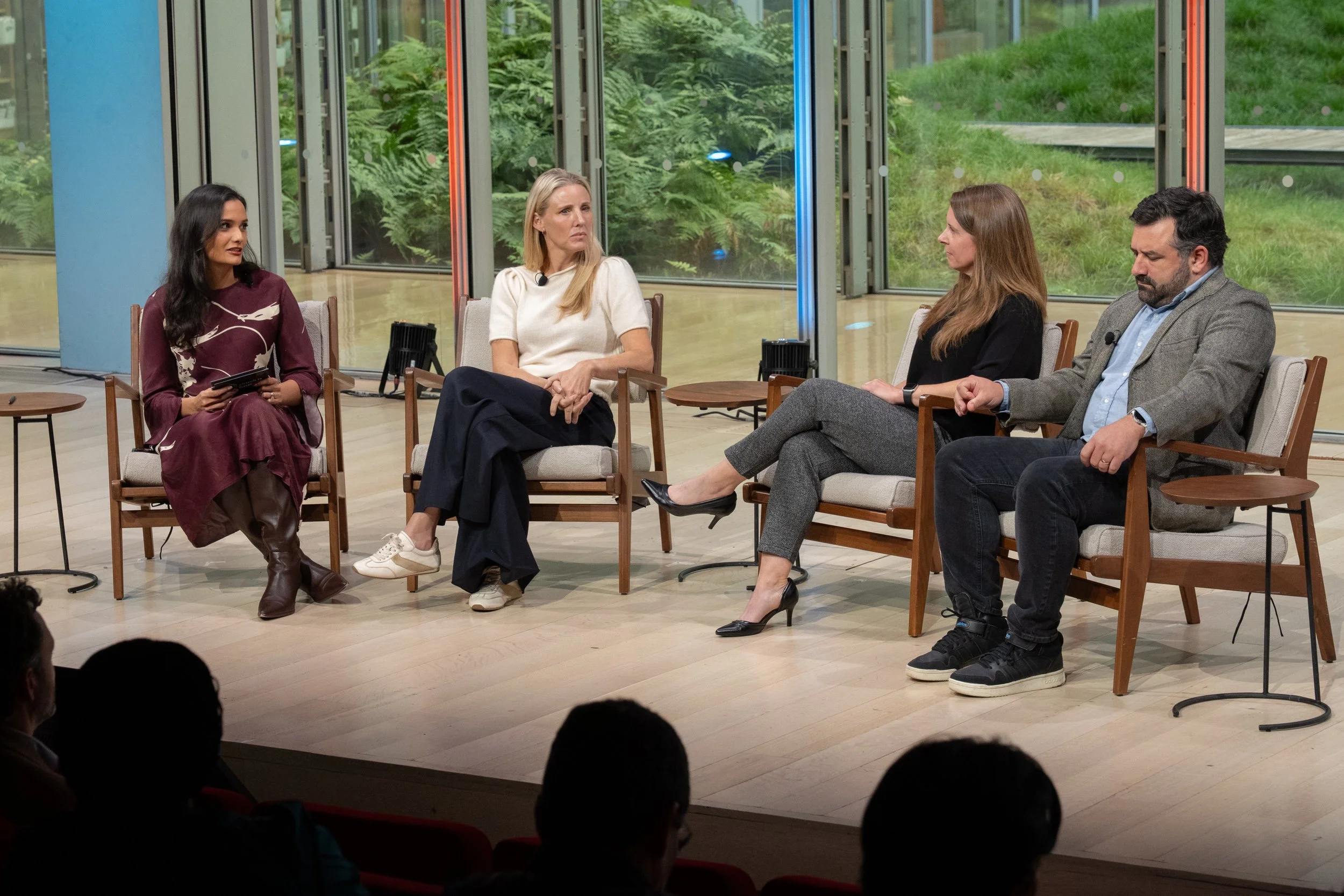
Rebuilding the Commons: Community and Pluralism in the AI Era. The conversation was moderated by Kristin Hansen (Executive Director, Civic Health Project) and featured Carrie Varoquiers (Chief Impact Officer, Workday Foundation), Eli Pariser (Co-Director, New_ Public), and Alison Lee (Chief R&D Officer, The Rithm Project).
Moderator Kristin Hansen sets out to leave the audience hopeful, with a conversation about connection, community, and pluralism in the age of AI. Eli Pariser argues that AI can strengthen human connection. Throughout history, he says, people have found ways to use new technologies for the public good, the way public parks once started as a radical idea. New_ Public’s app Roundabout applies that thinking to neighborhoods online, with local “stewards” who keep conversations productive. It is now expanding across Chicago through a partnership with Chicago Public Media. Carrie Varoquiers explains how her excitement over ChatGPT turned to alarm once she saw how well it simulates empathy. The real existential risk, she argues, is the slow fraying of our relationships. Workday’s research found that one in five Gen Z workers says their workplace relationships have gotten worse since AI arrived. The foundation is responding with microgrants for potlucks, block parties, and game nights.
Alison says young people often hide their AI use for fear of being judged, so her team uses play to open up the conversation. She leads the panel and audience in a round of the AI Effect, a card game that asks players whether a use of AI supports or erodes human connection. She also shares a story from upcoming research about a young man whose AI helped him repair a fight with his girlfriend one day, then took his side in a rant the next. AI amplifies the habits we bring to it, she says, for better or worse. Carrie points to a wave of prosocial builders making tools that bring people together offline. Eli closes with hope: many of the systems that haven’t worked for everyone are now up for reimagining, and that work shouldn’t be left to Silicon Valley alone.
Looking Back to Look Ahead: Co-Designing AI After a Decade of Tech Lessons. A fireside chat between Sinead Bovell (Founder, WAYE) and Beth Goldberg (Executive Director, Humanity AI).
Futurist Sinead Bovell opens by calling AI a general-purpose technology, the kind society rebuilds itself around, and asks what the social media era can teach us. Beth Goldberg, who spent about a decade at Google working to reduce social media’s harms, goes back further, to the early Internet. Its builders deliberately made it an open public good, while social media later locked data and power inside a few companies. AI is at that same early-’90s moment now, she says. The rails for the AI economy are being laid, and the window to shape them is short. Beth makes the case for co-design with a story about her first job. She built a crowdsourcing platform for reporting human rights abuses during the Arab Spring, and almost no one used it, because she never asked people on the ground what they needed. Years later at Jigsaw, her team spent long stretches listening to residents of Bowling Green, Kentucky, before building a digital town hall with them. Ten percent of the town took part.
To change how the big AI labs behave, Beth pushes for collective agency rather than the narrow kind the labs promise, like having an agent clear your to-do list. She points to musicians and Hollywood unions that bargained together with AI companies. She’s also excited about a new benchmark from the MIT Media Lab that measures how AI affects people, including their creativity, critical thinking, and well-being. Universities, governments, and investors could use it to reward better models. Sinead adds that independent AI auditors, overseen by government the way accountants are, may matter more than waiting on new regulation. Both close with a call for positive visions of the AI future, noting that most Americans picture either nothing or the Terminator. Beth shares hers, including teachers and students setting the rules for an AI tutor together.
Learn About the Supporters of This Year’s Responsible Tech Summit
Workday
Workday operates at the heart of the enterprise – HR, finance, and IT – where the margin for error is effectively zero. By tightly coupling AI with the context, guardrails, and trusted processes that run the business, Workday goes beyond AI that assists work to agents that do the work and drive measurable outcomes. More than 11,500 organizations worldwide, including more than 65% of the Fortune 500, trust Workday to deliver.
Mastercard
Mastercard is a global technology company in the payments industry, connecting consumers, financial institutions, merchants, and governments in more than 200 countries and territories. The company is committed to building a sustainable, inclusive digital economy that benefits everyone, everywhere.
Pinterest is a visual search and discovery platform where people find inspiration, curate ideas and shop products — all in a positive place online. Headquartered in San Francisco, Pinterest has over 600 million monthly active users worldwide.
Microsoft
Microsoft is a global technology leader empowering every person and organization on the planet to achieve more through its platforms and productivity tools. The company is committed to advancing responsible AI and ensuring emerging technologies are developed and deployed safely and ethically.
Siegel Family Endowment
Siegel Family Endowment takes an inquiry-driven approach to grantmaking, informed by the scientific method. As technology reshapes society, we fund organizations asking critical questions about its impact on learning, work, and infrastructure. Founded in 2011 by David Siegel, co-founder and co-chairman of Two Sigma, we advance technology in the public interest, supporting research and initiatives that imagine a more inclusive, resilient technology-driven society.
AE Studio
AE Studio is an applied AI and AI alignment company that builds software products for clients while advancing research on making advanced AI systems safe and beneficial. Its recent work with Anthropic, GRAM, trains dangerous knowledge into removable modules so it can be stripped from a model before release. AE Studio reinvests its commercial success into neglected approaches to AI alignment research. Learn more at ae.studio.
Google's mission is to organize the world's information and make it universally accessible and useful. As a leader in AI and computing, the company is focused on developing technology responsibly to benefit people and society.
Kapor Foundation
The Kapor Foundation works at the intersection of racial equity and technology to expand access to K-12 computer science and postsecondary tech pathways, improve tech accountability and worker protections, and increase investments in infrastructure and innovation. We advocate for policy changes, build the capacity of partners, conduct research, support partners through grantmaking, and invest in entrepreneurship and VC. We believe that when technology includes diverse perspectives and is harnessed to address societal challenges, we can transform the tech ecosystem for Black, Latine, and Native communities, and society as a whole. Kapor Foundation works collectively with the Kapor Center family of organizations, Kapor Capital, and SMASH to reimagine and reconstruct a more inclusive and equitable technology sector.
Check out Kapor Foundation's Responsible AI Principles for Advancing a More Equitable Innovation Future.
IAPP
The IAPP is a policy-neutral, not-for-profit association founded in 2000 with a mission to define, promote and improve the professions of privacy, AI governance and digital responsibility globally.
A quote from the team: “…Moving responsible technology from principle to practice requires people equipped to make it happen. IAPP supports that growing community of professionals working across digital responsibility, bringing together privacy, AI governance, cybersecurity, law, risk and related disciplines. Through research, training, certification, professional development and a global community, IAPP helps professionals build the skills, knowledge and connections needed to turn responsible technology into effective, durable governance.”
Civic Health Project
Civic Health Project is a nonpartisan nonprofit organization dedicated to advancing scalable solutions to the dangerous divisions that threaten American democracy. Since our founding in 2019, we have supported more than 75 academic researchers, grassroots practitioners, creatives, and technologists who are helping reduce polarization, strengthen civic norms, and foster social cohesion. Today, Civic Health Project focuses primarily on exploring the vast potential of promising new technologies to help resolve conflict, improve civil discourse and deliberation, foster social cohesion, and uphold societal norms.
Normsy.ai, our flagship in-house project, brings this mission to life. It identifies toxic content in real time and equips users to respond with respectful, trust-building messages grounded in social science and supported by artificial intelligence. We are also part of the initiative The Forum, a new model for civic leadership at a time when trust is low, division is high, and the need for credible, citizen-led solutions has never been greater.
GitHub
GitHub is the world’s leading platform for agentic software development — powered by Copilot to build, scale, and deliver secure software. Over 225 million developers, including more than 90% of the Fortune 100 companies, use GitHub to collaborate, and more than 140,000 organizations have adopted GitHub Copilot.
Cinder
Cinder is the industry’s first Trust and Safety operations platform to help organizations combat Internet abuse at scale. We provide Trust and Safety teams with a single system to manage complex integrity operations and investigations to create a safe environment for their users.
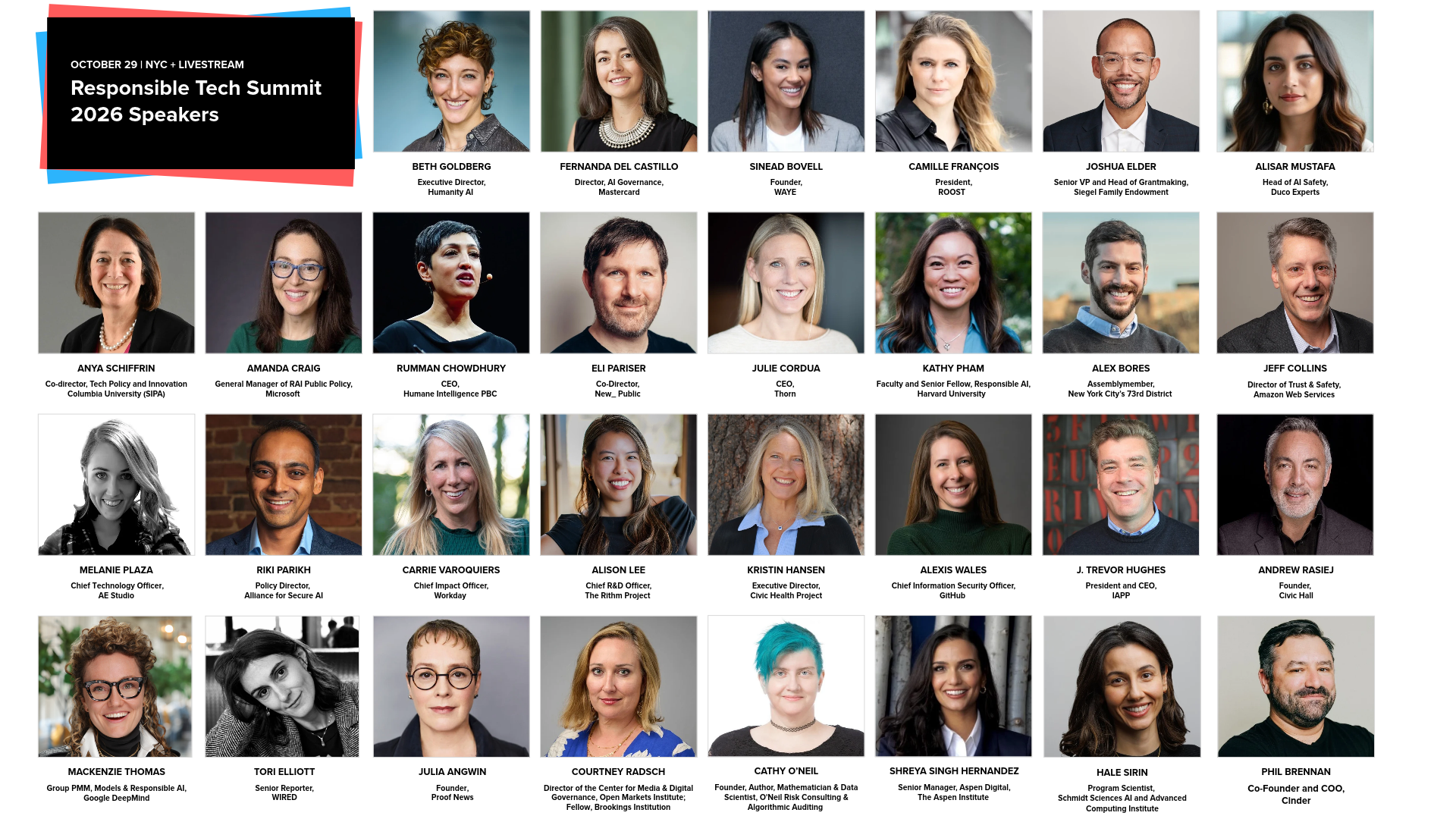
Learn About the Speakers at This Year’s Responsible Tech Summit
-
Alex Bores is the Assemblymember for New York's 73rd District (Murray Hill, Turtle Bay, Midtown East, and the Upper East Side) and the only member of his party elected at any level of New York government with a degree in computer science.
Before serving in the Assembly, Alex worked as an engineer — building software for local governments' COVID relief programs that helped 50,000 families, and assisting the DOJ and two Manhattan District Attorneys to solve violent crimes in NYC.
In the Assembly, Alex has championed tech-forward legislation: passing the RAISE Act, the strongest AI safety bill in the country, encouraging state agencies to adopt cloud computing, and protecting employees' intellectual property rights over their own inventions. He holds a B.S. from Cornell and an M.S. in Computer Science from Georgia Tech.
-
Alexis Wales is the Chief Information Security Officer of GitHub. She leads a team of security experts focused on safeguarding the GitHub platform, products and the open source community, empowering over 180 million developers worldwide to build and deploy software securely on GitHub.
Alexis has 20 years of experience defending critical national and private sector networks, spanning positions with the United States Department of Defense and the Department of Homeland Security’s Cybersecurity and Infrastructure Security Agency (CISA). This experience sparked her passion for collaboration between the public and private sectors to solve the hardest security challenges that threaten the technology we use every day.
Alexis is a self-described "borderless" leader. She believes that, just as threats and vulnerabilities transcend borders, the most significant security impact is achieved through open dialogue and collaboration to make risk-informed decisions and achieve secure outcomes. Outside of work, Alexis enjoys staying active through yoga and cherishes her “long” walks to the mailbox with her senior pug, Lola.
-
Alisar Mustafa is Head of AI Safety at Duco, where she works with technology companies and governments on the technical implementation of AI safety and governance, translating policy commitments into operational practice. Her current research examines how AI safety benchmarks evaluate harm across low-resource languages, and develops methodologies for building stronger multilingual benchmarks on high-risk safety topics for the languages that current evaluation tools, built largely for English, leave behind. She previously co-founded CivicSync and served on Meta's Responsible Innovation team, and advised the US Census Bureau's technology team on responsible AI. She writes the AI Policy Newsletter on policy, safety, and emerging risks.
Alisar holds a Master of Science in Public Policy and Management from Carnegie Mellon University and a Bachelor of Arts in Political Science from San Francisco State University.
-
Alison Lee is the Chief R&D Officer of The Rithm Project, leading youth-centered research as well as emerging tech foresight to fuel a powerful generation equipped to rebuild and evolve human connection in the age of AI.
A researcher, cognitive scientist, and product strategist, Alison’s spent her career studying and designing for youth belonging and safety. Her work spans from liberatory educational models to researching trust & safety and responsible AI at Meta and Instagram, with a laser-focus on supporting youth thriving in a tech-powered world.
Alison holds a Ph.D in Cognitive Science in Education and Masters in Learning Analytics (Machine Learning in Education) from Columbia University.
-
Amanda Craig leads the global public policy team within Microsoft’s Office of Responsible AI, advancing effective and interoperable policies that help Microsoft, our customers, and the world secure the benefits and establish guardrails to address the risks of AI.
She serves on the Partnership on AI (PAI) Policy Steering Committee and the Organisation for Economic Co-operation and Development (OECD) Expert Group on AI Risk & Accountability. Amanda previously led Microsoft’s global cybersecurity public policy team.
Before joining Microsoft, Amanda focused on technology law and policy issues at Indiana University’s Center for Applied Cybersecurity Research, the U.S. Department of State’s Office of Cyber Affairs, and Google. She was also a fellow of the Eric T. Werner Global Cybersecurity Policy Advancement Exchange Program in China. Amanda has a BS in Journalism and International Studies from Northwestern University, an MSc in Forced Migration from the University of Oxford, and a JD from Indiana University.
-
Andrew Rasiej is a futurist, a political and social entrepreneur, a technology strategist, and a community organizer who has spent three decades building institutions where technology meets public life. He founded Irving Plaza and the Digital Club Network in the early days of the digital music world, then turned to civic technology, founding MOUSE.org in 1997 to bring internet access and tech education to public schools. In 2004 he created the Personal Democracy Forum, for over a decade the leading conference on technology and politics, and later chaired the NY Tech Meetup, growing it past 60,000 members. In 2024 he founded Civic Hall @ Union Square, the largest digital skills training center in the US focused on serving under-represented populations. He serves on New York City's AI advisory board. His guiding conviction across every chapter of his career has been ensuring that technology shifts power from the few to the many.
-
Anya Schiffrin is a senior lecturer in the discipline of international and public affairs and faculty co-director of the Technology Policy and Innovation (TPI) concentration at Columbia University’s School of International and Public Affairs. She previously directed the Technology, Media, and Communications (TMaC) specialization and teaches courses on global media, innovation, and human rights. Dr. Schiffrin writes on journalism and development, investigative reporting in the global south and has published extensively over the last decade on the media in Africa.
More recently she has become focused on solutions to the problem of online disinformation, earning her PhD (with honors) on the topic from the University of Navarra. She is the editor of Women in the Digital World, (Routledge, April 2023) Global Muckraking: 100 Years of Investigative Reporting from Around the World (New Press, 2014) and African Muckraking: 75 years of Investigative journalism from Africa (Jakana 2017) She is the editor of Media Capture: How Money, Digital Platforms and Governments Control the News (Columbia University Press 2021.)
Her research with economist Haaris Mateen on the valuation of news has been cited in the Atlantic, Financial Times, Los Angeles Times, New York Times, Washington Post and many other publications. She is a leading thinker and commentator on AI and publishing, media sustainability as well as mis/disinformation and media impact.
-
Beth Goldberg is the inaugural Executive Director of Humanity AI and a Senior Fellow teaching at Yale University Jackson School of Global Affairs. At Humanity AI, she oversees the strategy and grantmaking for the philanthropic coalition to build a more humane future in which AI is shaped by and for people.
She has held senior roles at the intersection of technology, human rights, and democracy. Most recently, she served as the Head of R&D at Jigsaw, a Google incubator that builds free and open-source technologies to advance human agency and open societies. She led an interdisciplinary team that co-designed applied solutions to thorny challenges online, from interventions to counter disinformation to defenses against cyberattacks and harassment. She specialized in human-centered tech development, pioneering scalable "prebunking" techniques to build resilience to manipulation for over 250 million people. Her team advanced AI-enabled deliberative technologies to reimagine our public squares, empowering the public to share ideas and public officials to listen with nuance at scale.
Her public interest technology career began in civil society, investigating human rights protections for internet infrastructure with Article 19, and managing information access in authoritarian regimes for the U.S. Department of State with Freedom House. She leveraged early human rights technologies to document and report on human rights abuses and legal interventions globally with Amnesty International and Namati.
Beth holds graduate degrees from Yale University and a bachelor’s degree from Georgetown University School of Foreign Service. Her research has been published in top academic journals and she has been featured in The New York Times, The Washington Post, The Financial Times, Der Spiegel, and TIME.
-
Dr. Camille François is the founding president of ROOST (Robust Open Online Safety Tools) and a professor of practice at Columbia University’s School of International and Public Affairs.
She has held senior trust and safety and research roles across social media, cybersecurity, and gaming — including Principal Researcher at Google, Senior Director at Niantic, and Chief Innovation Officer at Graphika. She is known for building high-performing teams to detect and mitigate online harms at scale, from child safety to violent extremism, and her research has helped shape safety practices across major Silicon Valley platforms.
Her public interest work includes investigating information operations for the U.S. Senate Select Intelligence Committee, leading France’s governmental inquiry into immersive technologies, and being appointed by President Emmanuel Macron to co-chair the national consultative assembly on the future of the information society. Her current research focuses on public interest AI and new open source practices.
Recognized by TIME’s “100 Next,” MIT Tech Review’s “35 Under 35,” Fast Company’s “Most Innovative Companies,” and the World Economic Forum, she is also a Fulbright Scholar and a Young Leader of the French-American Foundation. She is affiliated with the Harvard Berkman-Klein Center and the French Institute of Geopolitics, and her work has been featured in The New York Times, The Washington Post, WIRED, and Le Monde.
-
Carrie Varoquiers is the Chief Impact officer at Workday, where she leads the Workday Foundation and Social Impact team. An insatiably curious and creative movement-builder and global philanthropy executive, Carrie has spent the past 25 years designing, launching, growing and investing in innovative initiatives that measurably improve lives.
As a leading voice on the human-technology frontier, Carrie specializes in AI’s transformative effects on both the labor market and our interpersonal relationships. Ultimately, her work is dedicated to steering technological advancement toward a future of collective human flourishing.
She also recently developed and executive produced a feature-length documentary film called “UNTAPPED,” available on Netflix, focused on accelerating the skills-based hiring movement globally.
Carrie holds a master’s degree in public health from Johns Hopkins University, a master’s degree in business administration from Golden Gate University, a bachelor’s degree from University of California, Berkeley, and is currently researching the impact of AI on human connection in the workplace. She serves on the board of JVS Bay Area.
-
Cathy O’Neil earned a Ph.D. in math from Harvard and worked as a math professor at Barnard College before switching over to the private sector, working as a quant for the hedge fund D.E. Shaw and as a data scientist in the New York start-up scene.
In 2016 she wrote the book Weapons of Math Destruction: how big data increases inequality and threatens democracy, and in 2022 she wrote The Shame Machine: who profits in the new age of humiliation.
She is the CEO of ORCAA, an algorithmic auditing company and a founder and board member of OCEAN, a non-profit defending the public interest against algorithmic harm.
-
Dr. Courtney C. Radsch is Director of the Center for Media & Digital Governance at Open Markets Institute and a fellow at the Brookings Institution. As a leading authority on the political economy of AI, tech policy, media, and rights, she has a track record of influential policy work and regularly testifies and provides expertise to governments, regulators, competition bodies, and publishers around the world. Her pioneering research, analysis and commentary on responsible AI and information ecosystems have been published in leading media outlets and scholarly journals, and she serves on the boards of theguardian.org and Tech Policy Press.
-
Eli Pariser is co-founder and co-director of New_ Public, a community and experimentation hub for digital public spaces. He’s been an author, activist, and entrepreneur focused on how to make technology and media serve democracy. In 2004, at 23, he became Executive Director of MoveOn.org, where he helped pioneer the practice of online citizen engagement.
In 2006, he co-founded Avaaz, now the world’s largest citizen’s organization. His bestselling 2011 book The Filter Bubble introduced the term to the lexicon. And Upworthy, the media startup he co-founded in 2012, reached hundreds of millions of visitors with civically important content.
Now his work is focused on bringing together community entrepreneurs, researchers, engineers, and designers to envision, architect and scale digital public spaces.
-
Fernanda Del Castillo is a Director in AI Governance at Mastercard, where she leads the development of the company's AI governance framework. Her work focuses on designing governance approaches that can keep pace with the scale, complexity, and rapid evolution of AI technologies, enabling teams to innovate responsibly while maintaining customer trust.
Fernanda works across technology, business, legal, privacy, and security teams to embed governance into the way AI products are developed and deployed. Her current focus includes building practical frameworks that support innovation at scale, including agentic governance enhancements.
She holds a PhD in Applied Mathematics from McGill University.
-
Hale Sirin is a program scientist at the Schmidt Sciences AI and Advanced Computing Institute and an assistant research professor at Johns Hopkins University, affiliated with the Center for Digital Humanities and the Center for Language and Speech Processing. Her research investigates how AI can understand language, culture, and narrative across the world's linguistic diversity. At Schmidt Sciences, she leads the Humanities and AI Virtual Institute (HAVI), which supports AI research that accelerates discovery in the humanities, and the AI Agents program, which studies how communication and cooperation emerge among AI agents. Previously, she was a postdoctoral fellow in computational linguistics at Johns Hopkins, focusing on AI for cultural heritage. She holds a PhD from Johns Hopkins and an MA from the University of Chicago.
-
J. Trevor Hughes is the president and CEO of the IAPP, the professional home for privacy, AI governance and digital responsibility globally. With over 90,000 members in more than 150 countries, the IAPP provides training, certification, publications, research, events and networking opportunities to respond to the growing need for professionals to manage the intersections of data, technology and humanity.
A native of Canada, Trevor previously served as the executive director of the Network Advertising Initiative and the Email Sender and Provider Coalition.
Trevor is widely recognized as a leading digital policy expert on the global stage. He is a sought-after speaker, appearing at SXSW, RSA Conference, TEDx, the Global Privacy Assembly and more. Recent speaking engagements have included the International Data Privacy Symposium in Kingston, Jamaica, AI Impact Summit in New Delhi, India, V2 Security Conference in Copenhagen, Denmark, and the AI Governance & Privacy Symposium at Yonsei University in Seoul, South Korea. He has lectured extensively around the world, including at Harvard, MIT, London School of Economics, Trinity College Dublin, University of Texas at Austin, and Northeastern University Law School.
Trevor has contributed to media outlets such as The New York Times, TechCrunch and Wired and has testified on issues of privacy, surveillance and privacy-sensitive technologies before U.S. Congress, the U.S. Federal Trade Commission, British Parlia
-
Jeff Collins is a technology and policy executive with three decades leading teams through some of the most complex challenges in technology and global affairs — from architecting Trust & Safety for AWS and TikTok, to managing foreign policy crises in the White House, to developing human rights frameworks for multinational corporations.
As Director of Trust & Safety at Amazon Web Services (AWS), Jeff leads trust and safety strategy for global cloud infrastructure at the forefront of the AI revolution. His team leverages AI to combat online abuse while simultaneously helping establish industry-leading safety standards across AWS, Amazon, and the broader tech sector. Jeff recently completed MIT’s Agentic AI Leadership Program to deepen his technical grounding as AI reshapes the safety landscape. He became a recognized leader in this field when he built and led global trust and safety teams at TikTok and the teen-focused social app After School.
Previously, Jeff served as White House National Security Council Director in the Obama Administration; U.S. Foreign Service Officer focused on human rights issues in Cuba, Iraq, Turkey, Bolivia, and Venezuela; Senior Counsel for Global Policy at Chevron; an international lawyer; and a federal appellate and district court law clerk. Jeff serves on the Board of Directors of the National Center for Missing and Exploited Children (NCMEC), is a founding member of the World Economic Forum’s Global Coalition for Digital Safety, and previously served on the
Board of Directors of the Technology Coalition. Over his career, he has helped create new cross-sectoral approaches to global policy as an active participant in the Aspen Institute, Ditchley Foundation, International Bar Association, and UN’s Global Forum on Business and Human Rights.
Jeff is a graduate of Stanford University and Northwestern School of Law. He is a competitive triathlete and open-water swimmer, and enjoys outdoor adventures with his two teenage sons.
-
Joshua Elder is Senior Vice President and Head of Grantmaking at Siegel Family Endowment, where he leads the foundation’s philanthropic strategy across learning, workforce, and infrastructure. He focuses on the evolving relationship between K–12 education and the future of work, especially as emerging technologies like artificial intelligence reshape what students need to thrive. At Siegel, Joshua oversees a dynamic portfolio of grantee partners and strategic initiatives aimed at building more inclusive, tech-fluent, and future-ready education systems.
Prior to joining Siegel, Joshua served as Director of Strategic Initiatives at CSforALL, where he worked to expand national access to computer science education and integrate CS into broader K–12 learning systems. His career spans over a decade in education, including roles in instructional leadership, science education, and school design. He also co-founded a network of low-cost private schools in South Africa and Kenya focused on increasing access to quality learning for underserved communities.
Joshua is currently pursuing an EdD in Leadership and Innovation at New York University. He holds a Master’s in Public Affairs from Columbia University, an MEd from Virginia Commonwealth University, and a Bachelor’s degree from Longwood University.
-
Julia Angwin is an award-winning investigative journalist, a bestselling author, a New York Times contributing Opinion writer and the founding director of the Independent Media + Audience Project at Harvard Kennedy School’s Shorenstein Center on Media, Politics and Public Policy. Her most recent book, with co-author Ami Fields-Meyer, “On Courage: How to be a Dissident in an Age of Fear,” (Mariner Books, 2026) is a New York Times bestseller.
She is the founder of Proof News, a nonprofit journalism studio that launched in 2024. In 2018, she founded The Markup, a nonprofit newsroom that investigates the impacts of technology on society. From 2014 to 2018, Julia was a senior reporter at the independent news organization ProPublica, where she led an investigative team that was a Finalist for a Pulitzer Prize in Explanatory Reporting in 2017 and won a Gerald Loeb Award in 2018.
From 2000 to 2013, she was a reporter at The Wall Street Journal, where she led a privacy investigative team that was a Finalist for a Pulitzer Prize in Explanatory Reporting in 2011 and won a Gerald Loeb Award in 2010. In 2003, she was on a team of reporters at The Wall Street Journal that was awarded the Pulitzer Prize in Explanatory Reporting for coverage of corporate corruption.
She is also the author of the New York Times bestseller “Dragnet Nation: A Quest for Privacy, Security and Freedom in a World of Relentless Surveillance” (Times Books, 2014) and “Stealing MySpace: The Battle to Control the Most Popular Website in America” (Random House, March 2009).
She earned a B.A. in mathematics from the University of Chicago, and an M.B.A. from the Graduate School of Business at Columbia University.
-
Julie Cordua is the CEO of Thorn, a nonprofit that transforms how children are protected from sexual abuse and exploitation in the digital age. For over a decade, she has helped shape Thorn into a leading force for safer online environments, developing tools for platforms to prevent and address child sexual abuse and solutions for law enforcement that have contributed to the identification of thousands of child victims globally. Under her leadership, Thorn has tackled emerging threats such as financial sextortion and the misuse of generative AI to create and distribute child sexual abuse material, while advancing a collaborative, ecosystem-wide approach that brings together tech companies, law enforcement, and policymakers. Previously, Julie served as VP of Marketing/Communications at (RED), helping deliver more than $160 million to fight AIDS in Africa, and spent nearly a decade in the wireless industry. She holds a B.A. in Communications from UCLA and an M.B.A. from Northwestern’s Kellogg School of Management.
-
Kathy Pham is a computer scientist, product leader, and recipient of the 2024 AnitaB.org Technical Leadership Abie Award, following recent recipients Drs. Fei-Fei Li, Daphne Koller, Lisa Su, Margaret Burnett, and Nuria Oliver. Her leadership spans industry, academia, non-profits, venture capital, and government across three presidential administrations. She is the founder of Agents of Purpose, a platform exploring human agency in the age of AI. She also serves as fractional Head of AI at Revive, and serves on the Faculty at Harvard, where she created and teaches Product Management and Society and co-founded the Ethical Tech Working Group.
Previously, Kathy was Vice President of Artificial Intelligence and Machine Learning at Workday. She was a Fellow at the MIT Media Lab and the Harvard Ethics and Governance of Artificial Intelligence Initiative, and serves on various tech and non-profit boards. She is a Senior Advisor at Mozilla, where she co-founded the Mozilla Builders Incubator and Mozilla Responsible Computing.
Kathy was appointed the inaugural Executive Director of the National AI Advisory Committee, led as the Deputy Chief Technologist at the Federal Trade Commission, and was a founding Engineering and Product member of the U.S. Digital Service at the White House, where she helped build critical digital services in government.
Kathy has also spent over a decade building large-scale systems in industry and healthcare at Google (Search, Health, People Operations), IBM, and Harris Healthcare. She completed her undergraduate and graduate studies in Computer Science at the Georgia Institute of Technology (Atlanta, Georgia) and Supélec (Metz, France).
-
As the Executive Director of Civic Health Project, a grantmaking and operating philanthropy, Kristin is dedicated to advancing scalable solutions to our dangerous divisions in the U.S. and globally.
During Kristin’s tenure, Civic Health Project has awarded more than 80 catalytic grants, funded the Strengthening Democracy Challenge, launched Bridge Entertainment Labs, launched the Mismatch school-based dialogue platform, co-chaired the Bridging Goals & Measures Working Group, and co-founded the U.S. Citizen Assembly and Deliberation Allies (CADA) forum. In 2026, Civic Health Project is co-leading The Forum, a three-state deliberative democracy project spanning Nevada, New Hampshire, and South Carolina.
In addition to her role at Civic Health Project, Kristin serves as a Co-Chair of the More Perfect campaign, a Co-Chair of the global Council on Technology and Social Cohesion, and an advisory board member for Listen First Project, More Perfect Union, and Business for America. Kristin has also previously served as a lecturer in management and communications at the Stanford Graduate School of Business.
Prior to her current work in civil discourse, Kristin held senior executive roles at IBM, Intel, and multiple start-up software companies. She holds a BA in Political Science and an MA in International Policy Studies from Stanford University, and an MBA from the Stanford Graduate School of Business.
-
Mackenzie Thomas’ career sits at the intersection of technology and civic engagement. Her 12+ years at Google are marked by a relentless advocacy for safety and responsibility in the development of models, products and company-wide initiatives. Currently, she leads the Google DeepMind generative media and provenance marketing team, managing go-to-market strategies on issues of safety, fairness and user trust. In 2019, she launched Google's gender equity in sports initiative in partnership with 15+ organizations including the WNBA, ESPN, NWSL, and AthleteAlly. Previously, Mackenzie led efforts to build innovative public-private partnerships that help millions of Americans register to vote, get aid after natural disasters, and return to the civilian workforce. Mackenzie is a graduate of UNC Chapel Hill (Go Heels!) and the Harvard Kennedy School. She founded UNC’s LGBTQ Alumni Network, and has served on the advisory boards of LPAC, the National LGBT Chamber of Commerce, New Leaders Council and UNC’s Shuford Entrepreneurship Program. She lives in DC with her wife and pup, and is a frequent host of knock-out basketball tournaments, queer dinner parties, and book swaps.
-
Melanie Plaza is Chief Technology Officer at AE Studio, an applied AI and alignment research company of around 150 people whose consulting practice, for clients including Samsung, Walmart and Electronic Arts, funds its alignment research. AE's research spans alignment techniques from model pretraining to deployed systems, including GRAM, a modular pretraining method developed in collaboration with Anthropic, and two further papers accepted at ICML 2026. Over ten years at AE, Melanie has led the engineering teams building custom AI systems across industries, and she now runs the company's work applying that alignment research to production AI, closing the gap between an AI agent that works in a demo and one an organization can trust to act on its own. She holds a B.S. from Yale.
-
Phil Brennan is the co-founder and COO of Cinder, the trust and safety infrastructure company. Before Cinder, he spent several years at Facebook building out its community threat intelligence team, where he worked alongside Cinder CEO Glen Wise. Earlier in his career, Phil ran counterterrorism units for the U.S. government.
-
Riki Parikh is Policy Director at The Alliance for Secure AI, a bipartisan nonprofit building political support for durable, enforceable safeguards on advanced AI. He built and leads The Alliance's policy department, directing its engagement with Congress, state legislatures, and the executive branch.
Riki came to The Alliance from the U.S. Department of Homeland Security, where he served as Senior Counselor to the Secretary, advising on national security and emerging technology. Previously, he held leadership roles in global public affairs at Meta and LinkedIn, shaping corporate engagement with policymakers around the world. He spent six years on Capitol Hill, as counsel to U.S. Senator Michael Bennet and press secretary to U.S. Senator Mark Warner. He earned his J.D. from the University of Denver Sturm College of Law and his B.A. from The George Washington University. -
Rumman Chowdhury, PhD, is a globally recognized expert in responsible AI, governance, and algorithmic accountability. She is the CEO and co-founder of Humane Intelligence, a nonprofit advancing community-driven AI auditing and evaluation.
Appointed as the U.S. Science Envoy for Artificial Intelligence, she engages in global AI governance efforts with a focus on emerging markets. Previously, she led AI ethics teams at Twitter and Accenture, pioneering enterprise-level AI risk mitigation tools. Rumman is also a Responsible AI Fellow at Harvard’s Berkman Klein Center and a trusted advisor to international organizations on AI policy and ethics.
-
Shreya Singh Hernandez is a technology policy researcher and social impact strategist working at the intersection of artificial intelligence, youth wellbeing, and public policy. She is a Senior Manager at Aspen Digital, a program of the Aspen Institute, where she leads national initiatives on responsible AI adoption, youth digital safety, and inclusive technology ecosystems. Her work brings together policymakers, researchers, educators, technologists, parents, and community leaders to translate emerging research into practical policy, product, and governance solutions that better serve young people.
Shreya has convened cross-sector collaborations on topics including AI governance, youth online safety, algorithmic accountability, responsible technology, and the future of labor, helping bridge the gap between research, industry, and public policy. She is a frequent speaker and advisor whose work has been featured at SXSW, the American Association for the Advancement of Science (AAAS) Annual Meeting, and American Pacific American Institute for Congressional Studies Legislative Leadership Summit, among others. Her work was featured at organizations including the Pew Research Center, Harvard's Center for Public Leadership, Johns Hopkins University, Georgetown University's Massive Data Institute, and Bloomberg's City Data Alliance. She has collaborated with companies including Google, Meta, Snap, Uber, and IBM. She has also participated in international technology policy exchanges through the U.S. Department of State.
Prior to Aspen Digital, Shreya held roles at the Obama Administration's White House Initiative on Asian Americans and Pacific Islanders, Edelman Data & Intelligence, and Planned Parenthood Federation of America, where she developed expertise in using data and technology to advance equity, opportunity, and public impact.
-
Sinead Bovell advises C-suite executives and senior leadership across governments, global corporations, and startups alike, with a core focus on emerging and exponential technologies and their implications for economic and national security, as well as long-term business strategy and model adaptation. She is an 11-time United Nations speaker and has delivered formal addresses to presidents, royalty, and Fortune 500 leaders on topics ranging from synthetic biology to artificial intelligence. She currently serves as an expert advisor to the United Nations AI Advisory Body, focusing on the future of work and AI’s long-term trajectory.
Sinead is one of the most sought-after voices on artificial intelligence and the future of education. She has advised over 17,000 educators, government officials, and policymakers worldwide on redesigning education for the age of AI and emerging technologies. Her recent talk at SXSW on AI and the Future of Education was accredited by the Association of Texas Professional Educators for a CPE credit.
Sinead is a member of the Bretton Woods Committee, where she contributes to strengthening multilateral systems to address 21st-century global challenges. She is also a regular tech commentator for platforms such as CNN, NBC, and CTV, where she discusses the societal impact of emerging technologies.
Sinead was named one of the top 50 voices shaping the future by Afrotech, she received the Mozilla Rise 25 award for her work in championing the development of open and responsible AI ecosystems, and she was dubbed the AI educator for the non-nerds by Vogue magazine. Before founding WAYE, Sinead earned her MBA from the University of Toronto and worked as a management consultant at A.T. Kearney. Sinead holds a bachelor’s degree in finance with a minor in chemistry.
-
Vittoria Elliott is a senior writer for WIRED’s politics desk, covering platforms and power. Her work covering DOGE’s incursion into the federal government has won a National Press Club Award and contributed to WIRED’s Hillman Award. Her reporting covering immigration was nominated for an Online Journalism Award.
She was previously a reporter at Rest of World, where she covered disinformation and labor in markets outside the US and Western Europe. She has worked with The New Humanitarian, Al Jazeera, and ProPublica. She is a graduate of Columbia Journalism School and, before transitioning to journalism, worked with startups in Kenya and India.
Continued Learning from All Tech Is Human
Read our new Responsible Tech Guide
Read our latest white paper, Two Views of the Same Transformation: AI Adoption, Invisible Work, and the Human Side of Organizational Change, in collaboration with the Notre Dame-IBM Technology Ethics Lab
Join our Slack community of 15k members across 122 countries
Sign up for our bi-monthly newsletter
See all of our upcoming gatherings, workshops, white papers, and more.
Reach out to All Tech Is Human below: