Katy Knight on Spending Less Time Playing Defense
Part of our Responsible Tech Voices series, featuring leaders from All Tech Is Human’s 2026 Responsible Tech Guide.
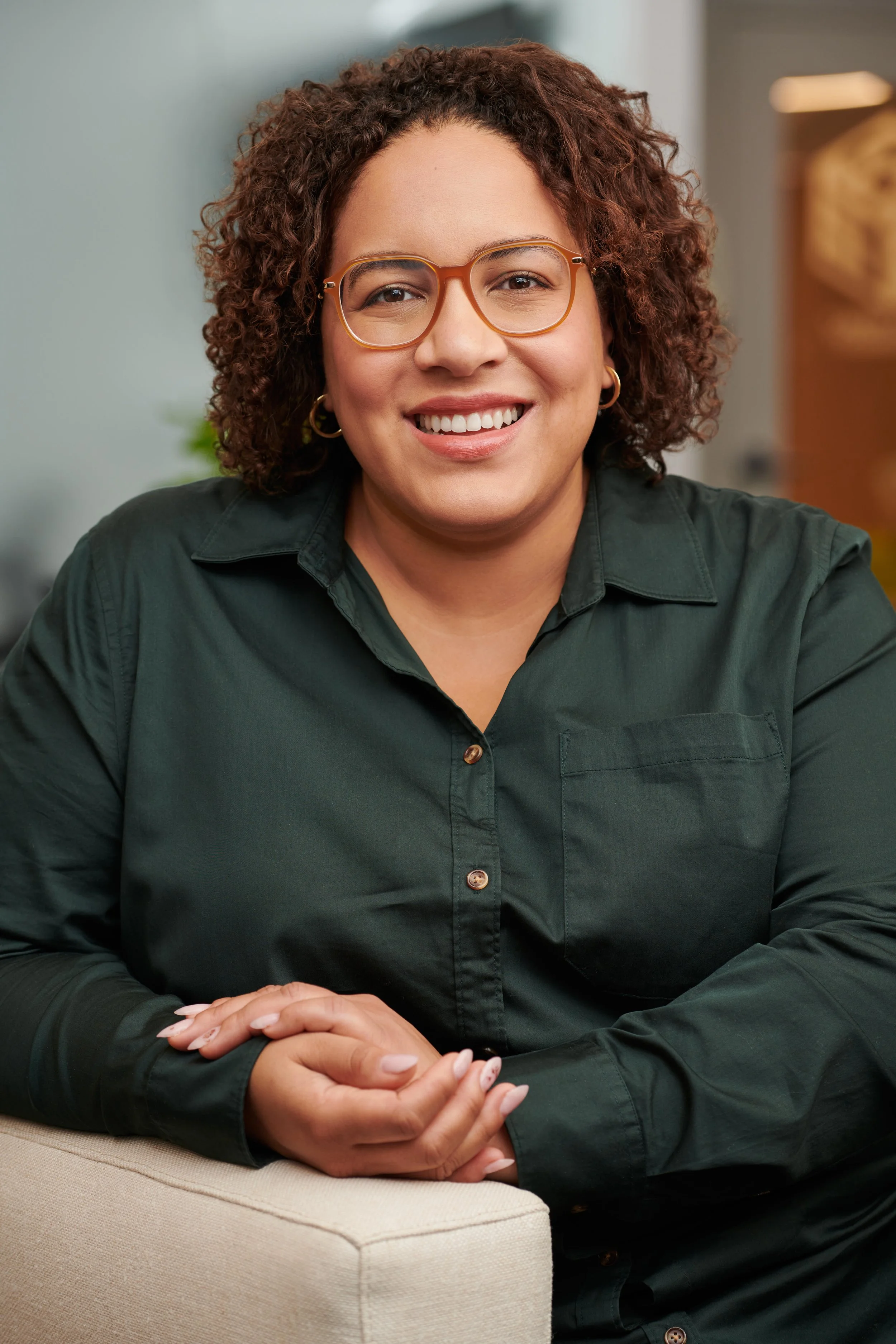
Katy Knight didn't take a straight line into philanthropy. She worked in real estate, joined a small nonprofit, and spent four years in tech policy and community affairs at Google before helping build Siegel Family Endowment, where she now serves as President and Executive Director. We asked her about her winding path, why responsible tech can't be one field, and why she wants to see more of us building rather than just reacting.
How did you get here?
It’s been a winding road, which is probably true of more careers than we admit. I knew I wanted to work in the nonprofit sector, and I was interested in philanthropy, but philanthropy felt opaque, difficult to access, and pretty insular. And, frankly, all of those things were true.
I took some time off from college and worked in real estate, then finished school and joined a very small nonprofit. From there, a combination of money, the promise of “don’t be evil,” and a genuine desire to help more nonprofits access technology led me to Google, where I spent about four years working in tech policy and community affairs.
I was eventually recruited to join our Chairman’s company. I had originally expected to do something else, but after about a year, I became increasingly drawn to the work happening to build out his foundation. It gave me a chance to think about technology not simply as a sector, but as infrastructure that increasingly shapes every other part of society, and to connect the questions around its development to so many of the social issues I had already encountered in my career. That felt like a meaningful place to focus my energy, and I decided to follow that thread. Ten years later, here we are.
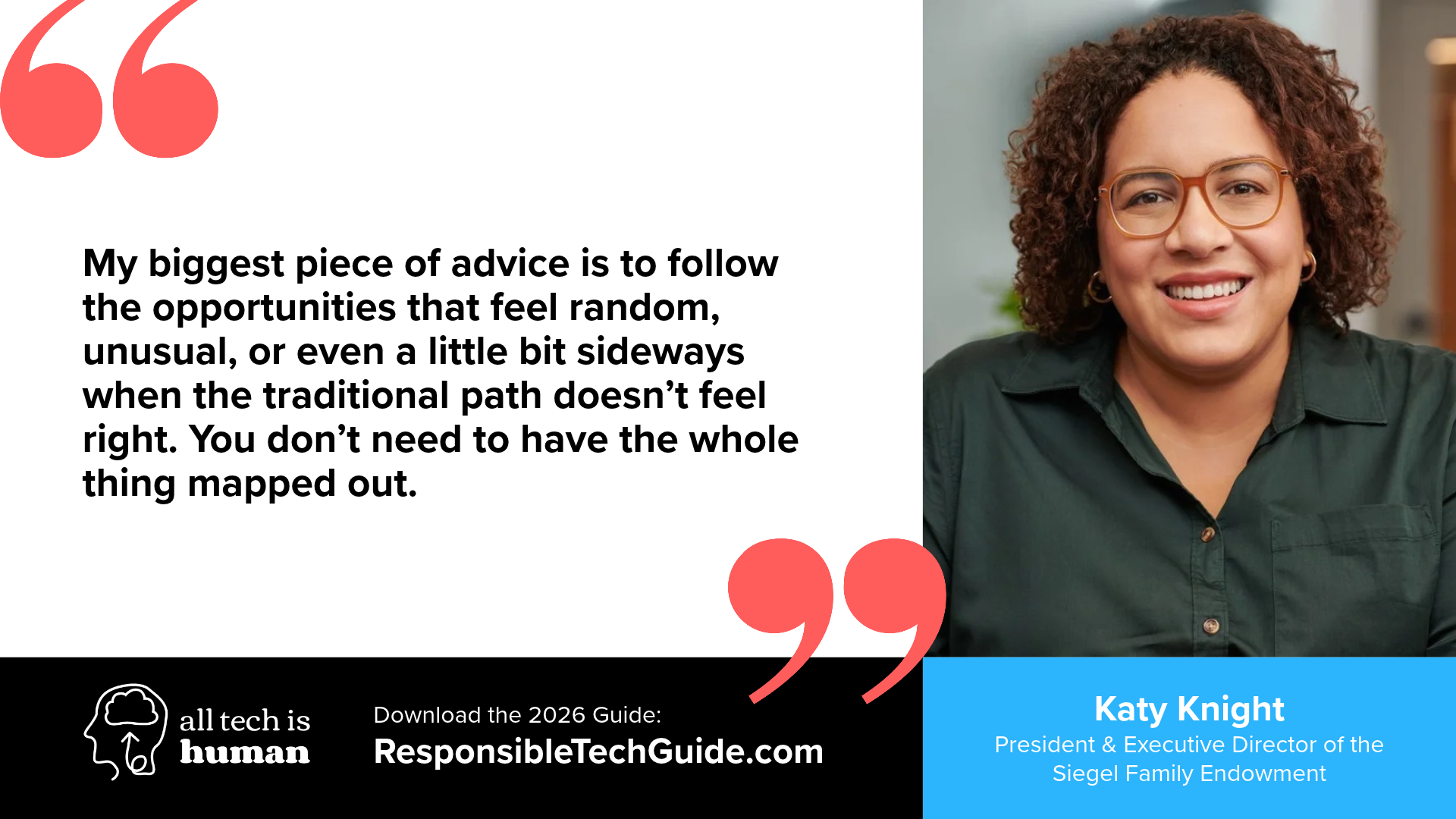
My biggest piece of advice is to follow the opportunities that feel random, unusual, or even a little bit sideways when the traditional path doesn’t feel right. You don’t need to have the whole thing mapped out. Some of the most consequential turns in my career came from opportunities that, at the time, didn’t look like they were leading anywhere in particular. You really never know where they’ll take you.
What fields intersect in your work?
Pretty much everything technical and everything non-technical.
A lot of my work sits at the intersection of technology and what we traditionally think of as the humanities: culture, politics, economics, history, education, communities, and the way people actually experience the world. I’m particularly interested in giving voice to issues that aren’t really about technology in and of itself, but about the ways technology is surfacing or accelerating societal problems we were already struggling with at the margins--and how we might address them.
That distinction matters. We can spend a lot of time debating whether a particular technology is “good” or “bad,” but often the more useful question is: what is this technology changing about a system that was already here?
Philanthropy and policy are also deeply connected, even though the ways most of us can engage in policy are limited. But I think we also have a responsibility to use the voices and resources we do have to talk honestly about both the risks we’re seeing and the potential solutions. We don’t get to sit this one out simply because the policy landscape is complicated.
What has surprised you most along the way?
One of the biggest surprises is that there really isn’t a playbook for how ideas become reality in the technology world.
There are certainly traditional paths. You can start a company, raise venture capital, build a product, and so on. But I’ve also watched people come from completely different backgrounds and corners of different fields and find ways to use technology to do remarkable things. Some of the most interesting work I’ve encountered has come from people who weren’t following the conventional technology career path at all.
I don’t think we tell those stories enough. We tend to talk about technology as though there is one pipeline into it, when in reality, there are many.
Another surprise is that I now consider academics to be my personal superstars. Whether they’re doing basic research that eventually powers the technology of the future, thinking through the implications of new developments for society, measuring progress, or simply helping us develop a deeper understanding of what is actually happening in the world, there are incredibly talented and thoughtful people doing this work.
We could all stand to listen to them a little more. There is a lot of value in having people whose job is to slow down, investigate what we think we know, and ask whether it’s actually true.
Why do those intersections matter?
Responsible Tech can’t be one field. And AI certainly isn’t going to be one field.
At Siegel Family Endowment, we’ve always talked about “investing at the intersections” of our priority areas: Learning, Workforce, and Infrastructure. We’ve found that there can be more leverage in the spaces between those areas than in any one of them on its own.
Our work helping to build the infrastructure for the field of public interest technology is a good example. If we wanted to bring people and funders from outside the technology ecosystem into that work, we couldn’t just tell them that technology was important. We had to show them how technology was intersecting with the things they already cared deeply about, whether that was reproductive justice, climate, education, democracy, or something else.
A lot of the problems we’re trying to address would be much more legible to the public if we stopped talking about them in siloes and started talking about them the way people actually experience them. People don’t experience “AI policy” in one compartment of their lives and “education” in another. They experience the systems around them as one interconnected thing.
The technology may be new. The human questions usually aren’t.
What's one action you'd like to see?
I think this is probably less about one action than about a lot of smaller actions adding up.
I’d like to see more people get involved in their local and hyperlocal politics. The national and global landscape is incredibly important, obviously, but I don’t think we can build the kind of community power and resilience we need to create the technology future we want unless we’re also paying attention to the people and institutions around us.
That means knowing your neighbors. Showing up to local meetings. Understanding who is making decisions in your community and how those decisions get made. Seeing the connection between something happening on your block, in your school district, or in your city and the much bigger questions we’re debating nationally and globally.
We sometimes talk about “community” as though it’s an abstract concept. It’s not. It’s made up of people who live near one another and decide to participate in what happens next.
What does a better tech future look like to you?
As AI lowers the barriers to building things with technology, I hope we see a world where creative people of all kinds are empowered to make things we haven’t even imagined yet.
That is the part of this moment that I find really exciting. There are going to be people who have never considered themselves “technologists” who can suddenly build, experiment, create, and solve problems in ways that weren’t available to them before.
For those of us who care about responsible technology, I think the challenge is to spend more time making that possible. We spend a lot of our energy playing defense, reacting to each new wave of innovation and trying to mitigate the harms after the fact. Some of that work is necessary. But I don’t want our vision of responsible technology to be defined entirely by what we’re against.
A better tech future is one where we are building, too. Where we’re elevating the things that are working, supporting people with good ideas, tinkering with possibilities, and helping more people have a hand in determining what comes next.
Technology is going to shape the future. I’d rather see more of us shaping the technology.
Learn more about the Siegel Family Endowment here. Want more perspectives like this? Read the full Responsible Tech Guide, where this interview is featured.