
How the technology sector can develop the wisdom to see the bigger picture while still getting things done.
By: Beth Watson, Strategy Director, Forum One
As AI reshapes how we work and live, leaders face a familiar polarity: how do we move quickly, experiment, and deliver meaningful results while also considering the broader consequences of the technology we're putting into the world?
In my previous article, I introduced polarity management as a way to understand the relationship between freedom to innovate and responsibility to society. Rather than treating them as competing priorities, we explored why both are essential, what each contributes, and what happens when we overemphasize one at the expense of the other.
So what does managing this polarity actually look like in practice? One place to look is the mission-driven sector, where organizations have long worked to address systemic challenges while meeting the immediate needs of the people they serve.
From principles to judgment
One of the things I appreciate most about polarity mapping is how it can be what Barry Johnson described as a wisdom organizer. It doesn't tell us what to believe or give us a universal set of rules. It helps us organize what we know about competing values, understand how they depend on one another, and apply that understanding to decisions.
I think this is particularly useful in responsible tech, where it's tempting to turn complex ethical questions into definitive positions about what organizations should or shouldn't do.
For example, we know that data centers consume significant energy and water, and that AI is being used to accelerate medical research, improve accessibility, and address other pressing challenges. That doesn't automatically justify the environmental costs of AI, but neither does the existence of those costs settle every decision.
Context matters. So do the people affected, the alternatives available, and the consequences we're willing to accept. Some decisions involve clear ethical boundaries, but many require us to navigate legitimate values that don't always point in the same direction.
Polarity mapping creates space for that kind of judgment. Rather than debating which value should win, we can examine what each contributes, where the risks lie, and what actions might help us sustain the benefits of both.
Beth’s first livestream on managing polarities, in conversation with All Tech Is Human’s Sandra Khalil.
What mission-driven organizations know about working at different scales
The responsible tech movement asks organizations to consider more than immediate user needs, business goals, and technical feasibility. We're being asked to account for broader societal consequences, long-term impacts, and people who may be indirectly affected by our decisions.
That's important, but it can also become overwhelming. Many of the problems responsible tech responds to aren't caused by – or can be solved by – any single product or organization.
That makes the question for any single organization narrower and easier to answer. Instead of asking how to fix the system, it can ask what its part in the system is and how to carry that part well. In this article, I use AI adoption as the main example, because that's where many organizations are facing these questions right now. The same approach applies whether you're building technology, buying it, or funding it.
Even at that scale, the questions multiply. An organization exploring AI to improve internal operations might begin with a relatively straightforward opportunity: reduce repetitive work or help employees make better decisions. Look more closely, and questions emerge about privacy, workforce displacement, accessibility, environmental costs, and the longer-term implications of relying on AI systems.
Mission-driven organizations have been working across these different scales for a long time.
Consider a nonprofit focused on improving public health. Its mission might be to reduce preventable disease, but the factors influencing that outcome extend far beyond its direct control. Public policy, economic conditions, access to care, education, and community infrastructure all matter. At the same time, the organization has specific programs to deliver, staff to support, and people who need services today.
To make progress, these organizations have to translate broad missions into work they can actually do. They develop theories of change to connect their activities to larger outcomes, engage stakeholders to understand how decisions affect different communities, and establish measures that account for both immediate results and longer-term impact.
These practices aren't perfect. Mission-driven organizations can become so focused on systemic change that they lose sight of the immediate experience of the people they serve. They can also become so focused on program delivery or funder requirements that they lose sight of their larger purpose.
But the underlying challenge is familiar: how do you maintain awareness of the system while making decisions about the part you can influence? That experience offers useful lessons for any organization navigating responsible AI adoption.
How to use the polarity map
In my previous article on polarity management, we took the first two steps of what Barry Johnson calls a SMALL process: Seeing, Mapping, Assessing, Learning and Leveraging. We recognized freedom to innovate and responsibility to society as an interdependent pair, then mapped the benefits of each and the downsides that emerge when either is overemphasized.
What Happens When We See the Whole Map?
A polarity map (below) helps us see the full picture:
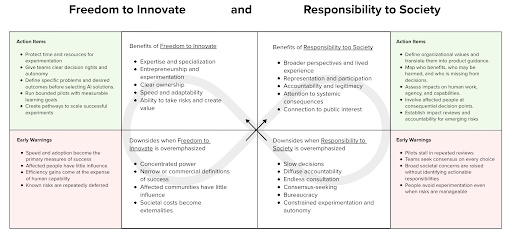
The completed polarity map, including the action steps and early warnings discussed below. The remaining steps—Assessing, Learning, and Leveraging—are where this understanding becomes useful in practice.
Assessing: Where are we now?
Assessing means looking at where we currently find ourselves within the polarity, based on the best information available. Previously, I suggested that much of the technology sector is experiencing the downside of an overemphasis on freedom to innovate. We've become remarkably effective at developing and scaling new technologies, but our ability to anticipate and respond to their broader consequences hasn't always kept pace.
The point of assessing isn't to establish a universal diagnosis, but to have an honest conversation about which benefits and downsides we're experiencing.
Learning: What needs to change?
Once we have a sense of where we are, we can begin exploring what would help us move toward the benefits of both poles. What strengths can we build on? What risks or gaps need attention? What opportunities might help us improve?
If we're experiencing the downsides of innovation without sufficient responsibility, we may need to invest more deliberately in understanding societal impacts, involving affected people, or strengthening organizational accountability. But we also want to preserve the experimentation, autonomy, and creativity that make innovation valuable.
The question becomes not simply how to increase responsibility, but how to do so while sustaining our capacity to innovate.
Leveraging: What will we do, and how will we know when to adjust?
Leveraging translates those insights into action. This means identifying actions that help us achieve the benefits of both poles, along with early warnings that signal when we're drifting toward their downsides.
The completed map above includes example action steps and early warnings for each pole. Recording actions and warnings in the polarity map makes it a practical tool for ongoing decision-making rather than simply a way to describe the tension.
The map, like any system map, isn't perfect. Different organizations will identify different actions and warning signs based on their values, circumstances, and the technologies they're developing. What matters is creating a shared understanding of what we're trying to achieve, what we're watching for, and how we'll respond as we learn.
Mission-driven organizations offer three practices that can help put these actions into effect:
connecting values to everyday decisions,
understanding the system around the work,
and building reflection into how decisions get made.
Connect organizational values to everyday decisions
Mission-driven organizations often use a theory of change to explain how their activities contribute to a larger purpose. The discipline is useful because it forces an organization to articulate the relationship between what it does and what it hopes to achieve.
Organizations adopting AI can apply similar thinking. Many have articulated principles around responsible AI, human well-being, equity, or transparency. But those principles don't necessarily make their way into product requirements, evaluation criteria, or measures of success.
For example, an organization might establish a principle that AI should strengthen human capability rather than simply replace human effort. That raises questions worth considering when evaluating an AI opportunity: Will this technology help people exercise better judgment, or remove their ability to participate in decisions? Will it free employees to focus on more meaningful work? Are we measuring improved outcomes for people, or primarily efficiency and cost savings?
The answers won't be the same for every organization or use case. What's important is making those choices deliberately and connecting them to the values the organization claims to uphold.
Understand the system around the work
Mission-driven organizations frequently use stakeholder engagement, community research, and systems mapping to understand the conditions surrounding the problems they're trying to address. They recognize that a program or intervention doesn't operate in isolation.
The same thinking can be used when introducing AI into an organization.
AI opportunities are often identified by examining individual tasks: drafting a document, processing a request, answering a question. But those tasks exist within larger human systems. People interpret ambiguity, build trust, recognize exceptions, coordinate across teams, and exercise judgment in ways that aren't always visible.
Systems mapping, service blueprints, and participatory research can help reveal that context. Before automating a task, it's worth asking what knowledge people bring to it, who depends on the outcome, and what might be lost or strengthened if the work changes.
This doesn't mean every AI initiative needs an extensive organizational study. The point is to recognize when a deeper understanding of the system could improve a decision. Sometimes that understanding reveals better opportunities for innovation than simply automating the most visible tasks.
It also helps clarify where responsibility lies. A team may directly control product design, implementation choices, and safeguards. It may influence organizational policies, procurement, or workforce development. Other concerns may require collective action or public policy. Distinguishing among these helps organizations act on what they can influence without losing sight of what lies beyond their authority.
Build feedback and reflection into how we work
Mission-driven organizations often have to look beyond immediate results to understand whether their work is achieving its intended impact. A program can meet its delivery targets without producing the broader change it was designed to support. Program evaluations, learning agendas, and strategic reviews create opportunities to examine that difference and adjust course.
Organizations adopting AI can build similar practices into their operating rhythms. When launching a pilot, for example, a team might establish measures of efficiency and adoption alongside indicators of human capability, accessibility, or other organizational values. Regular checkpoints give teams opportunities to review those outcomes, involve additional perspectives when necessary, and reconsider assumptions as they learn.
This is also where the early warnings in a polarity map become useful. If speed and adoption are improving but concerns about human oversight are going unaddressed, the team may need to give more attention to responsibility. If repeated reviews are preventing manageable experiments from moving forward, it may need to restore greater autonomy and clarity around decisions.
The goal isn't to deliberate over every decision or wait until every consequence is understood. It's to establish a rhythm of reflection and action that helps teams recognize when they're drifting toward the downsides of either pole. Between those checkpoints, people need the freedom to get their work done. There is no “winning” at polarity management, only continued tending.
Build the wisdom to do both
We're ready to bring the technology sector’s intentionality about innovation to developing our capacity for responsibility. Mission-driven organizations offer useful examples, not because they've solved the challenge, but because they've spent years working within it. They've developed ways to connect everyday activities to larger outcomes, involve people affected by their decisions, and revisit assumptions as circumstances change.
That doesn't mean turning ethical principles into an ever-expanding set of rules. It means building the organizational wisdom to apply them in context, especially when important values pull us in different directions.
This takes practice. Our first systems maps may be incomplete, conversations about competing values may be uncomfortable, and new decision-making routines may feel awkward. But organizations can get better at recognizing which perspectives are missing, which tensions deserve attention, when to involve others, and when they have enough information to move forward.
Responsible innovation doesn't require every organization to solve society's most complex problems. It asks us to understand the larger systems we're part of, recognize where we have responsibility and influence, and make thoughtful choices about the work in front of us.
We don't have to choose between seeing the bigger picture and getting things done. We can develop the wisdom to do both.
