

Youth Voices, Legislative Momentum, and the Future of Online Safety: All Tech Is Human's Participation In a Recent Roundtable
By Emma Hatheway
How do we tackle thorny issues related to online safety and youth? And what stakeholders bear the greatest responsibility in ensuring a safe online environment?
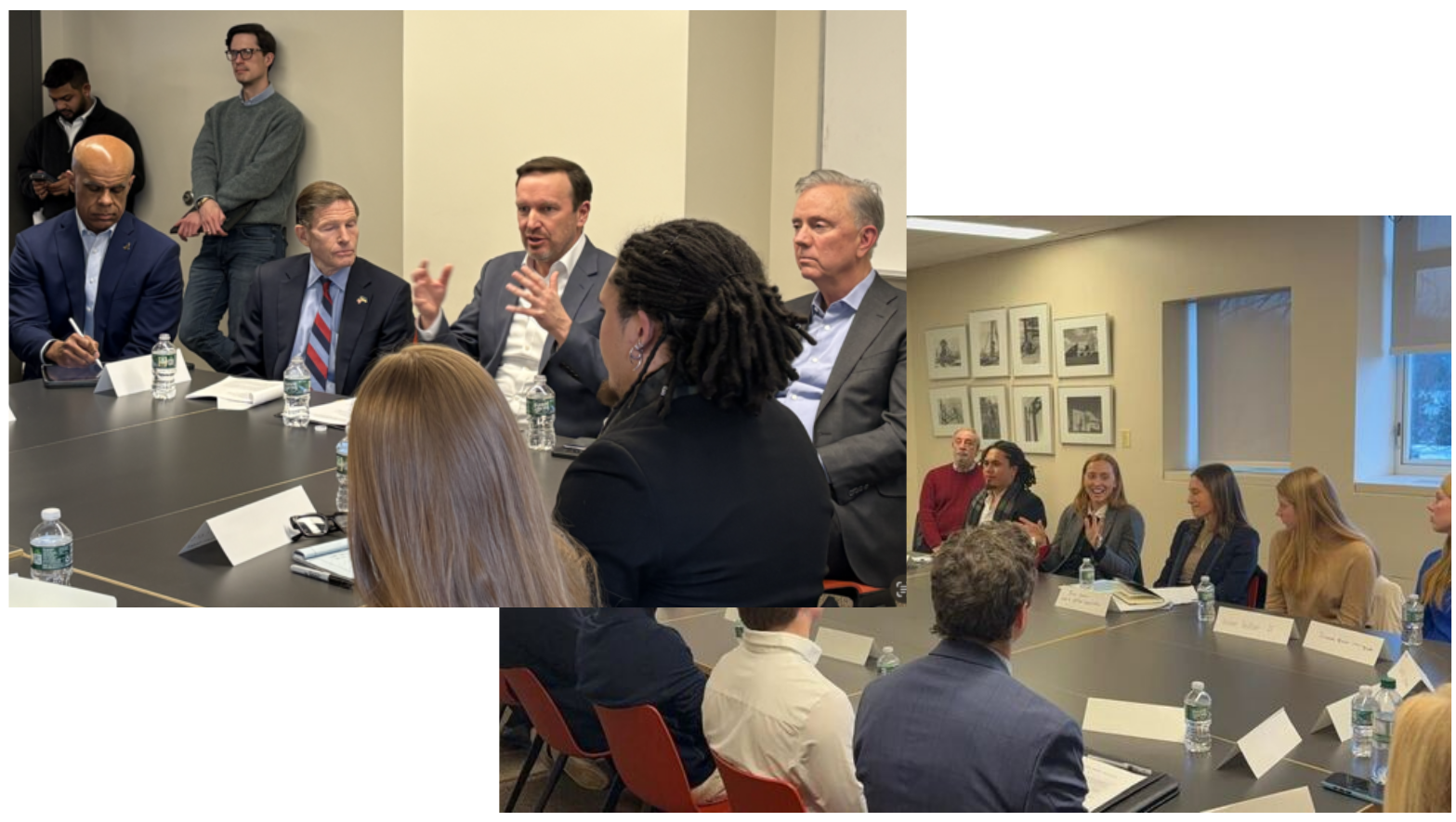
Left image: Senator Blumenthal, Senator Murphy, Governor Lamont opening up the roundtable discussion with an overview of state and federal legislation targeting online harms.
Right image: Emma Hatheway (All Tech Is Human) reviewing how ATIH’s work intersects and engages the topics discussed at the roundtable.
Earlier this month, All Tech Is Human (ATIH) was invited to attend a roundtable organized by Senator Chris Murphy focused on child online safety. With ongoing personal injury cases against Big Tech in California gaining national attention, the recent revelation that millions of non-consensual intimate images were generated by Grok, and the Super Bowl fast approaching – ultimately breaking records for online gambling – the conversation was not just timely, but imperative. For ATIH, the invitation followed the recent release of our AI Companions report, as well as a recent blog post examining the duty of care framework underpinning the Kids Online Safety Act.
The roundtable was convened in partnership with The Rowan Center, a Connecticut-based nonprofit organization dedicated to the prevention of sexual violence and trauma through education, awareness, advocacy, and survivor support. The discussion also marked an inflection point for The Rowan Center itself. While long embedded in community conversations around children’s physical, mental, and emotional health, the organization is now in the process of building KidSafeHQ, a digital product that will serve as a one-stop resource for parents in Connecticut. This new platform will help parents access information and tools to support their children as they navigate today’s online ecosystem and its associated harms.
Alongside The Rowan Center team, representatives from World Without Exploitation, Common Sense Media, and the United States government were in attendance. In addition to Senator Murphy, Senator Richard Blumenthal, Ned Lamont, the First Selectman of Westport, and State Representative Jonathan Steinberg joined the conversation. Last, but certainly not least, eight high school students from local schools participated, sharing firsthand perspectives on today’s social media landscape and offering their visions for effective state and federal legislation.
Senators Murphy and Blumenthal opened the discussion with an overview of the federal legislative landscape, highlighting bills such as KOSA and the GUARD Act, many of which remain under review or in holding patterns within Congress. The conversation surfaced recurring themes around algorithmic transparency, user autonomy, and the impact of limiting phones in schools following Governor Lamont’s state efforts.
The conversation regarding ongoing legislative attempts set the stage for the most compelling part of the roundtable: the young people themselves. Without recounting specific stories or phrases, the students spoke with striking honesty and self-awareness. Many reflected on the addictive nature of apps they’ve used since childhood, describing dopamine and anxiety as dueling forces shaping their online lives. Political polarization and the reinforcement of belief systems featured prominently in their reflections. When discussing Australia’s ban on social media for users under 16, most viewed it as a band-aid solution – one likely to create new problems down the line. Several raised concerns that abruptly introducing teenagers to highly addictive platforms at the age of 16, without earlier guidance or digital literacy to navigate the platforms, could be more harmful than helpful.
The prevailing sentiment in the room was clear: responsibility should rest with technology companies. Rather than banning young people or broadly restricting access, participants emphasized holding platforms accountable for making their products safer, especially for minors and adolescents. Technology companies, the students argued, have a moral – and potentially legal – obligation to prioritize safety over profit.
This moment underscores why legislators must continue to push for laws that translate responsibility into enforceable obligations. Retroactive fixes are not enough. Without clear standards, oversight, and accountability mechanisms, safety will remain secondary to engagement and profit. Meaningful regulation must embed duty of care into law, setting concrete expectations for platform design, transparency, and risk mitigation. Holding technology companies to account is not about limiting innovation, but about ensuring that innovation does not come at the expense of children’s safety.
For All Tech Is Human, conversations like this reaffirm why safety-by-design and duty of care must sit at the center of technology governance moving forward. When youth, advocates, and policymakers align around accountability, the path forward becomes harder to ignore. The question is no longer whether harm exists, but whether we are willing to redesign the systems that produce it.
Looking for continued learning on this topic? Check out the following resources: