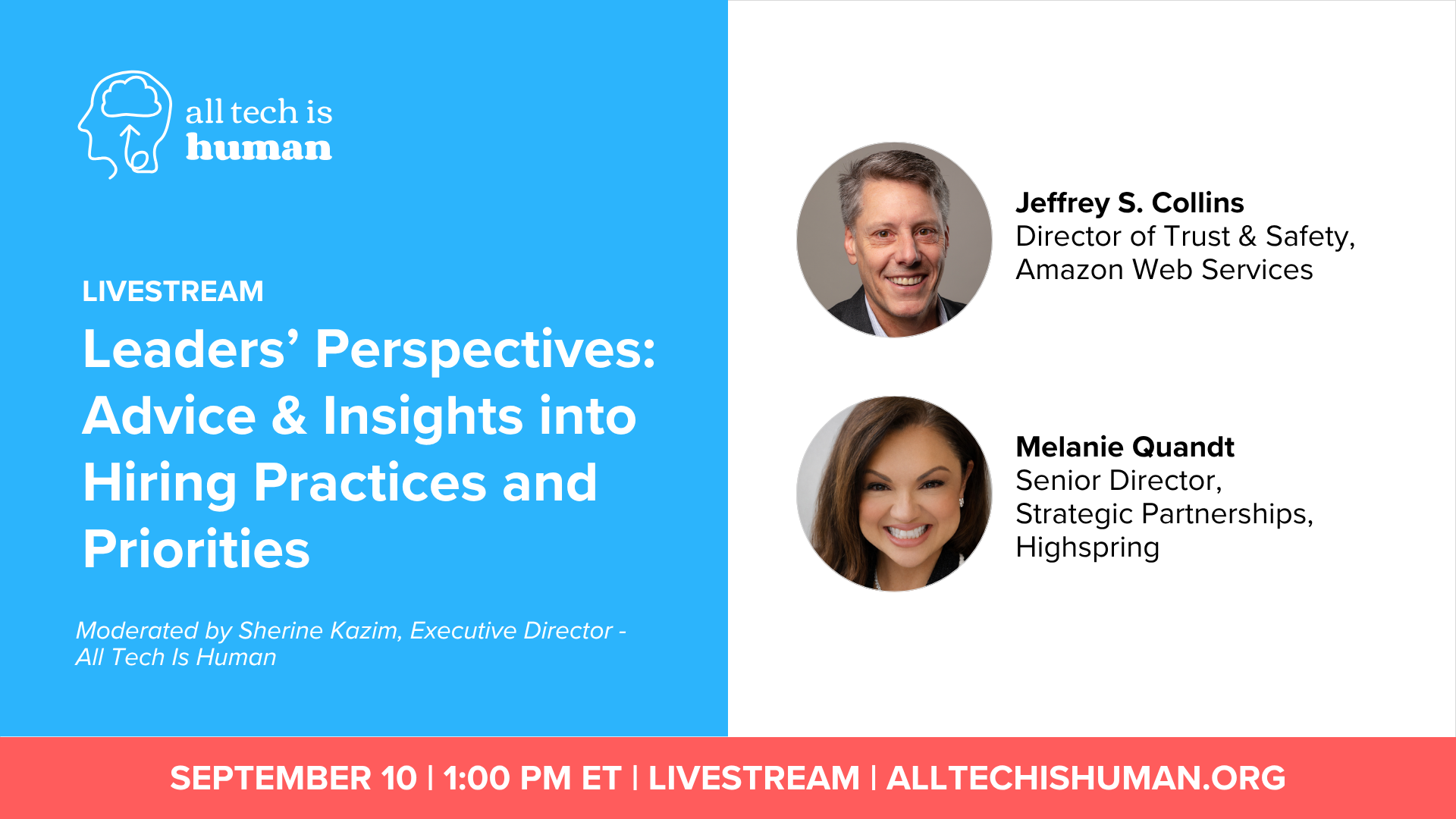
Leaders’ Perspectives: Advice & Insights into Hiring Practices and Priorities
This Livestream aired on September 10, 2026 at 1pm ET. Watch Video
Recap: ATIH's Executive Director Sherine Kazim and Highspring’s Senior Director of Partnerships Melanie Quandt bring a leader’s perspective to navigating careers in Responsible Tech with special guest Jeff Collins, Director of Trust & Safety at AWS.
Jeff shared his career trajectory spanning law, foreign service diplomacy, human rights, energy, and social media at TikTok. He highlighted the art of pivoting, emphasizing that career transitions rely on core principles, continuous curiosity, persistence, and building upon prior experiences rather than resetting completely.
There were quite a few questions from our audience that we didn’t have time to answer during the Livestream, so Melanie and Jeff are answering them below.
Q: As someone looking to move from Tech as an engineer to Tech Policy, what steps would you recommend?
Melanie: Work closely with legal counsel when possible, research and understand product and public policy for your company, and then start to look more macro across the industry to gain a bigger perspective. Then push to learn how other sectors could be solving similar problems, what tools are they using, what harms/ threats have they faced, what is government doing around regulation, who are NGOs and research/ academia saying about the industry and gaps in policy.
Additionally, as an engineer, (1) try to build tools that can help with governance (of data/ or security/ or access/ good behavior vs. misuse). (2) Start writing - build your POV and ask for feedback from your peers or anyone within policy at your company or in your network to understand how a policy leader might think. (3) Attend conferences & take classes.
Jeff: I would make sure to read things like Platformer (Casey Newton) and Tech Policy Press. Anthropic's blog posts (as well as some deepmind and oai) can be helpful to read about things like Claude's constitution. In addition, meet and speak to people who have worked/are working in tech policy. Going from eng to policy is easier than the reverse.
Q: Also with a big push towards AI use in development, how can we ensure the responsible use of AI given the underlying bias within the system and lack of responsible tech architects in most firms? Is there a future market for such roles?
Melanie: Absolutely, companies need tech architects and more experienced talent now more than ever to stress test what AI training data is being used and that the data stays current to mitigate AI RAG, hallucination, and AI laziness/ regression (which is a thing!)
Jeff: Nobody knows how we can do this; AI leaders themselves are calling for legislation. Becoming aware of and getting involved with various initiatives can help. Learn about partnership on ai and their work; get educated and figure out how you can influence a company, your representatives, etc. I do think there is a future market for roles related to trust, ethical tech, responsible tech.
Q: Do you see dedicated AI governance roles becoming as foundational as security roles, or are organizations still treating governance as an add-on to existing compliance functions?
Melanie: This will become a standard for mature organizations who want to truly "govern" responsible use both internally and externally.
AI & digital transformation for any organization requires a philosophy, policies, SOPs, training, metrics, knowledge bases, data and workflow oversight (security), controls, and defensible/ auditable thought processes as to which groups get funding for AI, access to data, the ability to turn things on, and what is the "ground truth" but before you can do any of that, addressing the company’s risk tolerance, AI use cases, and AI readiness and data cleanliness. We don't just jump into a car at 16 and drive in the U.S.; we need to get a permit, then a license, learn how cars work, learn the rules of the road ... and police are there to govern. We need all of this in an organization, too.
Jeff: I see security and t&s blending together. Lines are increasingly blurring. So, yes I see this role and this discipline as critical and believe that we will see this area incorporated into different roles and teams across companies.
Q: Who is doing the best public interest workforce development?
Melanie:
Work for America: Named one of the World's Most Innovative Companies, this nonpartisan non-profit focuses heavily on modernizing how state and local governments recruit. They specialize in repairing the talent pipeline by pulling younger, skilled professionals into public sector careers.
Jobs for the Future (JFF): A national powerhouse that designs equitable workforce and education systems. JFF works directly with public agencies, private entities, and educators to scale things like registered apprenticeships and career-connected learning for low-income workers.
NextGen Policy: A leading driver in building public-sector apprenticeship hubs. They focus on training workers for underfunded civic spaces—such as launching massive school-food labor programs and establishing pathways for justice-impacted youth into public careers.
Equal Justice Works: The gold standard for the legal public interest workforce. They fund and place thousands of passionate law graduates into public defender offices, non-profits, and legal aid groups.
The Bloomberg Philanthropies National Skilled Trades Initiative: A high-impact philanthropic leader connecting public high school systems with localized labor unions, civic employers, and manufacturers. They are currently training over 15,000 students for high-wage, high-demand public and private infrastructure jobs.