How to Transition Into Responsible Tech: Career Pivot Focus (Livestream Recap)
This Livestream aired on July 16, 2026 at 1pm ET. Watch Video
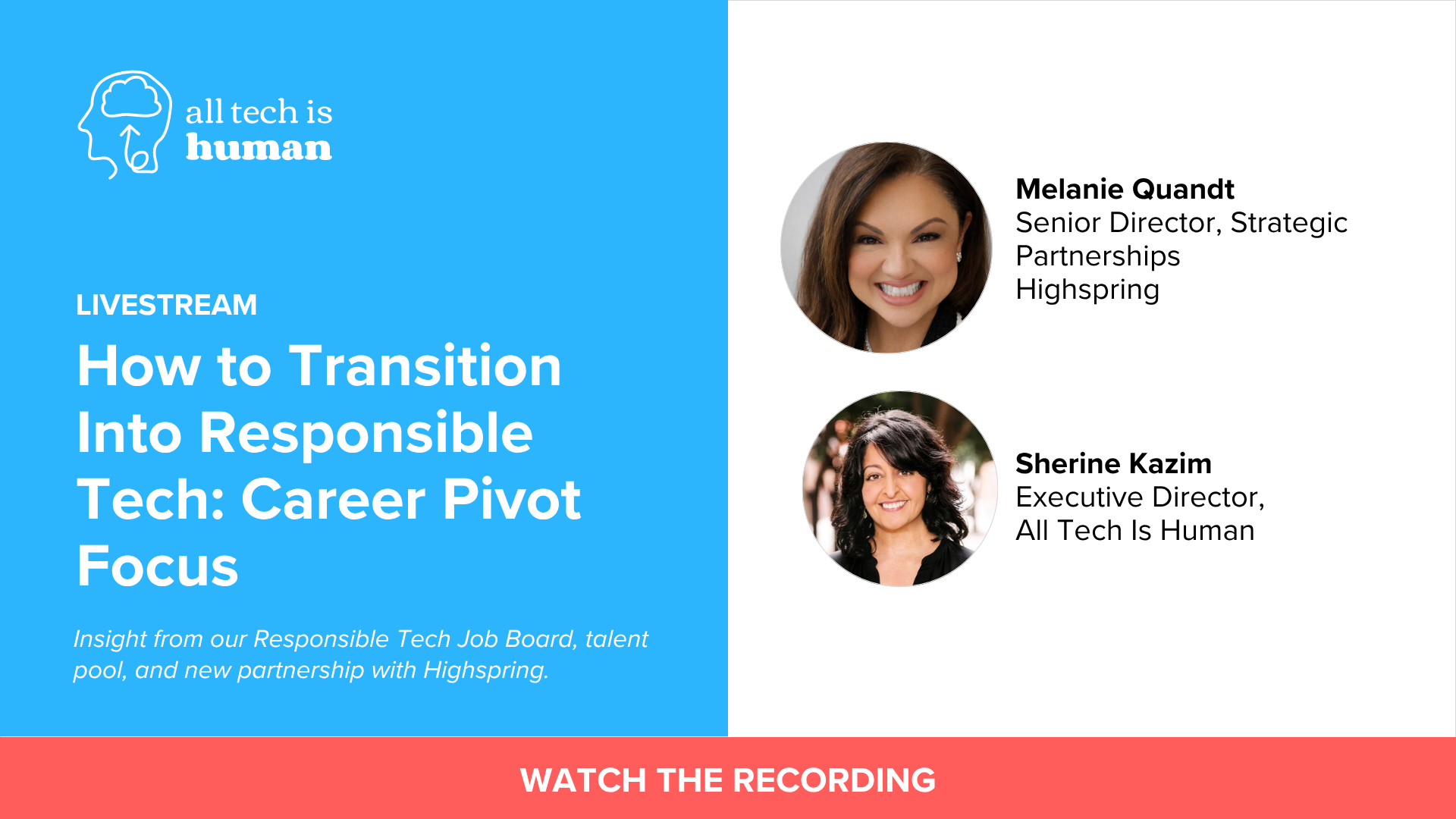
You asked, we’ve answered! ATIH’s Sherine Kazim had a fantastic Livestream conversation with Melanie Quandt, Senior Director of Strategic Partnerships at Highspring, about how to transition your career into Responsible Tech. Since we weren’t able to get to all of your questions during the session, Melanie is tackling them here.
Q: How can those outside the US/Europe + having pivot into responsible tech find responsible tech roles? Are companies willing to look at such profiles when they are changing industry and regions together?
Mel: Today, geography can still be a barrier for some roles, but I believe expertise is becoming more important than location. As AI adoption, regulation, and governance needs expand globally, companies will need talent everywhere. My advice is to focus on building skills, visibility, and community, because the opportunities are growing far faster than the supply of experienced Responsible Tech professionals.
Q: How can those outside the US/Europe + having pivot into responsible tech find responsible tech roles? Are companies willing to look at such profiles when they are changing industry and regions together?
Mel: I actually see this more often than people realize.
Many of the successful pivots I've seen involve people changing not only industries, but sometimes countries, regions, or entire professional identities at the same time.
The good news is that Responsible Tech is one of the most multidisciplinary fields out there. The field needs people who understand human behavior, investigations, policy, education, healthcare, law, risk, compliance, customer support, fraud, and operations. That means there's often more openness to non-traditional backgrounds than in some other parts of tech.
In fact, some of the strongest Responsible Tech professionals I've worked with have come from outside the U.S. and Europe, and from backgrounds unrelated to technology.
Q: How do you keep in touch with your connections when they’re way outside your work function? I feel like I’ve coffee chatted many people once but not really sure how to stay in touch without making the relationship seem transactional.
Mel: Try to think of self-advocacy as your superpower. Your genuine curiosity should come across as authentic, and most people want to help others. I try to learn more about what that person (or team/ function) is trying to achieve. Can you bring ideas, questions, examples of work you are doing or concepts you know, or awareness around growing regulation or policy that could create a richer conversation? Many are open to sharing their perspectives and giving examples of how they got into their role. Ask more about how the work is changing; that is an easy question to ask, and allows you to stay fluid. See if you can shadow them, or if they have process documents or knowledge bases you can study.
Another way to go … start to work with your leadership to get a stretch assignment, or ask if you can volunteer to help another team to gain cross-training. If you can help solve a problem for the company/ its customers/ or the gaps in their strategy, companies are very likely to move you into that area if you can lead the charge. An example of a real-world success like this: a T&S leader I know with a fraud background was helping a start-up with compliance monitoring as an IC. The work was boring, and he was underutilized. After a year and a half, he is now their Head of Risk. He kept talking to Legal, Product, and the C-level suite, and they realized his background was needed in a bigger way to help them think about governance. Once they realized they had $40M customers at risk of data privacy, they invested in creating a role for him that would solve that challenge as the company matured. So some of this has to do with timing, bringing domain expertise, and building trust with those at the company that have influence in the strategy of the organization. Think of ROI and any measurable impact you can bring.
Q: Can you talk more about the move from responsible non-tech to responsible tech? It seems like the trust and safety roles, even on the policy side, require a background in programming or with a tech company. (By responsible tech I mean work in areas like child protection but not in the online space.)
Mel: This is actually a great fit. As GenAI + AI models become more common in production (real-life use cases), they require domain expertise to fine-tune these models. We hire oncologists, linguists, clinicians, biologists, teachers, lawyers, social workers, and more to tackle AI evaluation and bring the knowledge around “context”. Native language skills are also in high demand, since AI is trained on English; most companies that are global need to design their systems to respond differently based on the emerging market and their users. If you see roles that are 75-80% a fit but you are missing the previous tech industry or “Python + SQL”, you can learn these things. You need to be diligent in how you talk about solving problems, learning, and the knowledge their team doesn’t have, whether that is tied to edge cases, or proven frameworks from specific domains (i.e. social work for child protection) - are there signals & patterns, or prevention, or interventions that have worked that can be brought into safety by design and risk assessments? The answer is likely YES, and a team of engineers building these products likely won’t have that expertise.
Could you kindly speak to the relative value of being a 'deep expert' in a specific (technical) domain, versus having (less-deep) proficiency across a broader scope of domains in our current and emerging age (of GenAI)?
Mel: Great question - if I understand it correctly, you are asking about the value of a “deep diver persona” vs an “adventure seeker” with broader knowledge. If you're early in your career, I'd focus on building depth first. Become known for something. If you're more established, start expanding your breadth and understanding adjacent disciplines. The sweet spot is being known for one thing while being conversant in many. As AI becomes more capable, I actually think domain experts become more important because organizations need people who can validate outputs, identify risks, and make nuanced decisions.
Honestly, my own career has been built that way. I'm not the deepest expert in engineering, law, policy, or AI research. But I've spent years connecting people, teams, technologies, and operational solutions across those domains. Increasingly, that's where I see a lot of value being created. In the age of GenAI, I don't think the future belongs to generalists or specialists. I think it belongs to translators. People with enough depth to be credible and enough breadth to connect ideas, teams, and disciplines. Especially in Responsible Tech, the ability to bridge technical, operational, legal, and human perspectives is becoming one of the most valuable skills of all.