

Election Brief: Bolivia 2025 General Elections
Executive Summary
On August 17, 2025, Bolivia will hold general elections to choose the President, Vice President, and members of the Plurinational Legislative Assembly—a vote that will test the resilience of democratic institutions amid political fragmentation, economic crisis, and intensified foreign interference. The ruling Movement for Socialism (MAS) faces internal divisions following the disqualification of former President Evo Morales, while a fractured opposition struggles to present a unified challenge. The stakes extend far beyond Bolivia's borders: as the holder of the world's largest lithium reserves, Bolivia's electoral outcome will influence global supply chains, regional geopolitical alignments, and the broader contest between democratic and authoritarian governance in Latin America.
Unlike many contemporary elections, Bolivia employs a predominantly manual voting system that offers unique advantages in cybersecurity resilience while creating different vulnerabilities that election practitioners must understand. The convergence of indigenous rights, environmental concerns, resource geopolitics, and technological challenges makes this election a critical case study for practitioners developing comprehensive election security frameworks.
Election Snapshot:
Election Dates: August 17, 2025 (General); October 19, 2025 (Runoff if necessary)
Offices: President, Vice President, 130 Deputies, 36 Senators
Voting Method: Paper ballots with manual counting
Eligibility: Bolivian citizens aged 18+, registered on the electoral roll
Polling Hours: 8:00 AM to 4:00 PM
ID Requirement: Valid national ID card
Key Points
Election Administration: Conducted by the Plurinational Electoral Organ (OEP), comprising the Supreme Electoral Tribunal (TSE) and nine Departmental Electoral Tribunals (TEDs).
Legal Framework: Bolivia retains strict laws on campaign finance and party disqualification that may undermine political pluralism.
Election Integrity: Risks include candidate disqualifications, state media dominance, potential unrest, and disinformation.
Context: The disqualification of Morales, fragmentation of MAS, and economic turmoil have destabilized political predictability.
Political Trends to Watch
Fragmentation of MAS: Emergence of internal factions could alter legislative control
Rise of Centrist Movements: CC and APB may appeal to disaffected urban voters
Youth Mobilization: Economic insecurity is driving youth voter turnout and activism
Disinformation: Use of AI-generated content and foreign media narratives could escalate
Key Strategic Takeaways:
Manual paper-based systems provide cyber-resilience but create different attack vectors
Resource-rich nations face amplified foreign interference pressures targeting economic leverage
Indigenous rights and environmental issues increasingly intersect with election technology policy
Political fragmentation within ruling parties creates unpredictable security environments
How to Use This Briefing
This briefing provides a comprehensive overview of Bolivia's 2025 general elections, including the political landscape, electoral system, integrity risks, and geopolitical dynamics. It is designed to help election practitioners, cybersecurity professionals, and international observers initiate election preparedness by providing foundational strategic intelligence. The brief is organized for quick reference, allowing users to quickly access high-level insights or dive deeper into specific areas of interest for developing their own operational frameworks.
Key Points
Political Leadership: The ruling Movement for Socialism (MAS) faces unprecedented internal fragmentation following the constitutional disqualification of former President Evo Morales from the 2025 ballot. Current President Luis Arce leads the party but faces challenges from rival MAS factions. The opposition remains divided among multiple parties including Comunidad Ciudadana (Carlos Mesa), Creemos (Luis Fernando Camacho), and newer centrist movements.
Election Laws & Technology: Bolivia employs a manual paper ballot system with limited technological integration, primarily for voter registration and result transmission. The Plurinational Electoral Organ (OEP) operates under Law 026 (Ley del Régimen Electoral) with constitutional-level independence. Key technological vulnerabilities exist in:
Voter Registration Systems: Digital databases requiring cybersecurity protection
Result Transmission Networks: Communication links between polling stations and electoral authorities
Information Systems: Official websites and public communication platforms
Social Media Environment: WhatsApp, Facebook, and regional platforms used for information warfare
Concerns Over Fairness: International observers and civil society organizations report:
Judicial decisions potentially favoring ruling party candidates
Limited press freedom in certain regions creating information vulnerabilities
State media dominance in rural areas where MAS maintains strong support
Disinformation campaigns targeting opposition candidates and electoral processes
International Context:
MAS Allies: Venezuela, Cuba, Nicaragua, and Iran provide political solidarity and potential intelligence support
Opposition Supporters: United States, European Union, Brazil, and regional democracies advocate for electoral transparency
Economic Partners: China maintains significant lithium extraction interests regardless of electoral outcome
Regional Observers: Organization of American States, European Union, and Carter Center expected to deploy observation missions
Context & Key Facts
The vote follows a period of political instability marked by the 2019 election crisis, interim government period, and MAS's return to power in 2020. The National Assembly serves as a crucial check on executive power, with authority over budget approval, judicial appointments, and constitutional amendments. Control of the legislature will determine the next government's ability to implement economic reforms and manage foreign investment in Bolivia's strategic resources.
Current Leadership:
President: Luis Arce (MAS)
Vice President: David Choquehuanca (MAS)
Assembly President: Andrónico Rodríguez (MAS)
Electoral Mechanics:
Voting Age: 18
Eligibility: Bolivian citizenship, Electoral Roll registration maintained by OEP
Voting ID Requirement: National ID card (cédula de identidad), valid or expired accepted
Polling Hours: 8:00 AM to 4:00 PM
Election Outlook: International observers expect competitive elections with potential for dispute over results. The fragmentation within MAS creates unpredictability, while opposition unity remains elusive. Post-election stability will depend significantly on margin of victory and acceptance of results by losing parties.
Key Election Information
Election Type: General (Presidential and Legislative)
Voting Methods: Manual paper ballot system:
Paper Ballots: Voters mark paper ballots manually
Manual Counting: Public counting process with party representatives present
Result Transmission: Digital transmission of final counts to electoral authorities
Verification: Multiple verification stages with audit capabilities
Voting Locations:
OEP Official Website: https://www.oep.org.bo/
Social Media: @TSEBolivia (Twitter/X)
Voter Information: Available through OEP portal and regional electoral tribunals
Voting Process:
Registration Verification: Presenting ID card to confirm electoral roll registration
Ballot Reception: Receiving official paper ballots for each office
Voting: Marking ballots privately in designated voting booth
Ballot Deposit: Depositing completed ballots in designated boxes
Verification: Ink marking of finger to prevent double voting
Polling Operations: Polling stations operate from 8:00 AM to 4:00 PM, with extended hours if voters remain in line at closing time.
Bolivia Political Landscape
The Bolivian political arena reflects deep social, ethnic, and regional divisions that have shaped the country's democratic development. The ruling MAS party built its power base on indigenous rights and resource nationalism, but internal divisions threaten its traditional unity. Opposition parties struggle to present alternatives that appeal across Bolivia's diverse constituencies.
Ruling Party: Movement for Socialism (MAS-IPSP)
Leader: President Luis Arce
Key Figures: David Choquehuanca (Vice President), Andrónico Rodríguez (Assembly President)
Ideology: Indigenous rights, resource nationalism, socialist economics
Status: Controls executive branch and legislative majority, but faces internal fragmentation over Morales' exclusion
Support Base: Rural indigenous communities, coca farmers, urban working class
Social Media: @MAS_IPSP (Twitter/X)
Opposition Factions:
Comunidad Ciudadana (CC)
Leader: Carlos Mesa (former President)
Ideology: Center-left, democratic governance, market economics
Status: Primary opposition party with urban middle-class support
Strategy: Emphasizes democratic institutions and anti-corruption platform
Social Media: @ComunidadCBo (Twitter/X)
Creemos
Leader: Luis Fernando Camacho (currently detained)
Ideology: Conservative, regional autonomy, free market
Status: Strong in Santa Cruz region, facing leadership challenges due to Camacho's legal situation
Base: Business community, eastern lowlands, conservative voters
Social Media: @CreemosBolivia (Twitter/X)
Frente Para la Victoria (FPV)
Leader: Chi Hyun Chung
Ideology: Centrist, technocratic governance
Status: Newer party attempting to capture moderate voters
Social Media: @FPVBolivia (Twitter/X)
APB Súmate
Leader: Manfred Reyes Villa
Ideology: Center-right, municipal governance experience
Status: Regional strength in Cochabamba, seeking national expansion
Social Media: @APBSumate (Twitter/X)
Election Integrity & Foreign Interference Risks
Context: Bolivia's manual voting system provides inherent cybersecurity advantages but creates vulnerabilities in information warfare, economic coercion, and traditional electoral manipulation. The country's strategic lithium reserves make it a target for foreign influence operations seeking to secure resource access or geopolitical alignment.
Exploitable Trends:
Information Warfare: WhatsApp disinformation campaigns, social media manipulation, foreign media narratives
Economic Leverage: Foreign investment pressures, trade relationship exploitation, sanctions threats
Judicial Manipulation: Court decisions affecting candidate eligibility, electoral law interpretation
Resource Nationalism: Competing foreign interests in lithium extraction and infrastructure development
Indigenous Rights: International pressure on environmental and indigenous policies
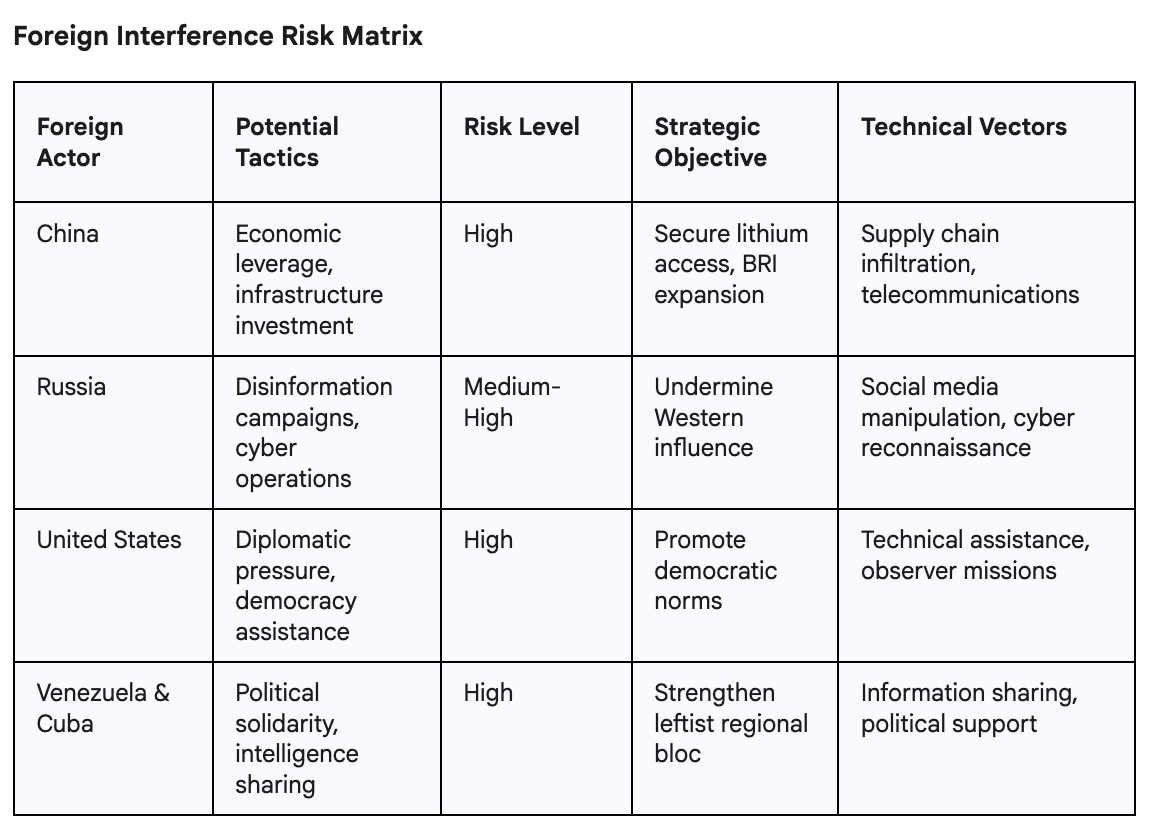
Likely Foreign Tactics:
China: Economic incentives, infrastructure investments, technology transfer agreements
Russia: Disinformation campaigns, cyber reconnaissance, diplomatic support for resource access
United States: Diplomatic pressure, democracy assistance, civil society support
Venezuela/Cuba: Political solidarity, intelligence sharing, ideological support
Geopolitical Landscape
The 2025 Bolivian elections represent a critical inflection point in South American geopolitics, where the outcome will influence not only domestic governance but regional power balances and global supply chains. Bolivia's position as holder of the world's largest lithium reserves places it at the center of competing international interests in the green energy transition. China seeks to maintain and expand its access to lithium resources through economic partnerships and infrastructure investments. Russia views Bolivia as part of its broader strategy to challenge Western influence in Latin America, potentially employing disinformation and diplomatic support. The United States and European Union prioritize democratic governance and environmental protection while seeking to counter authoritarian influence in the region.
Regional neighbors including Brazil, Argentina, Chile, and Peru monitor Bolivia's elections closely due to implications for trade relationships, migration flows, and regional integration initiatives. The election outcome will signal whether Bolivia maintains its traditional left-leaning orientation or shifts toward more centrist governance, with corresponding effects on continental political alignments.
Bolivia Political Trends
Several political trends in Bolivia create vulnerabilities that foreign actors may exploit:
Resource Nationalism vs. Foreign Investment: Bolivia's constitutional requirement for state control over natural resources creates tension with foreign investment needs, providing leverage points for economic coercion or incentives.
Indigenous Rights and Environmental Protection: International pressure on environmental policies and indigenous consultation processes can be exploited to influence electoral outcomes or post-election governance.
Regional Autonomy Movements: Tensions between central government authority and regional autonomy aspirations, particularly in eastern departments, create opportunities for foreign actors to support separatist or federalist movements.
Judicial Politicization: Concerns over judicial independence and politically motivated legal decisions create vulnerabilities for foreign actors to influence legal processes affecting electoral outcomes.
Information Environment Fragmentation: Limited press freedom in certain regions and reliance on social media for information create opportunities for disinformation campaigns and foreign narrative influence.
Diaspora Engagement: Bolivian communities abroad, particularly in Argentina, Chile, and the United States, represent potential targets for foreign influence operations aimed at affecting electoral perceptions and outcomes.
Authoritative Sources
Election Organizations:
Plurinational Electoral Organ (OEP): The constitutional-level authority overseeing elections in Bolivia - https://www.oep.org.bo/
Supreme Electoral Tribunal (TSE): Primary electoral management body within OEP structure
International Foundation for Electoral Systems (IFES): Provides detailed election analysis and technical assistance - https://www.ifes.org/
Carter Center: Offers comprehensive election observation and integrity assessment - https://www.cartercenter.org/
Organization of American States (OAS): Regional election observation and democratic governance support - https://www.oas.org/
Media Sources:
El Diario: Independent daily newspaper - @eldiario_net
La Razón: Major daily newspaper - @LaRazon_Bolivia
Los Tiempos: Cochabamba-based daily - @LosTiemposBol
El Deber: Santa Cruz regional newspaper - @grupoeldeber
Opinión: Cochabamba daily newspaper - @Opinion_Bolivia
Radio Fides: Catholic radio network - @GrupoFides
Unitel: Commercial television network - @UnitelBolivia
Research and Analysis:
Human Rights Watch: Monitors electoral and human rights conditions - https://www.hrw.org/americas/bolivia
Freedom House: Annual assessments of political rights and civil liberties - https://freedomhouse.org/country/bolivia
Inter-American Commission on Human Rights (IACHR): Regional human rights monitoring - https://www.oas.org/en/iachr/
Brookings Institution: Policy analysis and regional expertise
Council on Foreign Relations: Geopolitical analysis and strategic assessment
Legal and Constitutional Framework:
Bolivian Constitution: https://www.vicepresidencia.gob.bo/constitucion.pdf
Electoral Law (Law 026): https://www.oep.org.bo/wp-content/uploads/2019/10/ley-026-regimen-electoral.pdf
OEP Regulations: Available through official OEP website
Constitutional Tribunal: Judicial review authority for electoral disputes
By Alexis Crews, Senior Fellow, Information Integrity for All Tech Is Human
