

Recap of our May 21st Responsible AI gathering at the Finnish Consulate in NYC
ATIH at the Finnish Consulate
On May 21, 2025, All Tech Is Human gathered at the Finnish Consulate in Manhattan for a convening focused on Strengthening Multistakeholder Collaboration in Responsible AI, followed by a reception at the Finnish Residence.
The afternoon began with welcome and opening remarks by All Tech Is Human’s Founder & President David Ryan Polgar and Finnish Ambassador Jarmo Sareva before exploring the topic with two panels.
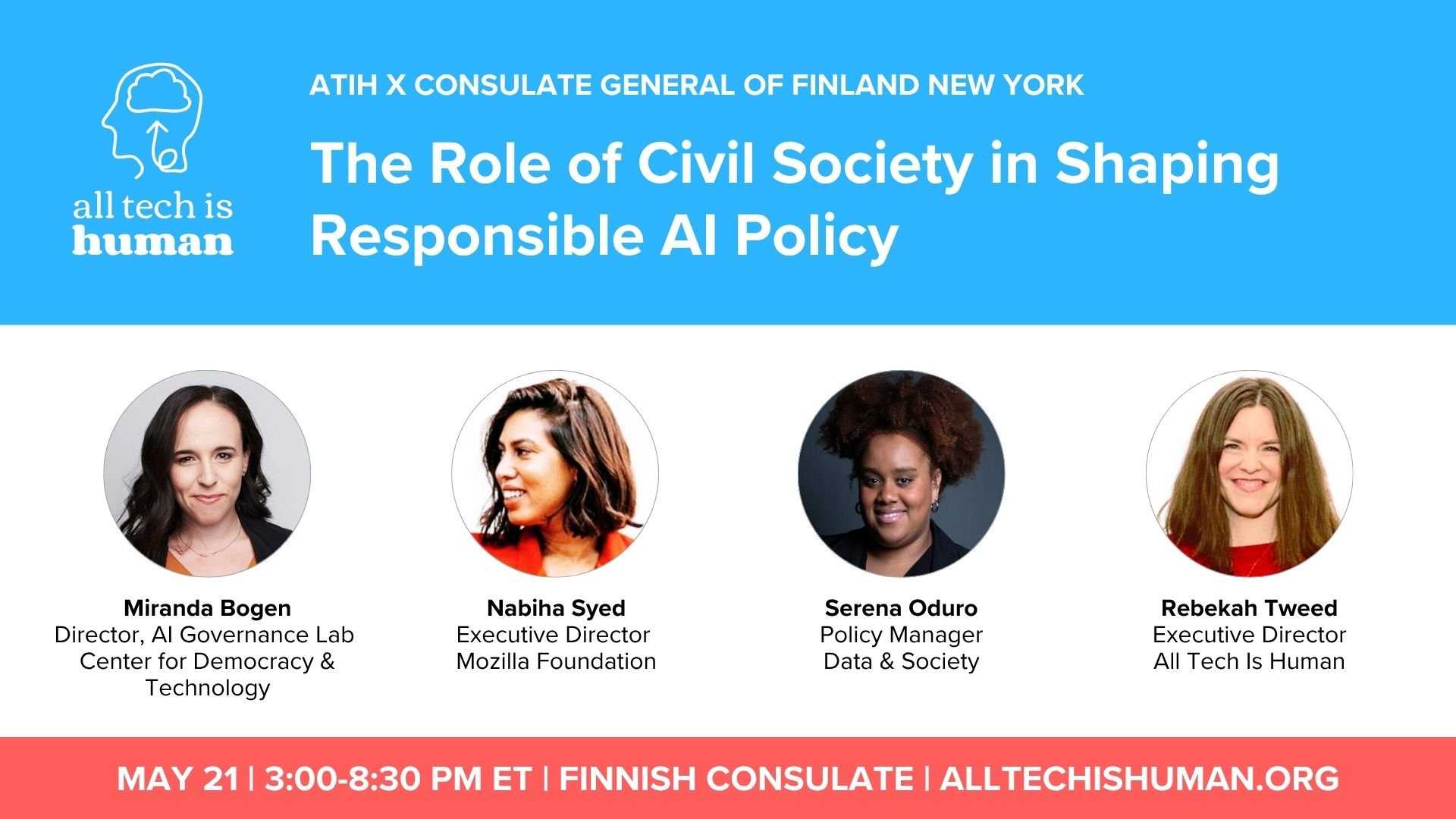
In a dynamic and thought-provoking discussion, Panel 1, The Role of Civil Society and Research in Shaping Responsible AI Policy, moderated by All Tech Is Human Executive Director, Rebekah Tweed, explored the role of civil society organizations in shaping the trajectory of artificial intelligence amid political upheaval and technological acceleration.
Nabiha Syed, Executive Director of Mozilla Foundation, likened the current AI landscape to a speeding car, with nonprofits often struggling to keep up,pursuing tech development and deployment like chasing dogs. She emphasized the need for intentionality in defining and designing what “good” AI looks like, and called for higher-level, principled engagement rather than reactive “whack-a-mole” tactics.
Serena Oduro, Policy Manager at Data & Society Research Institute, stressed the importance of base-building and collaboration within civil society, particularly around understanding and addressing harms that disproportionately affect specific communities. She highlighted the need for cross-sector communication to build shared understanding and strategies.
Miranda Bogen, Director of the Center for Democracy & Technology’s AI Governance Lab, added that her background in critiquing irresponsible tech informs her current work in governance, underscoring the impact of strategic interventions backed by strong relationships. She noted the changing landscape since 2024, with fewer formal opportunities and a more polarized discourse; she urged civil society leaders to focus on building power and pursuing various levers of change.
Nabiha, now leading Mozilla Foundation, described the organization’s next era as focused on education and public engagement with AI that is not driven by corporate self-interest. She dismissed ideological purity tests within civil society as distractions in a time when “real wolves” are present, calling instead for pragmatic and strategic unity.
Serena advocated for a strong, coherent counter-narrative during this period of deregulation, emphasizing the need for a proactive, coordinated vision. Miranda echoed the call for cohesion, warning that internal disagreements often derail valuable convenings and policy work. She stressed the importance of telling grounded, local stories of harm to push corporate and policy decision-makers towards more meaningful action.
The panel collectively emphasized the need for creativity, collaboration, and power-building to reshape AI governance for human flourishing.

In the second panel, a nuanced and globally-minded discussion on Aligning Transatlantic AI Governance in a Shifting Regulatory Landscape, moderated by Tatiana Rice, Director of U.S. AI Legislation at Future of Privacy Forum, speakers explored the challenges of developing inclusive, effective AI governance amid shifting legal, political, and technological landscapes.
“Amid political transitions and global uncertainty, the panel highlighted that responsible AI work hasn’t slowed down—it’s maturing. Researchers are thinking beyond just market incentives, focusing on how AI impacts real people. International cooperation is more advanced than public discourse often suggests, and some companies are treating responsible AI as a strategic asset, building it into products to meet both ethical and customer needs." – Tatiana Rice
Mala Kumar, Head of Impact at Humane Intelligence, emphasized that AI does not exist in a vacuum and cannot be governed solely by fluctuating legal standards. Her work with Humane Intelligence (HI) focuses on responsible AI evaluation, especially regarding bias in frontier models and other large language models (LLMs), which are regularly used in critical life decisions. She advocated for incorporating international standards over national legal frameworks alone, posing the question of why consumers worldwide should necessarily be subject to American legal norms.
Shahla Naimi, Policy Director for AI & Human Rights at Salesforce, brought a humanities perspective into her work in the tech industry andechoed the importance of grounding AI in human rights, not just in compliance. For companies operating in highly regulated sectors, AI governance is a business imperative tied to customer trust. She highlighted the demand for clearer regulatory guidance and shared that her company is navigating both compliance and enabling customers to meet their own obligations.
Lucia Velasco, Senior Advisor to the United Nations Under-Secretary-General and Special Envoy on Technology, drew on her background with the Spanish government and involvement in EU and OECD AI work and stressed that traditional governance models are inadequate for a technology this complex and fast-moving. She warned of political rivalries shaping divergent governance strategies and emphasized the need for multi-stakeholderism, despite declining trust in institutions. Efforts at the UN, including a global AI governance dialogue and an international panel on AI, reflect attempts to build this infrastructure.
The panel also addressed deeper philosophical and structural issues. Lucia pointed to the need for institutions to become “fit for purpose” in the digital age. Mala and Shahla both emphasized the value of human rights as a foundation for AI regulation and corporate accountability.
“AI models have moved from experiments to increasingly high stakes decisions. So now individuals, orgs and governments need to figure out if they are engaging with a bad system, a bad decision or if they need to correct behavior to prevent or mitigate or argue an unwanted decision that involves some kind of AI." - Mala Kumar
Discussions touched on how global governance must consider not only legal compliance but also inclusivity, meaningful oversight, and international norms—particularly in sensitive areas like conflict zones and among populations in the Global South.
Shahla criticized the lack of patience and proactive frameworks when AI is deployed in high-risk contexts. Mala further challenged the prioritization of markets over populations, especially as regulation often reflects the interests of customer bases in wealthier countries, leaving low- and middle-income populations vulnerable.
The conversation closed with a call for clearer definitions around open source tooling, deeper engagement with human-centered design, and a rebalancing of power to include voices from the global majority in shaping AI’s future.