What does free expression look like in a digital space?
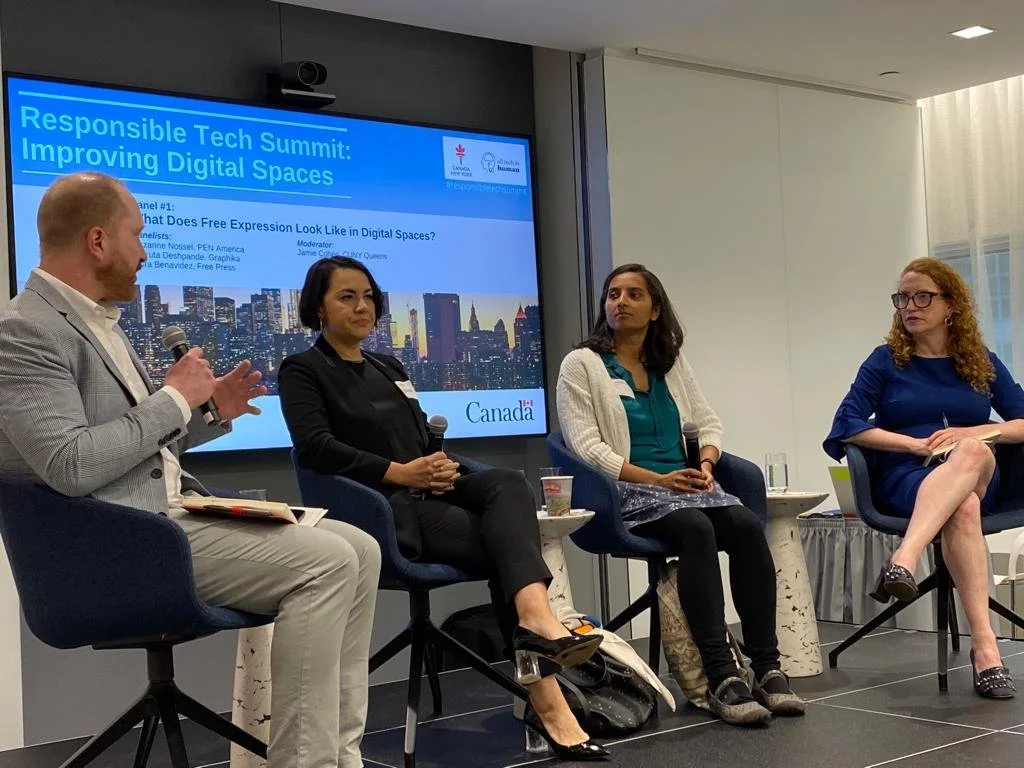
Moderator Jamie Cohen speaking with Nora Benavidez, Amruta Deshpande, and Suzanne Nossel at the Responsible Tech Summit on May 20th.
Panel discussion from our Responsible Tech Summit: Improving Digital Spaces held at the Consulate General of Canada in New York on May 20th. Find the full event overview here.
The first panel held at the Responsible Tech Summit: Improving Digital Spaces was a discussion on “What does free expression look like in a digital space?” The panel featured Suzanne Nossel (CEO of PEN America), Amruta Deshpande (Researcher at Graphika), and Nora Benavidez (Director, Digital Justice & Civil Rights at Free Press). The discussion was moderated by Jamie Cohen (Assistant Professor at CUNY Queens College, social media and digital activism).
Notes and overview provided by Gwyn Glasser
Key Takeaways
Free expression can be defined as either the freedom to say anything, or the ability to engage in a meaningful discourse on equal terms with other speakers. These two kinds of free expression will often be incompatible, so we must be clear about which definition is the one we need to protect.
Unconstrained speech for some can disempower and silence others; the kind of free expression we need to be protecting is the right to engage in a meaningful discourse on equal terms with other speakers.
There is a need for greater transparency in business practices and expandability in algorithms in order to understand the real impacts of technologies on society.
We need to educate the public broadly on these issues, and can begin with community-based organizations like All Tech is Human.
Tech companies have the know-how and resources to moderate their platforms and reduce harmful content, but do this infrequently.
Some of the questions and replies from the panel discussion
#1 “What does it mean to have free expression but the unequal distribution of power and the vulnerable?”
Suzanne began with a crucial distinction between free speech and open discourse that grounded the rest of the discussion: “It's not as simple as free speech for all…if that were the operative rule, free speech for all would really mean free speech for none…we need to think about ourselves really as guardians of open discourse.” She highlighted that instances of protected speech, such as harassment, can drive others off a given platform and make open discourse impossible. “We need a much more robust, engaged, complex examination of these questions where there really are no easy answers.”
All three panelists emphasized the importance of this distinction, which Nora called the difference between “the ability to say anything at all” and “equal speech.” She added that conflicting definitions of what free speech means can further complicate the question, and suggested that we have to work on mutual, clear understanding of the definition: “There are a lot of different levels here that we have to parse through together.”
#2 “In your book, Suzanne, you write about the unwritten rules of speech, the ability to have that arbitrary space and knowing how to interact; we can relate that to driving… the line is invisible, but we know to stay in our lanes. Where is that border [for speech]? Where is the space between what effects and what doesn’t?”
“If you yell fire in a crowded theater,” Amruta replied, “You're likely to cause panic and harm.” We know to treat information with care when sharing with large audiences. “Where individuals without information are freely exchanging information, whether or not they fully believe it - fully understand I - that certainly presents a case for considering moderation.”
Suzanne gave a strong argument in support of this case by asking us to consider why we value free-speech in the first place: “Free speech is not about enabling every last thought to be voiced…it’s about free speech’s value for society.” It fosters creativity, scientific innovation, and democracy, and it is these goods that underpin our commitment to it. Therefore, we should value free speech in so far as it brings us closer to these goods. It is not just the right to speak, but the right to engage, discuss, disagree and debate. “If the arena is so flooded with disinformation and falsehood, and if you have a public that has lost its ability to discern the difference between truth and falsehood, the value of free speech disintegrates!” Suzanne warned.
#3 How do we protect and empower people alongside algorithms that are mitigating certain forms of expression?
The panelists unanimously agreed that to engage with this question required data that is not currently accessible. Nora pointed out that most companies are unwilling to make the effort to be transparent about their data, not necessarily because of malicious intent, but simply because they have no in-built structures or procedures for sharing that information efficiently.
Business models aren’t the only problem; Amruta explained that many of the algorithms concerned are not easily explainable, so to understand the impacts of the digital space on society we need advances in transparency in business practices and explainability of algorithms. Suzanne finished by observing that to push for these changes, we need to collaborate with people who have had experience in the industries in question. These people have the knowledge to challenge the claims made by tech companies that argue that transparency and explainability will harm their business or violate the privacy of their users.
# 4 “How do we as a public become empowered to ask the right questions?”
Suzanne restated the need for transparency and explainability. She argued that it should not be a violation of user privacy agreements for tech companies to share data with researchers in this field.
According to Amrata, we also need better general education on these issues. She highlighted two obstacles to broader education on responsible tech:
It is important that people across demographics can receive this education, but different demographics, such as children and the elderly, require a vary different approaches to their education.
It is difficult to determine who is responsible for providing this education. She concluded that we will need a cross-organizational effort, but that community-based organizing is a good place to start.
Nora added that different demographics are not being moderated equally, with 87% of content moderation resources being dedicated to English content. It follows that companies need to increase resources for content moderation across different languages, “Protecting people equally across the world.”
Nora also explained that companies like Facebook already have the knowledge to moderate harmful content on their platforms. However, they only implement these tools anecdotally, to respond to specific events. She highlighted the need for constant moderation instead of this partial approach: “Democracies, as we know, are not threatened anecdotally.”
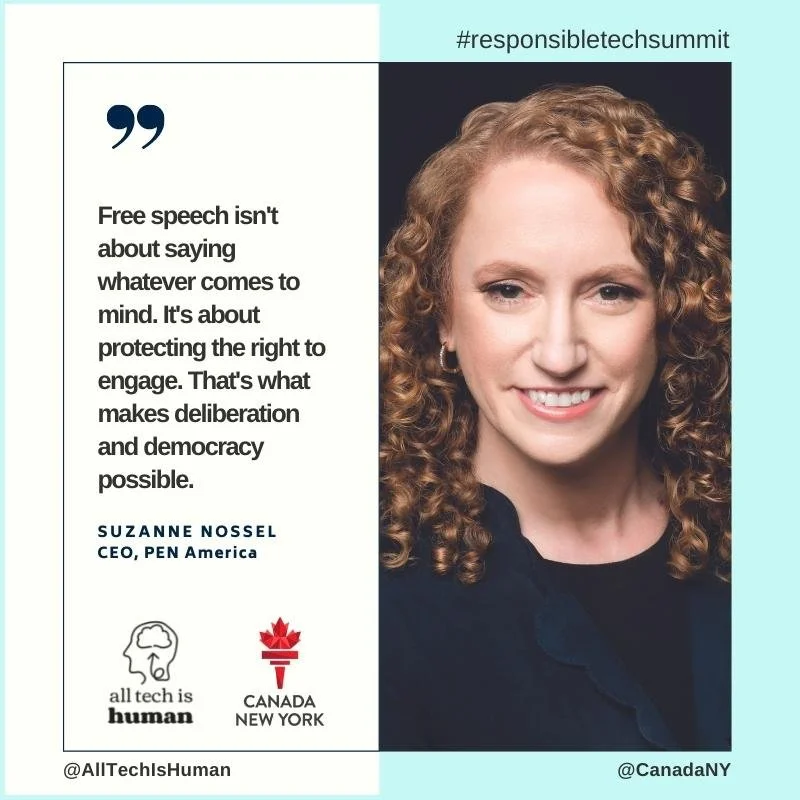

Suzanne Nossel currently serves as the Chief Executive Officer of PEN America, the leading human rights and free expression organization, and she is author of Dare to Speak: Defending Free Speech for All. She is a leading voice on free expression issues in the United States and globally, writing and being interviewed frequently for national and international media outlets. She has served as the Chief Operating Officer of Human Rights Watch and as Executive Director of Amnesty International USA. During the first term of the Obama Administration, Nossel served as Deputy Assistant Secretary of State for International Organizations, where she led U.S. engagement in the United Nations and multilateral institutions, on human rights and humanitarian issues.
In 2021, Nossel was selected as a member of the Oversight Board, an independent body using human rights principles to adjudicate decisions on Facebook and Instagram.
Amruta Deshpande is a Senior Research Scientist in Graphika Labs at Graphika Technologies, Inc. Graphika is a leading institution in uncovering disinformation through human and automated analyses. In her role, Amruta leverages social data and advanced methods to characterize disinformation and misinformation in online social media. Additionally, she leverages advanced methods to explore cross platform disinformation operations and behavioral and technological vulnerabilities and indicators of key characteristics that are useful to capture in this space. Amruta has formerly supported investigations that led to Graphika’s testimony on foreign interference in the 2016 U.S. presidential election before the Senate Select Committee on Intelligence.
Nora Benavidez is a civil and human rights attorney and a tireless believer in equal rights for all. She works at the intersection of law, tech, and democracy. She serves as Senior Counsel and Director, Digital Justice & Civil Rights at Free Press, where she leads the organization’s efforts to protect against digital threats to democracy. This includes advocating for media and platform accountability through structural reforms that disrupt the harms disinformation and hate cause to communities and democracies. She previously served as the director of PEN America’s U.S. Free Expression Programs, where she guided the organization’s national advocacy agenda on First Amendment and free expression issues, including press freedom and protest rights. Benavidez launched and led PEN America’s media literacy and disinformation defense program. She also led the organization's groundbreaking First Amendment lawsuit, PEN America v. Donald Trump, to hold the former president accountable for his retaliation against and censorship of journalists he disliked.
Jamie Cohen is an Assistant Professor at CUNY Queens College teaching social media and digital activism. Jamie holds a PhD in Cultural and Media Studies specializing in memes and digital culture. He is also the Head of Education for Digital Void, an internet literacies project that bridges the gap between digital life and everyday culture. He founded and formerly directed an internet studies college degree and is a Salzburg Academy on Media and Global Change faculty fellow. Jamie leads teams of students in immersive digital production design projects in Rome, Italy, that focus on site-specific storytelling and digital journalism ethics. Jamie is also the author of Producing New and Digital Media from Routledge and is currently writing a book on the Facebook Papers and American Society and he is also a partner columnist for Medium.