Getting Started with H-1B in Responsible Tech: Insights and Recap
June 25, 2024
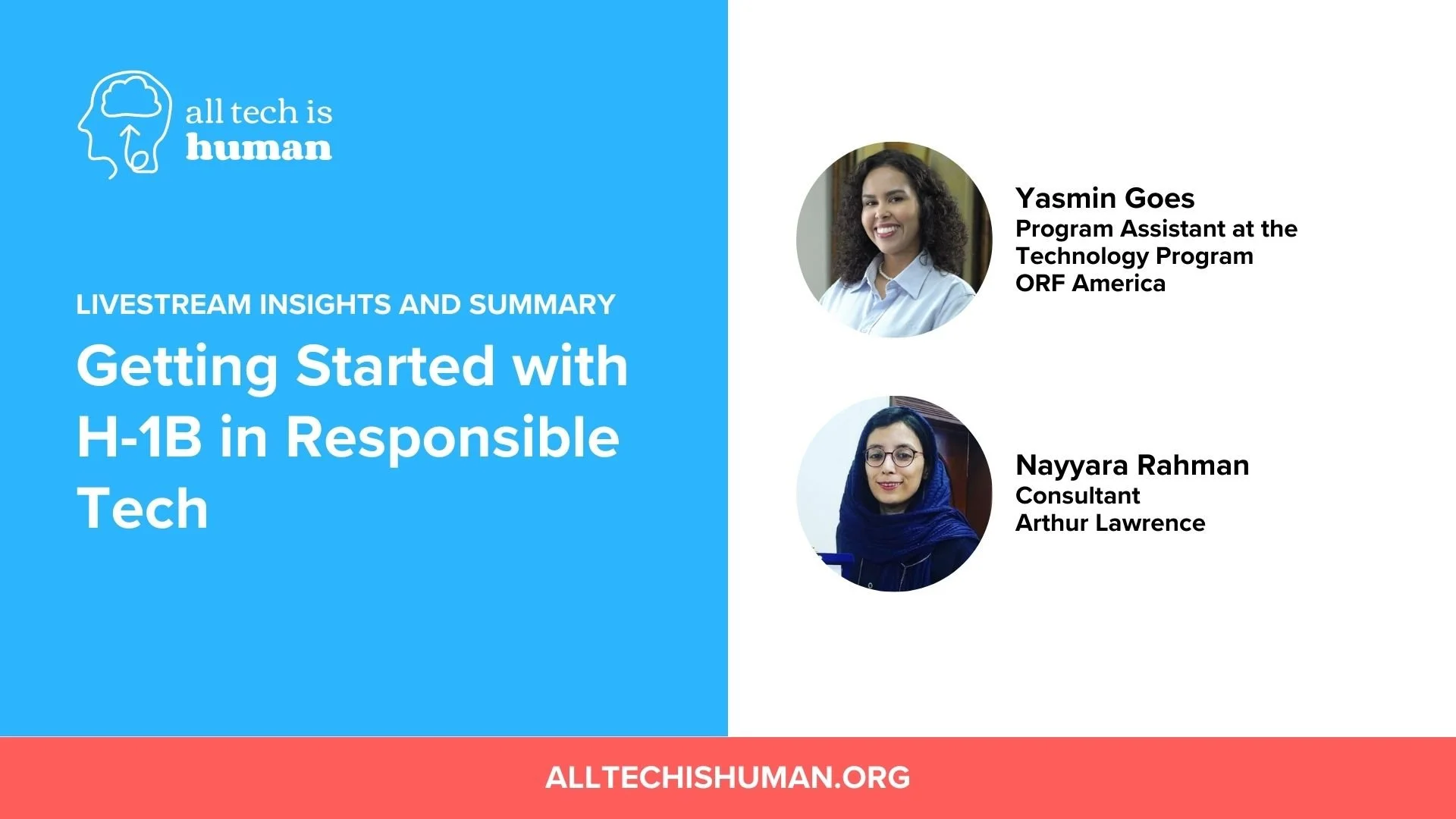
All Tech Is Human presented Getting Started with H-1B in Responsible Tech, a livestream featuring Nayyara Rahman (Consultant, Arthur Lawrence), Yasmin Goes (Program Assistant at the Technology Program, ORF America), and moderated by Sarah Welsh (Program Director, All Tech Is Human) on Thursday, June 20, 2024.
Getting Started with H-1B in Responsible Tech was a livestream dedicated to educating and empowering people seeking visa sponsorship for a role in responsible tech. Goes and Rahman discussed how employees can make themselves stand out among crowded talent pools, strategies to find employers willing to sponsor a H-1B visa, and advice to mentally prepare for the key obstacles involved in an international job search. You can watch the full livestream replay now.
Strategies applicants can use to discover employers willing to sponsor a H-1B visa.
Nayyara Rahman:
The first one would be to contract a talent acquisition firm. The second thing is to do freelance projects or even volunteer for the employer of choice that you want to work with, because the responsible tech space is growing, but right now it's very narrow in the whole tech space. Just think about the organization you want to be aligned with in the future and go for work that showcases your individual skills as opposed to team or group skills. The third thing is that you can start with a BPO or a CPO, a business process outsourcing or knowledge process outsourcing organization in your home country and ask them to sponsor you for a role in the head office. Now, this is actually going to take much more time. And it's very role dependent, but it's a very short bet because those people have already seen your work. They know what you have to offer. And if you make a good positive cost benefit analysis, if you wait positively on that, they will do everything to sponsor your visa.
Yasmin Goes:
There's one specific website that is pretty useful. It's specifically to know what type of employers end up sponsoring the visas in the previous year…This website, is called h1bdata.info, you can access and you can filter [the positions and regions] as well. One other strategy that I used was on LinkedIn, you can use the futures that can allow you to find employers that sponsored the visa…If you're anywhere in the world and you want to know exactly what employers in the U.S. that sponsor.
The first one would be to contract a talent acquisition firm, which is a little different from a staffing agency. The second thing is to do freelance projects or even volunteer for the employer of choice that you want to work with, because the responsible tech space is growing, but right now it's very narrow in the whole tech space. Just think about the kind of organization you want to be aligned with in the future and go for work that showcases your individual skills as opposed to team or group skills. The third thing is that you can start with a BPO or a CPO, a business process outsourcing or knowledge process outsourcing organization in your home country and ask them to sponsor you for a role in the head office. Now, this is actually going to take much more time. And it's very role dependent, but it's a very short bet because those people have already seen your work. They know what you have to offer. And if you make a good positive cost benefit analysis, if you wait positively on that, they will do everything to sponsor your visa.
Just think about the kind of organization you want to be aligned with in the future and go for work that showcases your individual skills as opposed to team or group skills. - Nayyara Rahman
How Can Applicants Make Themselves Stand Out?
Yasmin Goes:
I came from Brazil. So, I was exposed to a different type of education and also environment. I ended up going to a law school and that helped me understand a lot of the concepts and vocabulary that an average person would not be able to. I think the fact that I was transitioning the career and my field. I think that also helped me to bring that own experience that on specificity within my career and be like, “Hey, I'm not exactly proficient in American law, but I have a strong background in international law.”
That aligned with, for example, we [at ORF America] detect emerging technologies. We still don't have an international convention regarding the international application to cyberspace. This would be something that I will bring a different knowledge that could be used here in the U.S. because not a lot of people study international law and not a lot of people know exactly how that applies to cyberspace. It's just trying to find some things that your previous knowledge or something that relates to your past experience in your region, in your country, and then how you can use this knowledge in favor of a transition of a career or transition to a different country when you're trying to find a job. So I think that would be one experience that I would showcase and you would be able to see in my CV, for example, or my resume.
Nayyara Rahman:
I also have a similar experience here. I was working for a client in the United States and this is a remote project. My clients are top notch lawyers and the team also consists mostly of lawyers and I'm a business writer. So when the assignment came at hand, I really had nothing, no legal advice to offer. But what I had to offer was real life implications of what I was recommending and why I was recommending them. So when I need a suggestion about a certain guardrail or a certain modification, I could supplement that with things I had seen in my local market which may have not have happened in America yet, but could happen.
This made it very easy for them to sell that particular thing to their client. And then they came back and that really helped enrich our relationship. They actually told me that the examples helped.
What advice do you have for creating the right mindset in a job search that requires a Visa?
Yasmin Goes:
First of all, just be surrounded with people with similar kinds of objectives and goals. When I was in the process of graduating from a master's degree and then trying to get a job here in the U.S. the fact that I was surrounded with amazing people that were always supporting me and trying to help me through the ups and downs [was helpful] because it can be challenging.
Sometimes you're going to receive a lot of no's and you're going to receive a lot of rejections. And sometimes that can really affect your self esteem and even your confidence. So be surrounded with people that can support you and they can help you, go through all of those hardships.
And I think the other thing I would say to keep up with the mindset is trying to set up a plan A, a plan B: What if [this job search] doesn't work out? What would be the possible next outcome that would also make you happy and try to understand, “Okay, I might not get this job, but maybe I'll get something similar that would steer to something bigger in the future?”
Nayyara Rahman:
I will take a step back for those who have already applied for the H-1B visa, I would still give some macro advice and this is because in international jobs and in recruitment generally, from people who are getting resumes from all over the world, they do see some common mistakes, and this is guarding against that.
Even if you have made up your mind, go back and determine which of the following is your single biggest motivation for applying. Is it to settle in the USA? Is it to get a green card and then return to your home country? Is it to make a lot of money in a short time? Or is it to become a responsible tech leader or a key opinion leader in your space? is it to rejoin family already in the USA? Within each one of these, for example, extended family, cousins, and so on, who cannot sponsor you directly. So because whichever of these five options is your biggest priority, the pathways are different. You may not necessarily have to be resident in America to get any of these objectives met. And why I say this is because a lot of people don't make this determination and then they move on and then that is where an obstacle comes up. And that obstacle is when they don't see the gap between where they are currently in their home country and where they would be in America.
For example, again, when you are assessing your current situation, determine your support system over there. What does your extended family look like? Many of us who are applying to America for the H-1B are coming from collectivist cultures where grandparents, cousins, they're all there and they can often take on the load of chores and responsibilities when you can't. And they enable, they make it possible for you to achieve what you do. Are you prepared to take on all that on yourself and still pursue a very demanding career?
You can watch the full livestream now.
Please note: Excerpts from this livestream have been lightly edited.
About All Tech Is Human
All Tech Is Human is a non-profit committed to building the world’s largest multistakeholder, multidisciplinary network in Responsible Tech. This allows us to tackle wicked tech & society issues while moving at the speed of tech, leverage the collective intelligence of the community, and diversify the traditional tech pipeline. Together, we work to solve tech & society’s thorniest issues.
Join our working groups on Cyber & Democracy and Tech Policy
Read our reports, such as our Responsible Tech Guide and our recent Responsible Tech Org List 2024
Join our Slack community of over 9k members across 93 countries.
Read our Responsible Tech Job Board and join our talent pool