
Balancing Privacy and Child Safety in Encrypted Environments
THORNY TECH & SOCIETY ISSUE: How do we balance privacy and child safety in encrypted environments?
“The impasse is exacerbated by the fact that both sides often talk past each other, entrenched in their respective viewpoints around encryption, rather than looking towards the goal of reducing illegal activity and content." — Heather West, a non-resident senior fellow at the Center for European Policy Analysis
Fill out our short form to receive our white paper
Introduction
Safety by Design, a proposal which “puts user safety and rights at the center of the design and development of online products and services,” per a definition from Australia’s eSafety Commissioner, has evolved. It is no longer only an imperative from regulators to industry. It is now a multi-stakeholder effort for the industry ecosystem to drive toward adoption of Safety by Design practices. To move the discussion into collective action, all viewpoints need to be heard and understood.
One of the most intractable logjams in our collective movement toward Safety by Design has been the longstanding debate about the trade-offs between privacy and child safety online when it comes to end-to-end encryption (E2EE). Many child safety rights advocates argue that E2EE (without other appropriate mitigations to detect Child Sexual Abuse Material (CSAM) in encrypted environments, for example) prevents a proactive approach to safety. Such advocates believe that this approach naturally goes against the principles of Safety by Design whilst other, "privacy" advocates argue that E2EE is necessary to proactively uphold safety for all users. Though much more nuanced, the debate is often characterized as a binary one between child safety professionals and privacy professionals. That characterization is part of the problem, as we actually suffer from a collective failure across many borders to fully understand the interests and constraints of all stakeholders.
All Tech Is Human is uniquely positioned to help with this impasse. This document represents a multi-month effort to gather diverse expert stakeholder perspectives, put them on record, and foster discussion, develop solutions, raise public awareness, and increase understanding of this unresolved challenge.
Balancing privacy and protection for minors
The debate around E2EE should not be framed purely as a trade-off between privacy and safety but rather as a delicate balance between two interdependent rights. While privacy is a fundamental right that protects freedom of expression and safety, it stands alongside the right for children to be protected from exploitation and abuse. Further, an element of the debate is framed around the distinction between freedom-to privacy and freedom-from harms. While users have a freedom-to communicate privately amongst themselves, client-side-scanning presumes to provide third-party access to user communications in an ostensible attempt to keep them free-from harm.
Recommendations
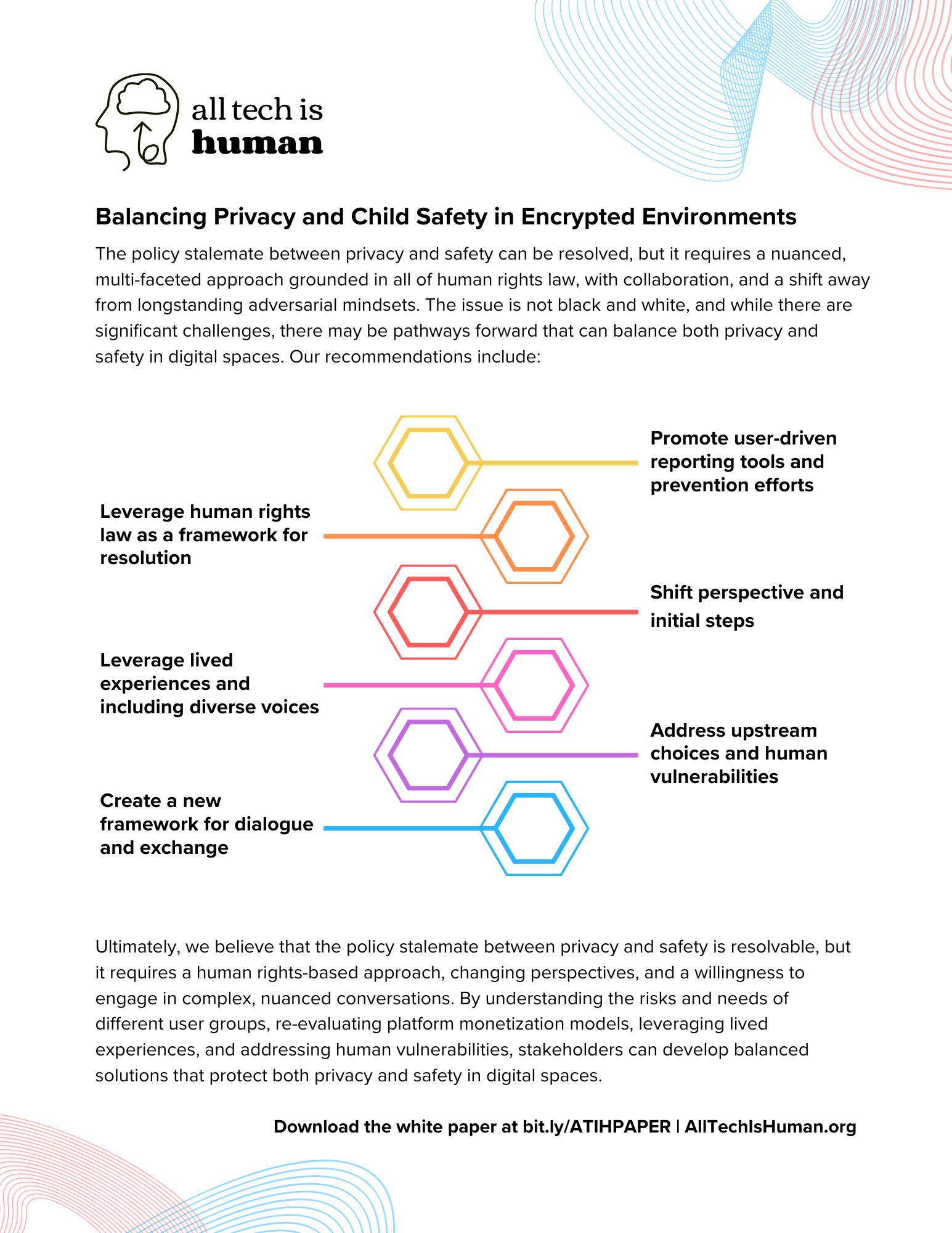
The policy stalemate between privacy and safety can be resolved, but it requires a nuanced, multi-faceted approach grounded in all of human rights law, with collaboration, and a shift away from longstanding adversarial mindsets. The issue is not black and white, and while there are significant challenges, there may be pathways forward that can balance both privacy and safety in digital spaces. Our recommendations include:
Promote user-driven reporting tools and prevention efforts
Leverage human rights law as a framework for resolution
Shift perspective and initial steps
Leverage lived experiences and including diverse voices
Address upstream choices and human vulnerabilities
Create a new framework for dialogue and exchange
Ultimately, we believe that the policy stalemate between privacy and safety is resolvable, but it requires a human rights-based approach, changing perspectives, and a willingness to engage in complex, nuanced conversations. By understanding the risks and needs of different user groups, re-evaluating platform monetization models, leveraging lived experiences, and addressing human vulnerabilities, stakeholders can develop balanced solutions that protect both privacy and safety in digital spaces.