

All Tech Is Human x Consulate General of Finland New York to hold a curated gathering on May 21st on strengthening multistakeholder collaboration in Responsible AI
Following the successful collaboration between All Tech Is Human and the Consulate General of Finland New York in last year’s Strengthening the Information Ecosystem curated gathering, we are starting to assemble a gathering to be held on Wednesday, May 21st. The curated gathering will be for 75 key individuals across civil society, government, industry, and academia who are focused on strengthening multistakeholder collaboration in Responsible AI.
The gathering on May 21st in Manhattan will be held from 3 to 8:30pm; there will be two panel conversations and opening remarks held at the Finnish Consulate, to be followed by a reception at the Finnish Residence. Demand for attendance greatly exceeds capacity, so please let us know about your interest and involvement related to multistakeholder collaboration in Responsible AI.
We currently have participants from Amazon, Boston Consulting Group (BCG), Center for Democracy & Technology, Cohere, Columbia University, Data & Society Research Institute, Digital Democracy Institute of the Americas (DDIA), Future of Privacy Forum, Georgetown University, Humane Intelligence, IBM, Integrity Institute, Intel, KPMG, Mastercard, Meta, Microsoft, Mozilla Foundation, Northeastern University, Pinterest, Princeton University, Salesforce, Schmidt Futures, TikTok, United Nations, YouTube, and more.
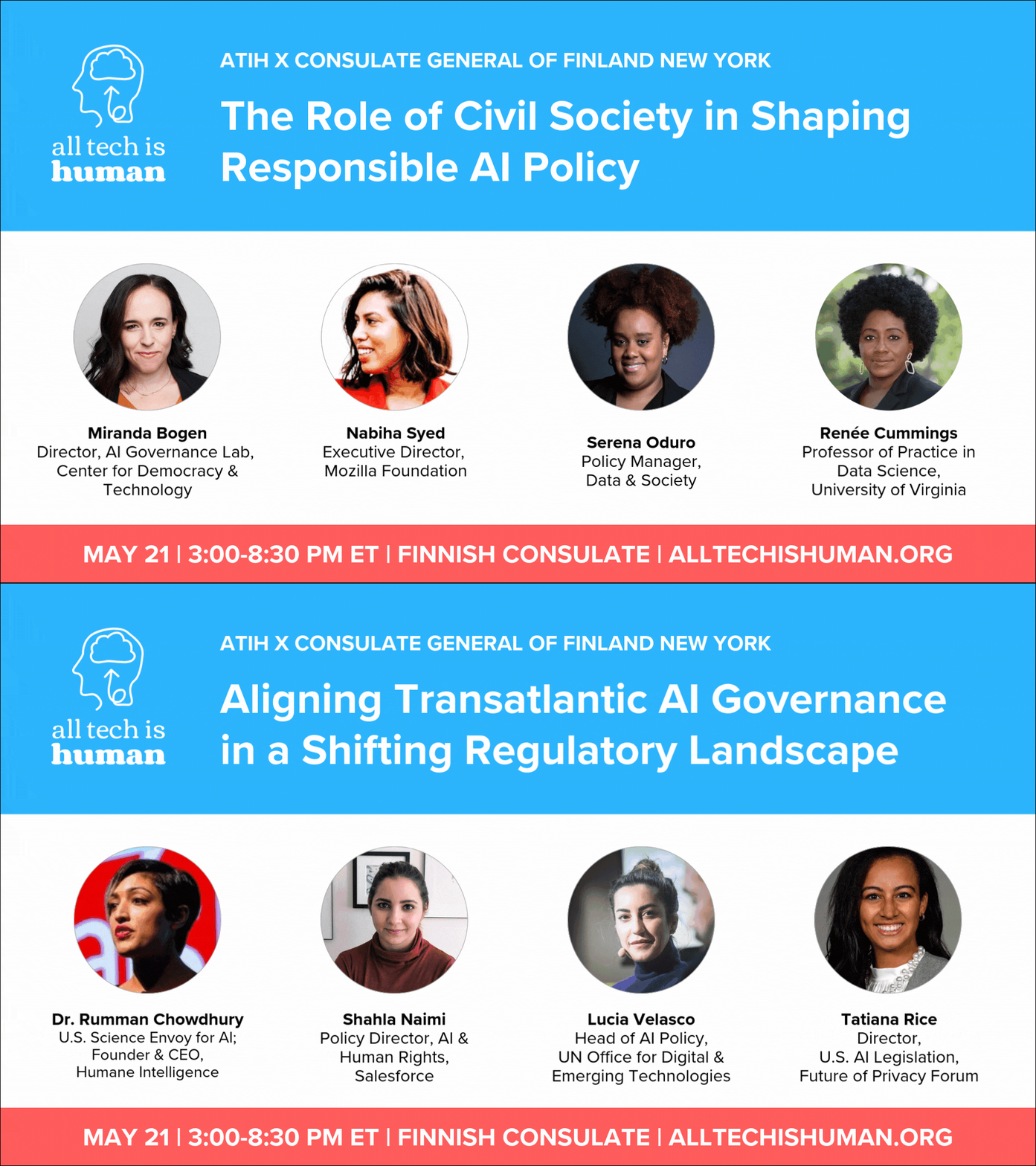
Panel 1: Aligning Transatlantic AI Governance in a Shifting Regulatory Landscape
As political landscapes shift, the future of AI governance hangs in the balance. This panel aims to explore the evolving regulatory and standard-setting frameworks governing AI across the transatlantic sphere, assessing the intersections and divergences in differing approaches to risk classifications, liability structures, and compliance standards. How will existing agreements bridge gaps in global AI governance and foster regulatory interoperability to prevent a fragmented tech ecosystem? What are potential strategies for maintaining hard-won progress in responsible AI development across the globe? The discussion will critically examine the implications of a new political administration directing the U.S. approach to AI governance and will highlight the need to safeguard rights-respecting and democratic standards in the balancing act of governance.
Dr. Rumman Chowdhury: Dr. Rumman Chowdhury’s passion lies at the intersection of artificial intelligence and humanity. She is a pioneer in the field of applied algorithmic ethics, creating cutting-edge socio-technical solutions for ethical, explainable and transparent AI. She is CEO and co-founder of Humane Intelligence, and the first person to be appointed by the Department of State as the United States Science Envoy for Artificial Intelligence. Previously, Dr. Chowdhury was the Director of META (ML Ethics, Transparency, and Accountability) team at Twitter, leading a team of applied researchers and engineers to identify and mitigate algorithmic harms on the platform. Prior to Twitter, she was CEO and founder of Parity, an enterprise algorithmic audit platform company.
Shahla Naimi: Shahla is a Policy Director at Salesforce, leading on AI policy and human rights for the Office of Ethical and Humane Use. The Office’s mission is to (1) understand the impacts of our products on the world and establish relevant guardrails; (2) inform inclusive product design and development; and (3) advance the field through multi-stakeholder dialogues to ensure a better path forward for the industry, society and world at large. Prior to joining Salesforce, Shahla served on Google’s human rights program within Government Affairs and Public Policy. She began her career working at the intersection of humanitarian assistance and international development in Afghanistan, Somalia, India, Mali and elsewhere in collaboration with governments, humanitarian and human rights organizations and academic institutions.
Lucia Velasco: Lucia Velasco is a Spanish-Argentinian economist currently serving as Senior Advisor to the United Nations Under-Secretary-General and Special Envoy on Technology. At the UN Office for Digital and Emerging Technologies she leads work on AI policy and governance. She began her career in the Spanish Parliament and has since held several high-level government roles before joining the World Economic Forum in Geneva to lead initiatives on AI governance. She is affiliated with the Oxford Martin School and the Maastricht School of Economics, and serves as an independent expert for both the European Commission and the OECD. Lucia is a book author and also co-chairs the Future of Work stream within the Global Partnership on AI (GPAI).
Tatiana Rice (moderator): Tatiana Rice is the Director of U.S. AI Legislation, where she helps lawmakers, industry leaders, and civil society navigate the evolving landscape of AI regulation and policy. She leads FPF’s strategic legislative and regulatory engagement at the state and federal levels, providing expert analysis, research, and guidance to support informed decision-making on AI policy and governance. Prior to joining FPF, Tatiana was at Shook, Hardy, & Bacon LLP, where she led biometric compliance efforts and supported industry clients in managing data privacy compliance, litigation, and investigations. She holds a J.D. from Washington University School of Law, where she clerked for the Department of Justice and the U.S. District Court for the Southern District of Illinois.
Panel 2: The Role of Civil Society and Research in Shaping Responsible AI Policy
As AI governance frameworks develop globally, civil society organizations and research institutions play a crucial role in ensuring AI systems align with ethical standards, such as transparency and accountability. How will this sector’s leadership role shift as the global AI landscape shifts? How can civil society partner with industry to align incentives with broader societal priorities in order to mitigate some of the worst potential harms of AI? How can civil society effectively pressure AI model developers to address critical threats, including chemical, biological, radiological, and nuclear risks, as well as mitigate the risk of increased cybersecurity vulnerabilities? This panel will also highlight the opportunities to grow civil society’s impact in the AI policymaking process, including strategies for fostering greater collaboration between U.S., EU, UK, and Canadian policymakers and global civil society actors.
Miranda Bogen: Miranda Bogen is the founding Director of CDT’s AI Governance Lab, where she works to develop and promote adoption of robust, technically-informed solutions for the effective regulation and governance of AI systems. An AI policy expert and responsible AI practitioner, Miranda has led advocacy and applied work around AI accountability across both industry and civil society. She most recently guided strategy and implementation of responsible AI practices at Meta, including driving large-scale efforts to measure and mitigate bias in AI-powered products and building out company-wide governance practices. Miranda previously worked as senior policy analyst at Upturn, where she conducted foundational research at the intersection of machine learning and civil rights, and served as co-chair of the Fairness, Transparency, and Accountability Working Group at the Partnership on AI.
Nabiha Syed: Nabiha Syed is Executive Director of Mozilla Foundation, the global nonprofit that does everything from championing trustworthy AI to advocating for a more open, equitable internet. Formerly, Nabiha was the CEO of The Markup, an award-winning journalism non-profit that challenges technology to serve the public good. Under her leadership, The Markup’s unique approach was referenced by Congress 21 times, inspired dozens of class action lawsuits, won a national Murrow Award and a Loeb Award, and was recognized as “Most Innovative” by FastCompany in 2022. Prior to The Markup, Nabiha was a highly acclaimed media lawyer with a legal career spanning private practice and the New York Times First Amendment Fellowship. She led BuzzFeed’s libel and newsgathering matters, including the successful defense of several high-profile libel lawsuits.
Serena Oduro: Serena Oduro is Data & Society’s policy manager. She leads and manages the organization’s state-level policy engagement. Driven by her dedication to realizing an AI ecosystem that truly benefits us all, she is passionate about advancing a sociotechnical and rights-forward approach to AI governance. Serena has given multiple presentations and talks about her policy and independent work on AI and Black feminism, including at ACM FAccT, Harvard’s Berkman Klein Center, UC Berkeley, Africa Law Tech Festival, and Credo AI’s Responsible AI Summit, where she was featured in the AI-conic Minds series. She is a Ragdale HUMAN Residency Fellow, awarded in support of her developing poetry collection which centers a Black feminist analysis and approach to AI. Her work has appeared in academic journals and publications and news media, including Politico, Meatspace Press, and Patterns. Previously, Serena was a technology equity fellow at The Greenlining Institute, where she provided key support for Greenlining’s sponsorship of the Automated Decision Systems Accountability Act of 2021.
Renée Cummings (moderator): Professor Renée Cummings, a 2023 VentureBeat AI Innovator Award winner, is an artificial intelligence (AI), data, and tech ethicist, and the first Data Activist-in-Residence at the University of Virginia’s School of Data Science, where she was named Professor of Practice in Data Science. She also serves as co-director of the Public Interest Technology University Network (PIT-UN) at UVA. She is also a nonresident senior fellow at The Brookings Institution and the inaugural Senior Fellow, AI, Data and Public Policy at All Tech Is Human, a leading think tank.


