Responsible Tech Journey: Cecilia Marrinan
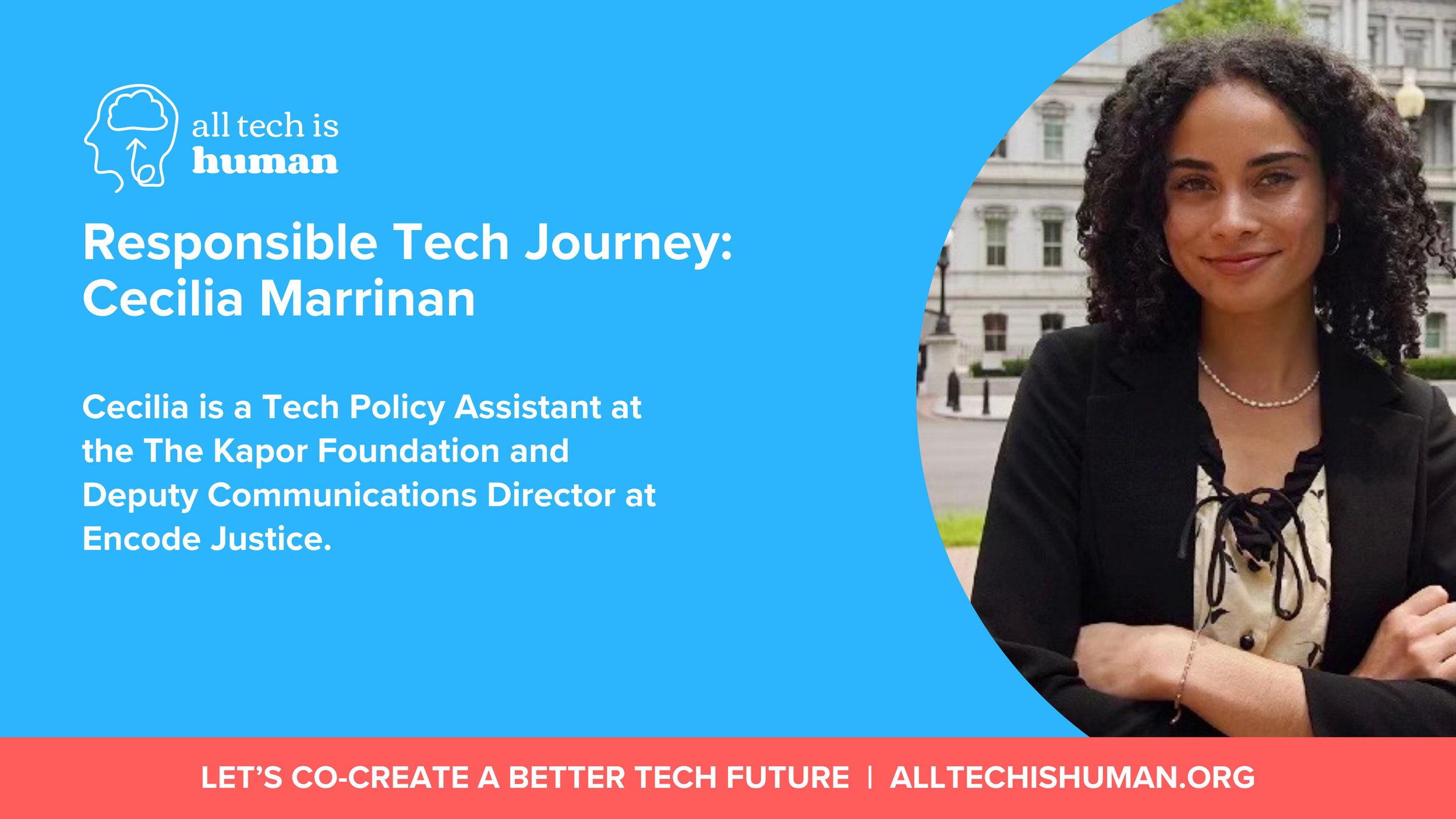
In our Responsible Tech Journey series, we learn from individuals carving their unique path into the Responsible Tech ecosystem. Today we learn from Cecilia Marrinan. Cecilia is a Tech Policy Assistant at The Kapor Foundation and Deputy Communications Director at Encode Justice.
Tell us a little bit about your background and what attracted you to the Responsible Tech movement?
I graduated from Brown University in 2024 with a degree in international and public affairs and a Data Fluency Certificate. Previously, I interned at The White House and the National Geographic Society, and most recently, I interned with the Digital and Cyberspace Program at the Council on Foreign Relations.
In 2020, I founded Skaneateles for Social Justice, where we led a BLM march and worked with the local school district to increase diversity, equity, and inclusion (DEI) into the curriculum. I had envisioned a career in policy or international humanitarian law, but after taking the “Cultures of Surveillance” seminar during my junior year at Brown, it became clear that working towards implementing ethical socio-technical frameworks in system design and policy is fundamental to advancing and protecting human rights in our increasingly digitized world.
What hurdles were you having in your Responsible Tech journey?
At first, finding resources or mentors who worked at the intersection of technology and social implications was difficult. I’m grateful I pursued Brown’s Data Fluency Certificate to gain more technical knowledge. Through coding, data ethics, and information systems courses, I applied heightened technical understanding to my undergraduate coursework in international relations.
What All Tech Is Human activities have you participated in?
I participated in the 2024 mentorship program and have been a member of the Slack community for over a year. Now that I have moved to San Francisco, I was able to attend my first in-person ATIH gathering, and I’m looking forward to more events!
Tell us about your experience with All Tech Is Human:
In the early fall of 2023, I stumbled upon the ATIH website after googling “What does an early career in tech policy look like?” Throughout this year, it’s been an informative space where I have observed and learned what responsible tech looks like across many different sectors. I participated in the 2024 Mentorship Program, collaborating with and learning from my mentor, Trent Kannegieter, on an audio essay project. This experience provided a structure for me to conduct in-depth research on the digital divide, specifically focusing on the development of autonomous cellular networks and digital redlining.
A major highlight of this project was interviewing Dr. Traci Morris, the executive director of the American Indian Policy (AIPI) Institute, and learning about her work on Tribal digital sovereignty.
What advice would you give to others looking to break into the Responsible Tech ecosystem?
I’m deeply grateful to my mentors, who gave me the confidence to break into this field. There’s a common, reductive misconception that success in this space requires a technical degree—I feel otherwise. Though it is important to educate oneself on the mechanisms of how technology works, this unnecessary expectation can isolate and perpetuate imposter syndrome for those who have different and valued perspectives in this field. Anyone working to advance human rights has a stake in this area. Whether your work centers on affordable housing, climate change, or criminal justice reform, your expertise is valuable in (re)defining the ethical design, policies, development, and research on advancing the responsible tech ecosystem.
Finally, what does a better tech future look like to you?
The proliferation of new technologies, particularly those concerning data privacy, is increasingly intertwined with current social, cultural, and political dynamics. Increased algorithmic transparency, digital literacy, computer science education, and passing comprehensive federal data privacy legislation are important building blocks for sustainable socio-tech systems. A better tech future requires centering and elevating the voices of young people and historically marginalized communities to address widening racial and socioeconomic disparities. Further, it is essential to address the digital divide and digital redlining to guarantee that technology's potential is accessible to all communities.

Cecilia, center, attending All Tech Is Human’s recent Responsible AI Mixer in SF (October 10, 2024)