Recap of Responsible Tech DC: The Future of Trust & Safety
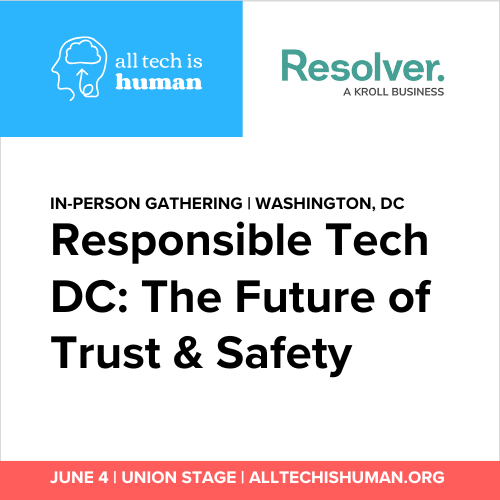
On Wednesday, June 4, 2025, All Tech Is Human hosted a gathering of trust and safety leaders in Washington, D.C. at Union Stage. Leaders across the tech industry, civil society, academia, and government convened for two panel discussions, one on the trust and safety policy landscape and another on the future of trust and safety, and a networking reception. This gathering was done in collaboration with Resolver Trust and Safety.
The evening started with welcome remarks from Resolver’s George Vlasto, Head of Trust and Safety, and All Tech Is Human’s David Ryan Polgar, Founder and President, followed by the Trust and Safety policy panel.
The Trust and Safety Policy Landscape
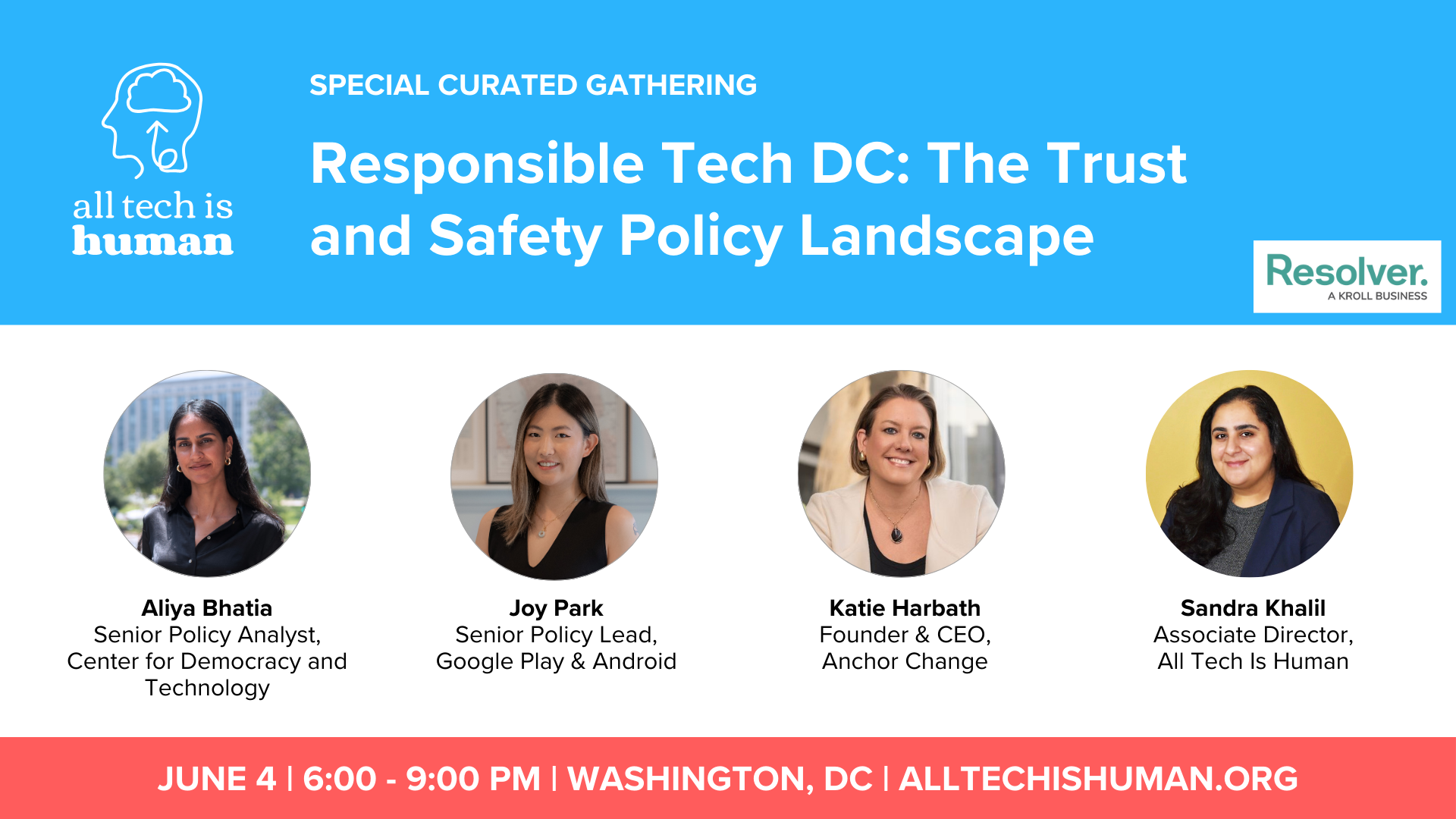
Sandra Khalil, Associate Director of All Tech Is Human and moderator of the first panel, was joined by Katie Harbath (Anchor Change), Joy Park (Google), and Aliya Bhatia (Center for Democracy and Technology). The conversation opened with an assessment of the current trust and safety landscape. Recent years have witnessed significant legislative activity alongside widespread layoffs across major tech platforms that have dramatically reduced T&S teams. This confluence of events has created a challenging environment where fewer practitioners are navigating an increasingly complex regulatory landscape.
The panelists noted that while the fundamental challenges of content moderation remain unchanged, the operational reality has shifted dramatically. Platforms are being forced to do more with less while simultaneously facing heightened scrutiny from regulators, civil society, and the public. New models are emerging, including increased reliance on automated systems and third-party vendors, but these approaches come with limitations.
Aliya highlighted a persistent gap between legislative intent and operational reality in trust and safety. Policymakers often craft regulations without a deep understanding of how content moderation functions at scale. This disconnect manifests in the complexity of cross-cultural content. Similarly, the multilingual nature of platforms creates enforcement challenges that are poorly understood by policymakers.
Joy drew attention to one of the most pressing challenges: protecting vulnerable populations from harms that are increasingly amplified by AI. She noted that current trust and safety frameworks are inadequately equipped to address the unique risks faced by marginalized communities, particularly when AI lowers the barriers to creating and distributing harmful content.
Katie provided insights from her experience working on election content policies at major platforms, emphasizing the unique challenges posed by generative AI in electoral contexts. The emergence of AI-generated content has fundamentally altered the threat landscape, creating new vectors for disinformation and manipulation that traditional election integrity frameworks struggle to address. Katie noted that the pressure to act quickly during election periods often conflicts with the processes needed to develop policies around AI-generated content. This tension is exacerbated by the fact that different stakeholders, government officials, civil society groups, and end users often have conflicting expectations about how platforms should respond to potential threats.

The Future of Trust and Safety
The second panel of the evening was moderated by Resolver’s Henry Adams, Director of Trust and Safety Intelligence; he was joined by Colleen Mearn (Anthropic), Scott Vlachos (CENSA), and Juliet Shen (ROOST).
Colleen opened the discussion by addressing one of the most persistent challenges in trust and safety work: how to meaningfully measure success in an environment where traditional metrics often fail to capture the full picture. The field has long relied on quantitative measures, but these metrics increasingly feel inadequate for assessing the true impact of trust and safety efforts.
The challenge lies in the fact that effective methods that prevent harm never become visible in traditional metrics. Preventive successes are difficult to quantify but may represent the most meaningful outcomes of trust and safety work. Colleen suggested that organizations are beginning to explore more sophisticated success metrics that focus on ecosystem health rather than just enforcement actions. However, developing these metrics requires significant investment in research and data infrastructure that many organizations struggle to prioritize.
Scott provided insights into the evolving world of adversarial networks and how malicious actors are leveraging AI for harmful purposes. The sophistication of these networks has increased dramatically, with bad actors adopting many of the same AI tools that platforms use for detection and prevention.
Juliet explored the emerging landscape of open-source tooling in trust and safety, highlighting both the potential and significant challenges of this approach. The open-source movement in T&S represents a fundamental shift from proprietary, platform-specific solutions toward collaborative, transparent tool development. She noted that transparency in tool development allows for broader community review and improvement, potentially leading to more robust and effective solutions. Open-source approaches can also democratize access to sophisticated T&S capabilities, allowing smaller platforms and organizations to benefit from tools that would otherwise be prohibitively expensive to develop independently.
These conversations underscored that while the challenges facing T&S practitioners are growing in complexity and scale, there are also unprecedented opportunities for innovation and collaboration. Success in this evolving landscape will require not just new tools and techniques but new ways of thinking about trust, safety, and security online.


