Building Multistakeholder Collaboration: Fireside chat with Yu Ping Chan from the United Nations and Justin Hendrix from Tech Policy Press
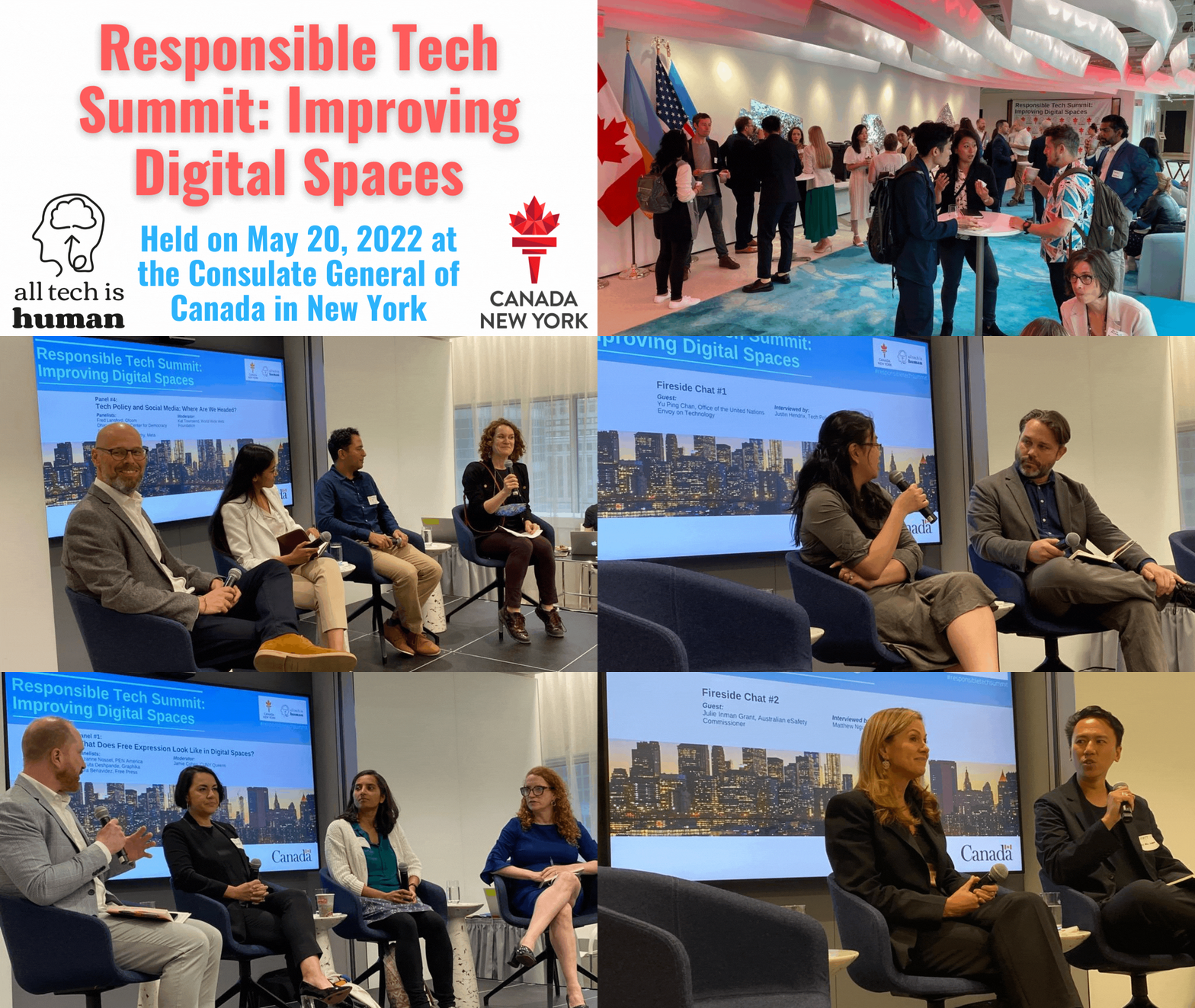
Fireside chat from our Responsible Tech Summit: Improving Digital Spaces held at the Consulate General of Canada in New York on May 20th. Find the full event overview here. Notes for this write-up provided by Gwyn Glasser
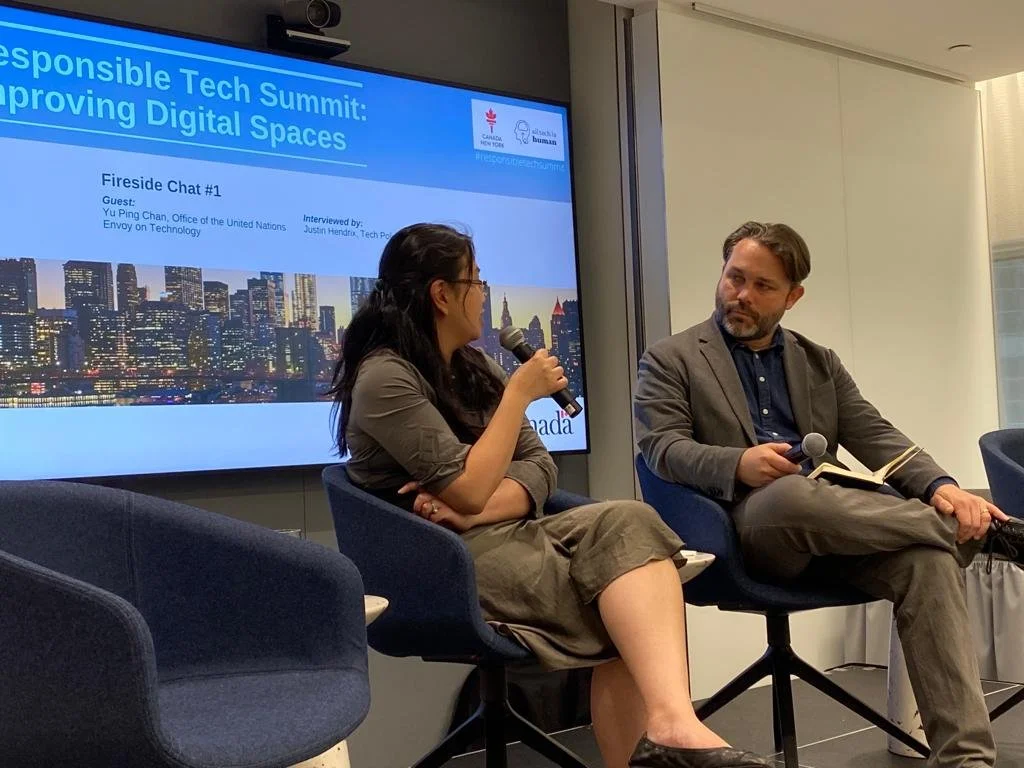
Yu Ping Chan, Senior Programme Officer, Office of the Secretary-General’s Envoy on Technology at the United Nations, chatting with Justin Hendrix, founder & CEO of Tech Policy Press.
Key Takeaways
1. Due to competing values for improving digital spaces, the UN hopes to use its convening power to create a space for conversations involving multiple state and non-state stakeholders, as per the Common Agenda, with the ultimate goal of setting universal standards.
2. Digital inclusion is fundamental to resolving other issues in the digital space. 2.9 billion people still do not have effective access to the internet, which impacts their access to information, work and education, as well as limiting their representation online and exacerbating existing socio-economic inequalities.
3. The UN’s Common Agenda is not exhaustive. For example, it does not engage with issues of sustainability and climate change in the digital space. However, Yu Ping suggests that it is ultimately up to member-states and other stakeholders to collaboratively improve the digital space in practice, while the UN facilitates conversation.
4. Governments need more pressure to acknowledge the importance of the range of stakeholders that need to be involved in these conversations, such as private sector companies, civil societies, youth activists and the technical community.
Quotes
“We have the convening power and the credibility to say ‘we all come to this table.’We try to agree on values that are incumbent on the UN Charter, the Universal Declaration of Human Rights and then think about these means manifested in the digital space. The extent to which we then have the power to compel governments or the private sector, civil society to do these things is another question.” - Yu Ping Chan
“If you want to win a global discussion about global values for the global internet, then it's probably best to have these discussions in a global forum.” - Yu Ping Chan
“What we are doing at the UN is to create this space precisely for multi-stakeholder engagement, and to put the pressure on to make sure that the governments realize where the future of the digital space should rest and to engage with stakeholders.” - Yu Ping Chan
Resources
UN ‘Our Common Agenda’ report - Our Common Agenda is an agenda of action, designed to strengthen and accelerate multilateral agreements – particularly the 2030 Agenda – and make a tangible difference in people’s lives.
UN High-Level Panel on Digital Cooperation - The High-level Panel on Digital Cooperation was convened by the UN Secretary-General to provide recommendations on how the international community could work together to optimize the use of digital technologies and mitigate the risks.
Declaration for the Future of the Internet - The United States with more than 60 partners from around the globe launched the Declaration for the Future of the Internet. This Declaration represents a political commitment among Declaration partners to advance a positive vision for the Internet and digital technologies.
Coalition for Digital Environmental Sustainability In support of the UN Secretary-General’s Roadmap for Digital Cooperation and in collaboration with the Office of the Secretary-General’s Envoy on Technology, the United Nations Environment Programme, the United Nations Development Programme, the International Science Council, the German Environment Agency, the Government of Kenya, Future Earth, and Sustainability in the Digital Age have joined forces to act as co-champions for a new global initiative called CODES (Coalition for Digital Environmental Sustainability).

Bios
Yu Ping Chan is a Senior Programme Officer in the Office of the Secretary-General’s Envoy on Technology at the United Nations. She coordinates the team’s work on follow-up to the Secretary-General’s Roadmap for Digital Cooperation and the digital-related aspects of his Common Agenda Report, in particular the development of a proposed Global Digital Compact. She also oversees the Office’s overall advocacy, engagement and coordination efforts to strengthen global digital cooperation and its work on other emerging technologies.
Yu Ping previously led the Policy and Regional Support teams in the United Nations Office of Counter-Terrorism. Prior to this, she worked in the UN’s Department of Political Affairs, and in the New York Office of the United Nations Office on Drugs and Crime. Before joining the UN Secretariat, Yu Ping was a diplomat in the Singaporean Foreign Service. She served at the Singapore Mission to the United Nations in New York and before this posting, in the Singaporean Ministry of Foreign Affairs’ department handling the Association of Southeast Asian Nations (ASEAN) and regional political and strategic issues.
Justin Hendrix is cofounder and CEO of Tech Policy Press, a new nonprofit media venture concerned with the intersection of technology and democracy. Previously, he was Executive Director of NYC Media Lab. He spent over a decade at The Economist in roles including Vice President, Business Development & Innovation. He is an associate research scientist and adjunct professor at NYU Tandon School of Engineering, and holds a BA from the College of William & Mary and an MSc in Technology Commercialization from the University of Texas at Austin.